Residual ridge height and distance
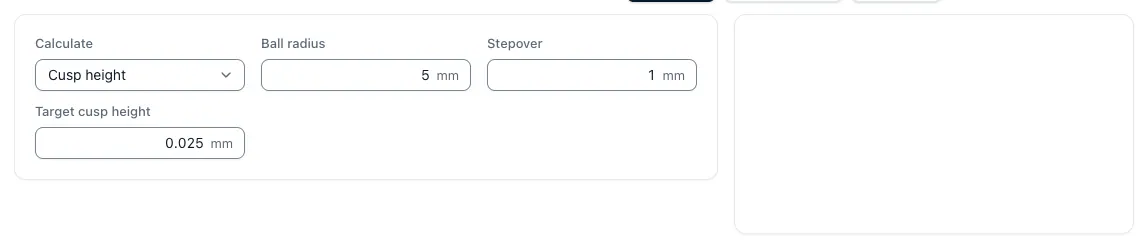
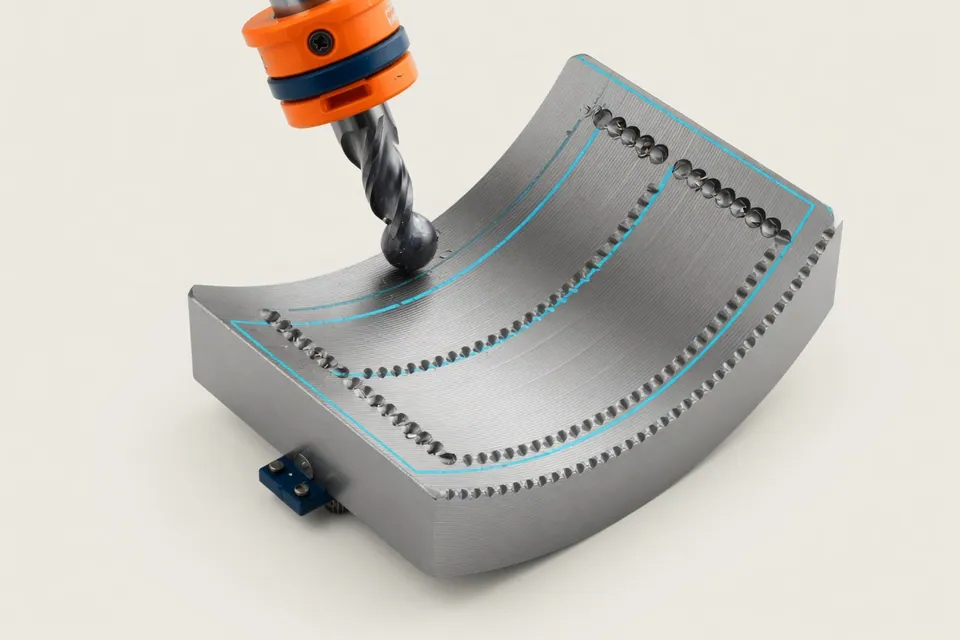
Two adjacent webs of a ball cutter cut into a comb whose height follows from the circle geometry. The calculator residual comb height works in both directions: From the radius of the ball and the distance between the web, the height of the comb is obtained in micrometers, from a permissible comb height the largest web distance.
With R = 5 mm and 0.5 mm web distance, a comb of 6.25 μm remains. If a maximum of 5 μm is allowed, the web distance may be 0.447 mm, for 2 μm only 0.283 mm. The web distance applies along the actual surface; on inclined surfaces, the distance projected in the CAM system must be converted.
h = R − √(R² − (a ÷ 2)²) · a = 2 × √(h × (2R − h))
Railway distance and final time
For small comb heights, approximately a 2 × √(2 × R × h) applies. The distance between the webs grows with the root of comb height and radius. If the permissible comb height is halved, the number of webs increases by a factor of √2 and the final time by a good 40 percent. A larger sphere radius acts in the opposite direction, provided radii and hollow hollows of the component allow it.
For example, an area of 120 × 80 mm is arranged in 120 mm length tracks, with an assumed feed speed of 3,000 mm/min. With R = 5 mm and 5 μm comb height, the approximately 180 tracks and 7.2 minutes of pure finishing time, for 2.5 μm 255 tracks and 10.2 minutes. With a ball radius of 8 mm, the range for 5 μm is around 143 tracks and 5.7 minutes. Overpassing distances between the tracks are added. At a machine hourly rate of 90 €/h, the three additional minutes for 2.5 instead of 5 μm cost around 4.50 € per surface area; the narrower ridge height therefore only belongs where the drawing requires it.
The residual comb height is a geometric profile height across the web. Measured roughness values also contain feed marks, concentricity errors and vibrations; the comparison with Ra or Rz of the drawing is therefore only an approximation.
a ≈ 2 × √(2 × R × h) für h ≪ R
Impact diameter at low immersion depth
A vertical ball cutter touches only a small circle of the sphere with a low axial immersion depth. This effective diameter determines the actual cutting speed. A 10 mm ball cutter with a 0.2 mm immersion depth cuts with an active diameter of 2.8 mm, i.e. with 28 percent of the nominal diameter.
The full diameter is only effective at a depth of immersion equal to the radius of the ball; larger immersion depths are indicated by the computer, because the procedure then reaches the cylindrical part of the tool. The diameter of the active action goes towards the tip towards zero. A flat intervention in the middle of the tool therefore cuts at a very small cutting speed, even if the speed is high. The speed calculator of the app applies to each tool with a known diameter; for the ball cutter you use the active diameter there.
deff = 2 × √(D × ap − ap²)
Speed for the cutting speed at the intervention
Those who expect the speed to be the nominal diameter drive only a fraction of the planned cutting speed at the intervention. The active diameter calculator therefore determines the speed from the target cutting speed at the active diameter: For 120 m/min at 2.8 mm, the 13,642 1/min instead of 3,820 1/min with the nominal diameter. Limits the spindle to 12,000 1/min, the computer shows the achieved cutting speed of 105.6 m/min.
With the higher speed, the feed speed also increases with the same tooth feed, and the finishing time decreases as long as tool manufacturers and machines release these values. If the tool tilts or touches a free-form surface, the contact point lies elsewhere; the model of the app applies to the vertical ball cutter on a flat contact surface.
n = 1000 × vc γ (π × deff)
Questions and answers
How do you calculate the residual comb height?
With h = R − √(R² − (a ÷ 2)²), where R is the ball radius and a is the track distance. For R = 5 mm and a = 0.5 mm, 6.25 µm result.
What distance do I need for 2 μm residual comb height?
A = 2 × √(h × (2R − h) is changed. With a ball cutter of 10 mm diameter, i.e. R = 5 mm, a maximum distance of 0.283 mm is possible for 2 μm.
Why is the cutting speed on the ball cutter smaller than planned?
Because at low immersion depth, the nominal diameter is not cut, but the smaller active diameter. At 10 mm nominal diameter and 0.2 mm immersion depth, it is 2.8 mm; with the speed for the nominal diameter, the cutting edge reaches only 28 percent of the planned cutting speed.
Are the formulas also applied to oblique surfaces?
The residual comb height applies to the web distance along the surface. On inclined surfaces, the distance projected in the CAM system deviates from this and must be converted. In the case of the active diameter, the app calculates the vertical fall; in the case of the tool employed, you determine the contact point separately.