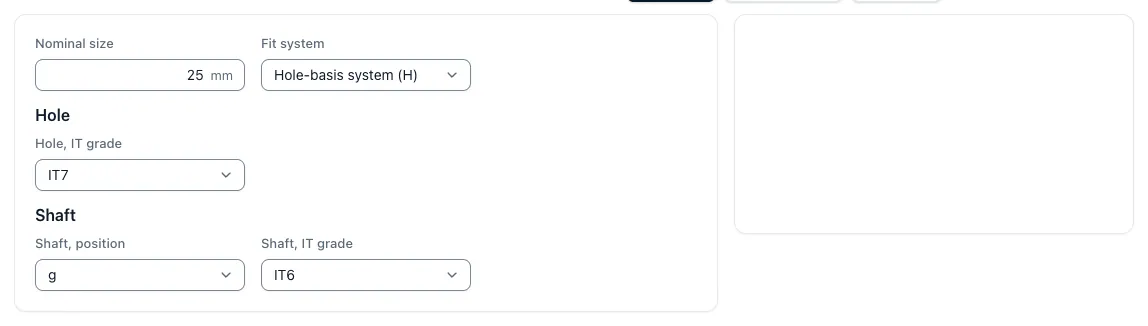
The fit calculator determines the limit dimensions according to ISO 286, the maximum and minimum play as well as the fit type – match, transition fit or oversize fit from nominal dimension, bore tolerance field and wave tolerance field.
Formulas
Höchstmaß = Nennmaß + oberes AbmaßLimit dimensions
The maximum and minimum dimensions of borehole and shaft are obtained from nominal dimensions and dimensions in μm.
Mindestspiel = EI − esUnfavorable case for joining
Smallest hole against the largest wave. A negative result means excess.
Höchstspiel = ES − eiBiggest Possible game
Largest hole against the smallest shaft – decisive for guidance accuracy and concentricity.
Passungstoleranz = IT Bohrung + IT WelleSpread of the fit
The sum of both tolerances determines how much play or excess in the series fluctuate.
Common fits in the unit bore system
Game and oversize exemplary for the nominal size Ø 50 mm, calculated according to ISO 286. Negative values mean oversize.
| Match | Species | At Ø 50 mm | Typical use |
|---|---|---|---|
| H7/h6 | Match (limited case, minimum game 0) | 0 to +41 μm | Sliding seat, manually available, guided parts |
| H7/g6 | Match | +9 to +50 μm | Sliding seat for moving guides and bearing seats |
| H7/f7 | Match | +25 to +75 μm | Running seat for plain bearings with lubricating film |
| H7/k6 | Transitional adjustment | −18 to +23 μm | Centring seat, available with light force |
| H7/n6 | Transitional adjustment | −33 to +8 μm | Fixed seat, joining with press usual |
| H7/p6 | Excessive adjustment | −42 to −1 μm | Press seat for permanent connections |
| H8/f7 | Match | +25 to +89 μm | Continued running seat, non-critical storage |
| H11/h11 | Match | 0 to +320 μm | Rough leadership, attacks, uncritical seats |
The values apply to Ø 50 mm. With the nominal dimension all dimensions change – therefore use the calculator with the actual dimension of the drawing.
ISO 286
Play and excess for H7/g6, H7/k6 and H7/p6 by nominal size
Minimum and maximum play in μm per nominal dimension, calculated according to ISO 286. Negative values mean excess.
| Nominal dimension | H7/g6 Match | H7/k6 Transitional passport | H7/p6 Overpass |
|---|---|---|---|
| Ø 6 mm | +4 to +24 μm | −9 to +11 μm | −20 to 0 μm |
| Ø 10 mm | +5 to +29 μm | −10 to +14 μm | −24 to 0 μm |
| Ø 16 mm | +6 to +35 μm | −12 to +17 μm | −29 to 0 μm |
| Ø 25 mm | +7 to +41 μm | −15 to +19 μm | −35 to −1 μm |
| Ø 40 mm | +9 to +50 μm | −18 to +23 μm | −42 to −1 μm |
| Ø 63 mm | +10 to +59 μm | −21 to +28 μm | −51 to −2 μm |
| Ø 100 mm | +12 to +69 μm | −25 to +32 μm | −59 to −2 μm |
According to ISO 286, a nominal dimension at a range limit (e.g. 10 mm) belongs to the range "over 6 to 10" . For other fields and intermediate dimensions, the fit calculator calculates in the app.
Match Finder
Find match from desired game
Those who do not start from the short character, but from the game that the function needs, use the fit finder of the app: They filter the deposited preference fits for a nominal size according to the smallest and largest permissible game, optionally in the system unit bore, unit shaft or in both. The result is a list of suitable combinations with minimum and maximum play and fit type, which you then check in the fit calculator.
Find fit in the app Free
Graph
Tolerance fields of the three types of fit
The diagram shows on a scale how the position of the shaft for hole H7 decides on the fit type at Ø 25 mm. If the shaft is completely below the hole field, it always remains a game; if the fields overlap, play or excess depending on the actual measure; if the shaft is completely above it, it always becomes excessive.
The dimensions of all common ISO tolerances for borehole and shaft are in the full ISO tolerance table for bore and shaft. For dimensions without own tolerance the General tolerances according to ISO 2768. Where boreholes and shafts consist of different materials or are measured at other temperature, the thermal expansion changes the game; the amount is calculated by the side Calculate length expansion.
Matches are functional and cost decisions
A tolerance field describes not only a measure, but also a manufacturing and testing process. Anyone who reads fit early recognizes additional simplicity, friction, grinding and measurement processes before the price is fixed.
Questions and answers
What does a fit according to ISO 286 mean?
A fit describes the interaction of the tolerance fields of bore and shaft with the same nominal dimension. The letter determines the position of the tolerance field to the zero line (large letter = bore, lower letter = shaft), the number the IT degree and thus the width of the tolerance. H7/g6 means: bore H7, shaft g6.
How does the fit calculator indicate the fit type?
From minimum and maximum game: If the minimum game is positive or zero, it is a match; is also the maximum game negative, an oversize fit; in between a transition fit. What the three types of assembly and function mean, the page fits according to ISO 286 explains.
Which fit is used for what?
H7/g6 is a sliding seat for guided movements, H7/h6 a sliding seat without any significant play, H7/f7 a running seat for sliding bearings, H7/k6 a centering transition seat, H7/n6 a fixed transition seat and H7/p6 a pressing seat. The selection follows the function, not the habit.
Why is H7 so common?
In the unit bore system, the bore has the lower dimension zero, the fit is adjusted via the shaft. This is technically advantageous because boreholes are often made with solid tools such as reamers, while shaft dimensions are flexibly accessible.
How do tight adjustments affect the calculation?
A close IT degree requires additional levelling, higher-quality tools, often rubbing or grinding, a more stable clamping as well as additional measurement processes and, if necessary, documentation. IT6 instead of IT9 on a pass surface can significantly increase the processing and testing time for this feature.
What area does this computer cover?
The computer works with the limit dimensions according to ISO 286 for nominal dimensions above 0 to 500 mm and the tolerance fields used in machining (drilling D to P, shaft d to p). Uncovered combinations are explicitly marked as such instead of indicating an untested value.