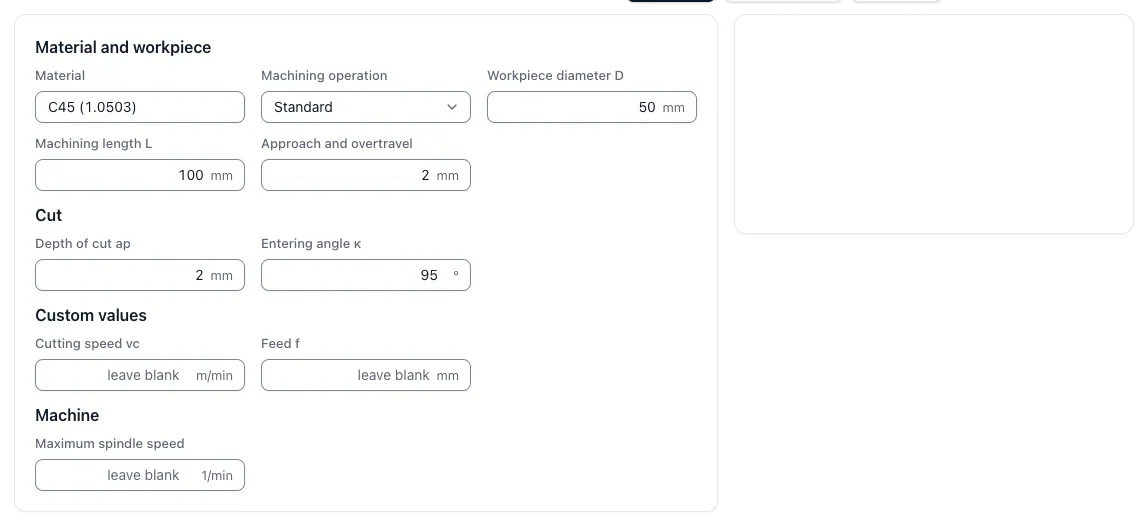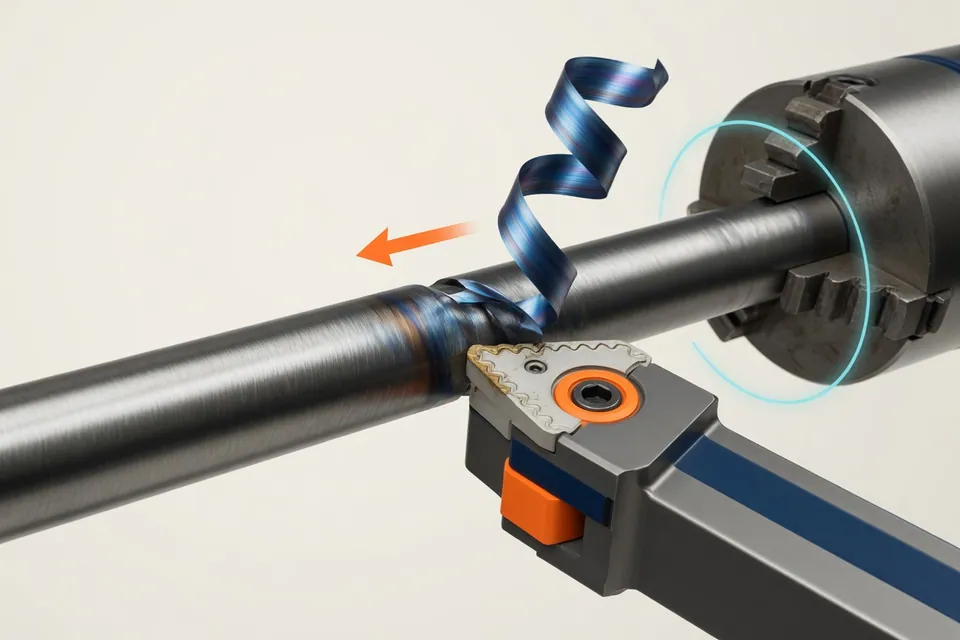
When turning, the speed is calculated from the diameter at the cutting edge: n = (vc × 1000) ÷ (π × d). Feed speed, time machining volume, power requirements and cutting time per overflow follow directly from this – including limitation by the maximum spindle speed.
Formulas
n = (vc × 1000) ÷ (π × d)Speed at diameter
d is the diameter at the cutting edge, not the finished diameter.
vf = n × fFeed speed
The feed per revolution is multiplied by the speed.
Q = vc × ap × fVolume of cutting time
When turning directly from cutting speed, cutting depth and feed in cm³/min.
t = L ÷ vfCut time per overflow
The rotation length divided by the feed speed.
Longitudinal turning Ø 60 mm in mild steel
vc 220 m/min, f 0.25 mm/rev, ap 2.5 mm, turning length 120 mm, kc 1,700 N/mm², speed limit 4,000 rpm.
- RPM n = 220 × 1000 (π × 60)1,167 1/min
- Feed speed vf = 1.167 × 0.25292 mm/min
- Average time per overflow = 120 ÷ 2920.41 min
- Timing volume Q = 220 × 2,5 × 0,25137.5 cm³/min
- Power output = 137.5 × 1,700 ÷ 60,000 ÷ 0.854,58 kW
ResultApproximately 0.4 minutes per overflow at 4.6 kW power requirement.
When turning, the removal power is significantly higher than when milling – here the spindle power is actually relevant.
Cutting speed when turning – table per material
Starting areas of cutting speed in m/min from the app's material database, one material per line, for coated carbide turntables (HM) and HSS.
| Material | vc HM (m/min) | vc HSS (m/min) | Start value HM (m/min) |
|---|---|---|---|
| Aluminium EN AW-6082 | 400–1.000 | 120–300 | 700 |
| Structural steel S235JR | 180–300 | 54–90 | 240 |
| Structural steel S355J2 | 170–280 | 51–84 | 225 |
| Remuneration steel C45 | 150–260 | 45–78 | 205 |
| Remuneration steel 42CrMo4 | 120–220 | 36–66 | 170 |
| Stainless steel 1.4301 | 120–200 | 36–60 | 160 |
| Stainless steel 1.4404 | 110–180 | 33–54 | 145 |
| Grey cast iron EN-GJL-250 | 150–250 | 45–75 | 200 |
| Titanium Ti-6Al-4V | 50–90 | 15–27 | 70 |
| Brass CuZn39Pb3 | 250–500 | 75–150 | 375 |
| Hardened steel 45–55 HRC | 60–140 | 18–42 | 100 |
| Plastic POM-C | 300–600 | 90–180 | 450 |
| Plastic PEEK | 200–400 | 60–120 | 300 |
The starting value is the centre of the area. The cutting data recommendation of the tool manufacturer is binding; when milling, the surface limits the feed over Rz ≈ f² ÷ (8 × corner radius). Cutting materials in the cutting data finder of the app: coated hard metal with the values of the table and high-speed steel (HSS) with about 0.3 × vc at unchanged feed.
Speed, feed and price of the rotating part
Each cut changes the reference diameter and thus the speed; formula, table per material and the effect of the speed limit are calculated below speed when turning. As from the feed per revolution the feed speed becomes, also when turning to plan with G96, input shows. The cutting time leads over the rotation time to the calculation of turns.
In the app, the tool "Constant cutting speed" keeps up the speed over the diameter. The Fully automatic calculation from drawing and CAD (Pro) combines cutting data, times and costs of a rotary part from drawing and CAD model to a calculation design; each value remains comprehensible and you release the design.
Origin of the cut values
The answers are from the table on this page and thus from the material database of the app.
Questions and answers
What cutting speed is used when turning steel, stainless steel and aluminium?
Starting values of the material database of the app for coated carbide: structural steel S235JR 180 to 300 m/min, remuneration steel C45 150 to 260 m/min, stainless steel 1.4301 120 to 200 m/min and aluminium EN AW-6082 400 to 1,000 m/min. For HSS, the app is expected to be 0.3 × vc. The indication of the tool manufacturer is binding.
How to calculate cut data for turning?
The speed follows from n = (vc × 1000) γ (π × d) with the currently processed workpiece diameter. The feed speed is vf = n × f, with the feed per revolution. The time machining volume is obtained directly from Q = vc × ap × f.
What diameter is used?
Always the diameter at the cutting edge, not the stock or finished diameter. When grinding from 60 to 50 mm, the speed does not decrease at constant cutting speed – it increases because the diameter is smaller.
What does G96 mean to G97?
G96 keeps the cutting speed constant and adjusts the speed continuously to the diameter. G97 works with fixed speed. When turning to the center of the plan, a speed limit is mandatory under G96, otherwise the speed runs against the machine maximum.
How do feed and surface hang together?
The theoretical root depth when turning is approximately derived from Rz ≈ f² ÷ (8 × r) with the corner radius r of the cut. A smaller feed or a larger corner radius improves the surface - but the larger radius increases the passive strength and thus the bending of slender parts.
How do you get from the cut data to the shooting time?
The cutting time per overflow is rotational length . Feed speed. For the cycle time per part all overflows, delivery, tool changes, rod feed, stabbing and measuring are added and the set-up time is distributed to the lot size.
Sources
- Material database and cutting data finder of the CNC Calculator app, as of 28.10.2026 – Start areas for coated carbide; HSS with the experience factor 0.3 of the app.