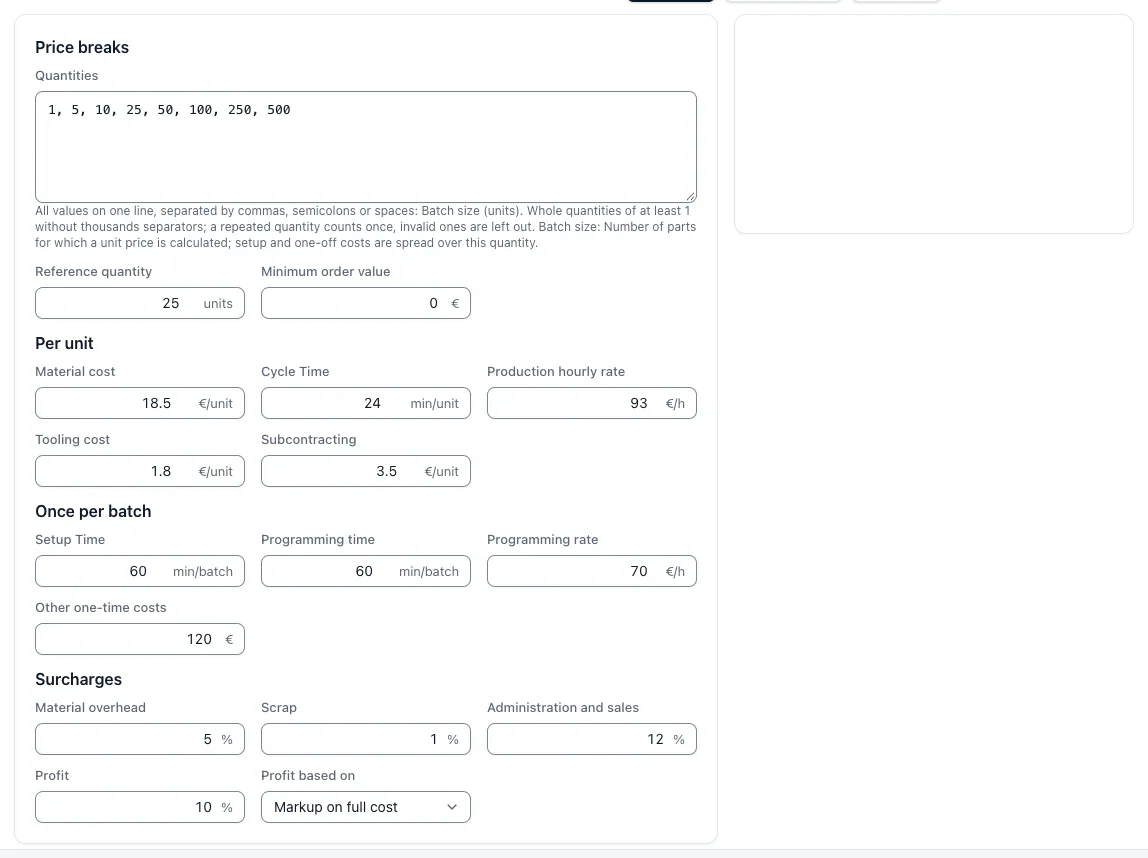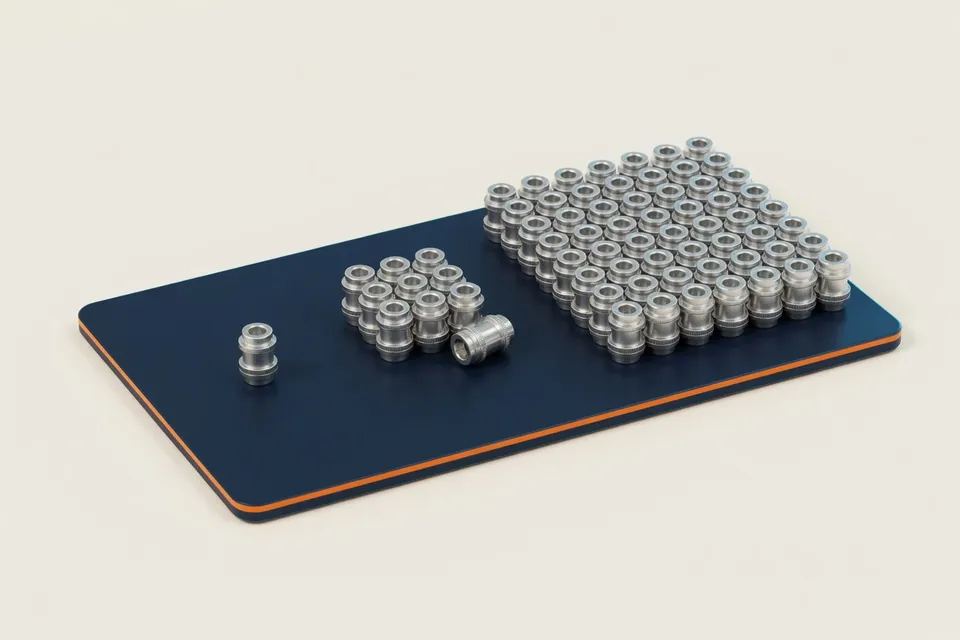
batch prices are unit prices which fall with the quantity ordered; in production they arise because fixed costs per order – setup, programming, device – are distributed to the lot size, while material and processing time per piece remain the same. The batch prices calculator of the app shows the unit price for several quantities in one pass.
Formulas
k_var = Material + t × Stundensatz ÷ 60Variable costs per unit
Do not change with lot size.
k_fix = Rüstzeit × Stundensatz ÷ 60 + EinmalaufwandFixed costs per order
Setup, programming, device, start-up, first pattern.
Selbstkosten = (k_var + k_fix ÷ N) × (1 + GK)Cost per unit
The fixed portion is divided by the lot size.
Preis = Selbstkosten ÷ (1 − Marge)Tender price
The margin is calculated from the selling price, not applied.
A milling part over the entire quantity scale
Assumptions: 18,50 € Material, 24 min processing at 72 €/h, 75 min setup, 180 € Programming, 18 % overhead costs and 12 % margin from the selling price.
- Variable cost per piece = 18.50 + 24 ÷ 60 × 7247,30 €
- Fixed costs = 75 ÷ 60 × 72 + 180270,00 €
- Cost of production for 1 piece = (47,30 + 270,00) × 1,18374,41 €
- Price at 1 piece = cost of production ÷ 0.88425,47 €
- Price at 100 pieces = (47.30 + 2.70) × 1.18 ÷ 0.8867,05 €
ResultBetween 1 and 500 pieces, the price falls by 84.9% – exclusively through the distribution of fixed shares.
The processing time is identical in all quantities. Whoever compares the differential prices without specifying the quantities, therefore compares incomparable.
batch prices of a milling part from 1 to 500 pieces
The same milling part as in the example: fixed share, cost and price per piece and the savings compared to the individual piece. Example of calculation with round assumptions, no market prices.
| Quantity | Fixed percentage per piece | Cost per unit | Price per piece | Savings compared to 1 piece |
|---|---|---|---|---|
| 1 piece | 270,00 € | 374,41 € | 425,47 € | – |
| 10 pieces | 27,00 € | 87,67 € | 99,63 € | 76,6 % |
| 50 pieces | 5,40 € | 62,19 € | 70,67 € | 83,4 % |
| 100 pieces | 2,70 € | 59,00 € | 67,05 € | 84,2 % |
| 500 pieces | 0,54 € | 56,45 € | 64,15 € | 84,9 % |
Costing 18 % overhead on the entire cost base, price with 12 % margin from the selling price. With your rates, the scaled-price calculator of the app expects the same table.
What are batch prices?
The term has two meanings. In retail, a scaled price is a quantity discount: a fixed list price gives a discount from a certain quantity, about ten pieces five percent. The dealer's costs per piece hardly change; the discount is a sales decision.
In the production process, the batch prices is generated from the costs. Setup, programming, device and initial sample testing occur once per order. The more parts an order includes, the smaller the fixed portion per piece, and the price decreases, although each part is processed for the same length of time. The page shows how the set-up time itself is created and evaluated. Calculate set-up costs.
Season from drawing and CAD
In Pro, batch prices are part of the fully automatic calculation design: The app plans operations, setups and programming from drawing and STEP model and distributes the one-time expenditure to every requested quantity. They check the design and release it; Pro is unlocked on request. The page describes how this is done, fully automatic calculation from drawing and CAD. Without AI, you can count the same season free of charge with the batch prices calculator.
A season makes the cost structure visible
The course of the season reveals more about a calculation than any individual price: If the price falls too little, the fixed costs are set too low – if it falls too much, there are no variable shares.
Questions and answers
How to calculate batch prices?
The costs are separated into variable and fixed parts. Variable material and processing time per piece, fixed are setups, programming and device per order. The unit price is based on (variable costs + fixed costs ÷ quantity) × (1 + overhead charge) ÷ (1 − margin). Only the fixed part changes with the lot size.
What is the difference between batch prices and quantity discount?
A quantity discount in the trade is a discount on a fixed list price from a certain quantity. A scaled price in the production arises from the costs: One-time expenses such as setup and programming are distributed over more parts, therefore the price per piece decreases. An additional discount is then a commercial decision.
Why is a single piece so much more expensive?
Because the complete one-time work is not required for one part. At 75 minutes set-up time to 72 €/h and 180 € programming effort is 270,00 € – calculated on one piece 270,00 €, on 100 pieces 2.70 €. The actual processing is identical in both cases.
From what amount is a device worth?
As soon as the spared set-up and handling time exceeds the one-time costs over the planned quantity. The device belongs as its own position with useful life in the calculation, so that it remains visible from which number of pieces it calculates.
Should the customer be exposed to the season?
A season with a comprehensible history is a sales argument: it shows that the price is based on times and not on feeling, and invites the customer to order a more economical quantity. Internal cost rates do not have to be disclosed.
Why is the price hardly falling in large quantities?
Because the fixed portion has already been distributed almost completely. From the point where the fixed percentage per piece is small compared to the variable costs, only material and processing time determine the price. Further discounts are then a commercial decision, no cost effect.