Calculating distance of a rotating part from the bar to the unit price
A rotary part is calculated in four blocks: bar section and material, rotation time per operation, set-up percentage per piece and cost rates, which make up times and material cost and offer price. Each block is calculated separately, so that a different quantity, another material or an additional tension has a targeted effect.
Four steps to calculate turning parts
Bar section and unwrought weight
The bar section per part is the finished length plus plan width and decutter width. From diameter, length and density follows the stock weight, with the kilo price the material costs. In the bar material in the loader, the residual piece and clamping length per bar are added; if a forge or cast stock is used, the price of the bar section replaces the bar section.
L_R = L + Plan size + detachment width
m = π ÷ 4 × d² × L_R × ρ
Average values and main time
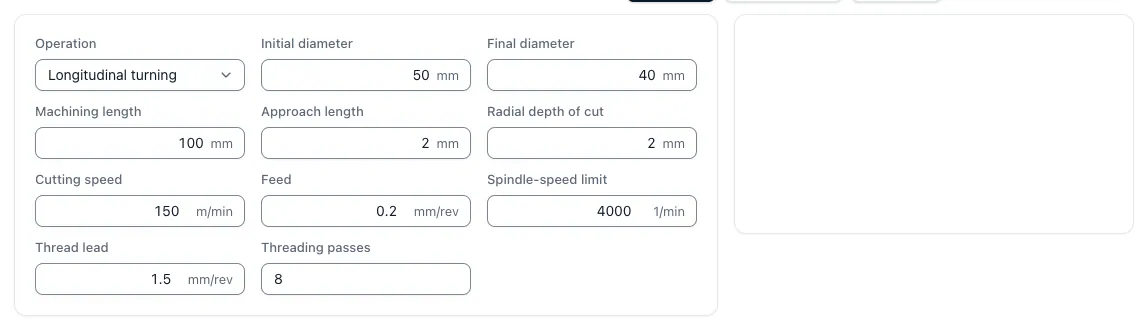
For each operation – roughing, finishing, puncture, threading, drilling, cutting – the cutting speed and feed rate are set per revolution. The cutting speed and diameter result in the speed, the feed path, the speed and feed time. When the plan turning and cutting at constant cutting speed, the speed increases to the middle until the spindle limit reaches.
n = vc × 1000 γ (π × d)
t_h = L ÷ (n × f)
Unit time with set-up part
At peak time, there are non-cutting times for tool changes, positioning, rod feed and measuring. Setup, tool preparation, program adaptation and first part release occur once per order and are divided by lot size N.
t_piece = t_h + t_n + t_r ÷ N
Cost rates and price
The unit time is assessed with the production hourly rate for machine and operator. Material and external services are added, overhead costs are added as an additional charge; this results in the cost of production. The margin is calculated from the selling price, not on the costs.
Price = cost of production ו (1 − margin)
Example of calculation: a rotating part from 1 to 500 pieces
Assumptions: Bar section Ø 40 × 62 mm from 58 mm finished length, 1 mm flat measurement and 3 mm cut width, main time 3.2 min, side time 1.1 min, assembly 90 min, assumed production hourly rate 72 €/h, steel with 7.85 g/cm³ at 2.40 €/kg, 18 % common costs and 12 % margin. Bar section: π ÷ 4 × (4.0 cm)² × 6.2 cm = 77.9 cm³; with 7.85 g/cm³ it weighs 0.612 kg and costs 1.47 € per piece at 2.40 €/kg.
| Size | 1 piece | 20 pieces | 100 pieces | 500 pieces |
|---|---|---|---|---|
| Set-up per piece | 90.0 min | 4.5 min | 0.9 min | 0.18 min |
| Time of piece | 94.3 min | 8.8 min | 5.2 min | 4.48 min |
| Machinery costs per unit | 113,16 € | 10,56 € | 6,24 € | 5,38 € |
| Material per piece | 1,47 € | 1,47 € | 1,47 € | 1,47 € |
| Production costs per unit | 114,63 € | 12,03 € | 7,71 € | 6,84 € |
| Cost of production with 18 % overhead | 135,26 € | 14,19 € | 9,10 € | 8,08 € |
| Price at 12 % margin | 153,71 € | 16,13 € | 10,34 € | 9,18 € |
The processing is the same in all columns; only the 90 minutes set-ups are distributed over more parts. Therefore, the item costs a multiple of the serial part, and a unit price without quantity is not comparable. The values are a calculation example with round assumptions, no market prices; sums are made of unrounded values.
Price Drivers and Where They Work in the Calculator
It is not the component itself that makes a rotating part expensive, but individual requirements. Each one acts at a specific point of the calculation path:
| Feature on the drawing | Block in the calculation path | How it is calculated |
|---|---|---|
| Close fit, such as h6 or H7 | Rotation time | additional finishing, measuring in the machine or grinding as own operation |
| Shape and position tolerance with reference | Clamping sequence | Reference and tolerated surface as far as possible in one clamping, otherwise additional clamping with alignment |
| Fine surface | Cut values | smaller feed per revolution during finishing, thus longer main time |
| Long internal working | Cut values and tools | reduced cutting values due to the length of the collar, special tool, more cuts |
| Hardening or coating | Foreign output and stock | Supplier price with minimum amount, dimensions for hard machining, further operation |
| Measurement log or initial sample test report | One-off and test time | Test time per part or lot, documentation as its own position |
Lathe class and calculation sequence
Which machine a part produces, decides how many stresses it takes and how much set-up and side-time it takes. The assignment is a planning decision that stands before the time calculation:
| Machinery class | What is possible in a clamping | Follow for setup and side-time |
|---|---|---|
| Lathe with two axles | External and internal turning, punctures, threads, centred holes | Crossholes, surfaces and grooves need a second machine with own setup and transport |
| Lathe with driven tools and C-axis | additional crossholes, surfaces, grooves and multi-edge | less tension; longer cycle time and more tools to set up |
| Lathe with counter spindle | Machining of the back after stabbing | No hand spanning; the time of the longer side determines the measure |
| Long-turning machine | slim parts from the rod with moving spindle stick | elaborate set-up, but short cycle time per part; is more worthwhile with larger lots |
Automatic drawing and CAD
In Pro, the CNC Calculator app creates this calculation path from drawing and STEP model fully automatically as a calculation design: bar section, work schedule, times, costs and batch prices, each value with its origin. They check the design and release it; Pro is unlocked on request. More information under Full automatic calculation from drawing and CAD.
For free, calculate the same steps individually: Calculate turning parts online stands the way with the tools of the app, the Gross part weight calculator supplies the bar section and the Unit cost calculator the price per part. The factors determining the price of a rotating part in practice are shown by the page Turned parts costs.
Key points
Rotating parts are explained in such a way that inputs, procedures, effects and limits in the CNC calculation remain comprehensible.
- Realistically apply stock: Rod diameter, detachment width, plan dimensions and clamping length determine the material costs per piece.
- Evaluate operations individually: Scratching, finishing, stabbing, threading, drilling and stabbing have their own times and cutting values.
- Visibly distribute fixed parts: Setup, programming and initial sample testing have a completely different effect on ten parts than on a thousand.