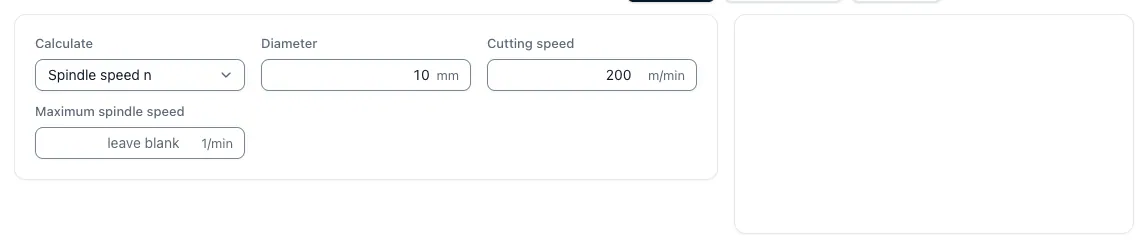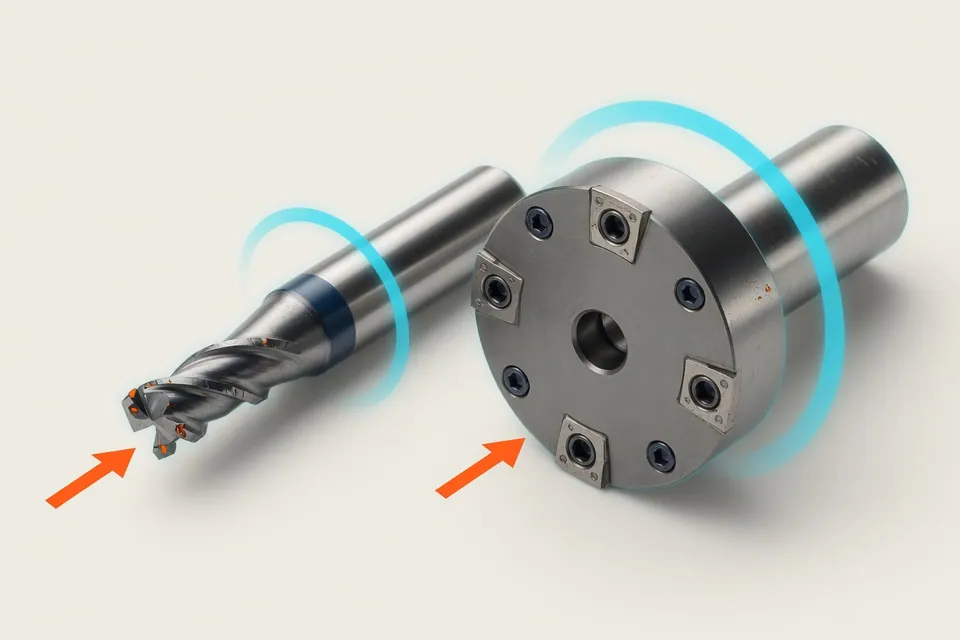
With n = (vc × 1000) ÷ (π × d), a cutting speed of 200 m/min and a diameter of 40 mm give about 1,592 rpm. For turning, use the workpiece diameter at the cutting edge. For milling and drilling, use the tool diameter. Cap the result at the machine's maximum spindle speed.
Formula for speed calculation
n = (vc × 1000) ÷ (π × d)Speed from cutting speed
n in 1/min, vc in m/min, d in mm. Applies equally to milling, drilling and turning.
vc = (π × d × n) ÷ 1000Cutting speed from speed
The inversion shows which cutting speed is actually effective on a limited spindle.
vf = n × f bzw. vf = n × z × fzConnection to feed
f is the feed per revolution when turning and drilling, fz the tooth feed and z the number of teeth when milling; vf is obtained in mm/min.
n = v × 60 000 ÷ (π × d)Speed from circumference speed in m/s
v in m/s, for example in the case of grinding wheels, pulleys and rollers. 60 000 summarizes the factor 1000 for mm and 60 seconds per minute.
Speed of longitudinal rotation of a shaft
A shaft made of C45 tempering steel is rotated lengthwise to Ø 40 mm. 200 m/min are used for a coated carbide turning cutting plate, a value from the starting range 150 to 260 m/min of the table below.
- Cutting speed vc200 m/min
- Diameter at the edge d40 mm
- n = 200 × 1000 ÷ (π × 40)1,592 1/min
- The same cut to Ø 20 mm3,183 1/min
Resultn ÷ 1,592 rpm at Ø 40 mm
If the diameter is halved, the speed doubles at the same cutting speed. With G96, the control takes over this adjustment; the speed limit protects when turning to the center.
Reference values for cutting speed vc
Starting values in m/min for coated carbide tools, one material per line with the same areas as in the material database of the cutting data finder. The information provided by the tool manufacturer for the specific application is always binding.
| Material | Vc Milling (m/min) | vc Turning (m/min) | vc Drilling (m/min) |
|---|---|---|---|
| Aluminium EN AW-6082 | 300–800 | 400–1.000 | 150–350 |
| Structural steel S235JR | 150–250 | 180–300 | 80–130 |
| Structural steel S355J2 | 140–230 | 170–280 | 75–120 |
| Remuneration steel C45 | 120–200 | 150–260 | 70–120 |
| Remuneration steel 42CrMo4 | 100–160 | 120–220 | 60–100 |
| Stainless steel 1.4301 | 80–140 | 120–200 | 50–90 |
| Stainless steel 1.4404 | 70–130 | 110–180 | 45–80 |
| Grey cast iron EN-GJL-250 | 100–180 | 150–250 | 80–140 |
| Titanium Ti-6Al-4V | 40–80 | 50–90 | 25–50 |
| Brass CuZn39Pb3 | 200–400 | 250–500 | 100–250 |
| Hardened steel 45–55 HRC | 50–120 | 60–140 | 20–45 |
| Plastic POM-C | 300–600 | 300–600 | 100–300 |
| Plastic PEEK | 200–400 | 200–400 | 80–200 |
The values are areas of experience for pre-calculation. They do not replace cutting data recommendations and no starting test on the machine. Cutting materials in the app's cut data finder: coated carbide with the values of the table and high-speed steel (HSS) with approximately 0.3 × vc with unchanged feed.
Factor 1000, fist formula and units of speed
In the formula for the speed calculation, the factor 1000 stands, because the cutting speed is used in metres per minute and the diameter in millimetres. If one divides 1000 by π, it remains around 318; from this follows the fist formula n ᐅ 318 × vc י d. For 200 m/min at Ø 40 mm it results in 318 × 200 γ 40 = 1,590 1/min, the exact calculation 1,592 1/min.
- n: spindle speed in 1/min, equivalent to rev/min, min⁻¹ or rpm
- vc: cutting speed in m/min
- d: diameter in mm, turning the workpiece at the cutting edge, milling the tool
The speed calculator of the CNC Calculator app calculates the same formula online in the browser, free of charge and without an account, and shows, besides the computational speed, the speed limited by the machine and the effective cutting speed.
Typical errors in speed calculation
- Radius instead of diameter used: The calculated speed is twice as high as right.
- Diameter in meters, but the factor 1000 stops: The speed is thousands of times too small.
- Cutting speed in m/s from a grinding table used as m/min: The speed is 60 times too small.
- When turning, use the stock or finished diameter instead of the diameter at the cutting edge, for example when grinding a large stock.
- The spindle limit is overlooked: If the spindle already runs at its maximum speed, a higher calculation speed does not work, and the effective cutting speed is below the plan.
Calculate rotational speed
On the lathe, the workpiece diameter at the cutting edge belongs to the formula, not the finished diameter and not the stock diameter. It is smaller with each cutting, and the speed must rise at the same cutting speed.
Lathes therefore usually work at a constant cutting speed (G96): The controller continuously calculates the speed from the current diameter. A speed limit prevents the spindle from running up to the machine limit when turning to the center of the plan. Fixed speed (G97) is used, for example, when turning threads.
n = vc × 1000 γ (π × d_piece)
Speed above diameter at constant cutting speed (G96)
vc = 200 m/min, speed limit 4,000 1/min. Where the limit reaches, the effective cutting speed decreases.
| Diameter d | n computational (1/min) | n with limitation (1/min) | effective vc (m/min) |
|---|---|---|---|
| 100 mm | 637 | 637 | 200 |
| 80 mm | 796 | 796 | 200 |
| 60 mm | 1.061 | 1.061 | 200 |
| 40 mm | 1.592 | 1.592 | 200 |
| 20 mm | 3.183 | 3.183 | 200 |
| 10 mm | 6.366 | 4.000 | 126 |
| 5 mm | 12.732 | 4.000 | 63 |
Depending on the control, the limit is programmed with G50 or LIMS. The calculation shows the effect; the maximum permissible speed specifies clamping medium and machine documentation.
Rotation speed table per material
Speed n in 1/min for the middle of the start area "vc turning" of the app's material database, coated carbide, per workpiece diameter at the cutting edge.
| Material | vc (m/min) | Ø 10 mm | Ø 20 mm | Ø 40 mm | Ø 60 mm | Ø 100 mm |
|---|---|---|---|---|---|---|
| Aluminium EN AW-6082 | 700 | 22.282 | 11.141 | 5.570 | 3.714 | 2.228 |
| Structural steel S235JR | 240 | 7.639 | 3.820 | 1.910 | 1.273 | 764 |
| Structural steel S355J2 | 225 | 7.162 | 3.581 | 1.790 | 1.194 | 716 |
| Remuneration steel C45 | 205 | 6.525 | 3.263 | 1.631 | 1.088 | 653 |
| Remuneration steel 42CrMo4 | 170 | 5.411 | 2.706 | 1.353 | 902 | 541 |
| Stainless steel 1.4301 | 160 | 5.093 | 2.546 | 1.273 | 849 | 509 |
| Stainless steel 1.4404 | 145 | 4.615 | 2.308 | 1.154 | 769 | 462 |
| Grey cast iron EN-GJL-250 | 200 | 6.366 | 3.183 | 1.592 | 1.061 | 637 |
| Titanium Ti-6Al-4V | 70 | 2.228 | 1.114 | 557 | 371 | 223 |
| Brass CuZn39Pb3 | 375 | 11.937 | 5.968 | 2.984 | 1.989 | 1.194 |
| Hardened steel 45–55 HRC | 100 | 3.183 | 1.592 | 796 | 531 | 318 |
| Plastic POM-C | 450 | 14.324 | 7.162 | 3.581 | 2.387 | 1.432 |
| Plastic PEEK | 300 | 9.549 | 4.775 | 2.387 | 1.592 | 955 |
Start values for planning; the cut data recommendation of the tool manufacturer is binding. If a value is above the spindle limit of the machine, the limit from the table above applies.
How the speed with the feed per revolution becomes the time for a longitudinal section, the page shows Calculate rotational time.
Calculate milling speed: speed of milling
When milling, the tool diameter is decisive; the spindle speed follows directly from it. A solid carbide shaft cutter with 10 mm diameter in mild steel at 160 m/min runs at 5,093 rpm. For small tools, the spindle limit is quickly reached: The same value would already be 16,977 rpm for a milling cutter with 3 mm.
In the case of knife heads and planing cutters, the nominal diameter of the cutter body counts over the cutting edges, because there the cutting corners are cut.
n = vc × 1000 ÷ (π × d_tool)
Speed per diameter and material
Spindle speed n in 1/min for the middle of the start area "vc milling" of the app's material database, coated solid carbide.
| Material | vc (m/min) | Ø 2 mm | Ø 3 mm | Ø 4 mm | Ø 6 mm | Ø 8 mm | Ø 10 mm | Ø 12 mm | Ø 16 mm | Ø 20 mm |
|---|---|---|---|---|---|---|---|---|---|---|
| Aluminium EN AW-6082 | 550 | 87.535 | 58.357 | 43.768 | 29.178 | 21.884 | 17.507 | 14.589 | 10.942 | 8.754 |
| Structural steel S235JR | 200 | 31.831 | 21.221 | 15.915 | 10.610 | 7.958 | 6.366 | 5.305 | 3.979 | 3.183 |
| Structural steel S355J2 | 185 | 29.444 | 19.629 | 14.722 | 9.815 | 7.361 | 5.889 | 4.907 | 3.680 | 2.944 |
| Remuneration steel C45 | 160 | 25.465 | 16.977 | 12.732 | 8.488 | 6.366 | 5.093 | 4.244 | 3.183 | 2.546 |
| Remuneration steel 42CrMo4 | 130 | 20.690 | 13.793 | 10.345 | 6.897 | 5.173 | 4.138 | 3.448 | 2.586 | 2.069 |
| Stainless steel 1.4301 | 110 | 17.507 | 11.671 | 8.754 | 5.836 | 4.377 | 3.501 | 2.918 | 2.188 | 1.751 |
| Stainless steel 1.4404 | 100 | 15.915 | 10.610 | 7.958 | 5.305 | 3.979 | 3.183 | 2.653 | 1.989 | 1.592 |
| Grey cast iron EN-GJL-250 | 140 | 22.282 | 14.854 | 11.141 | 7.427 | 5.570 | 4.456 | 3.714 | 2.785 | 2.228 |
| Titanium Ti-6Al-4V | 60 | 9.549 | 6.366 | 4.775 | 3.183 | 2.387 | 1.910 | 1.592 | 1.194 | 955 |
| Brass CuZn39Pb3 | 300 | 47.746 | 31.831 | 23.873 | 15.915 | 11.937 | 9.549 | 7.958 | 5.968 | 4.775 |
| Hardened steel 45–55 HRC | 85 | 13.528 | 9.019 | 6.764 | 4.509 | 3.382 | 2.706 | 2.255 | 1.691 | 1.353 |
| Plastic POM-C | 450 | 71.620 | 47.746 | 35.810 | 23.873 | 17.905 | 14.324 | 11.937 | 8.952 | 7.162 |
| Plastic PEEK | 300 | 47.746 | 31.831 | 23.873 | 15.915 | 11.937 | 9.549 | 7.958 | 5.968 | 4.775 |
For HSS milling machines, the cut data finder of the app calculates 0.3 × vc; all the speed of the table then decreases in the same ratio. Many values for small diameters are above the maximum speed of common spindles.
Ball cutter: speed with the active diameter
A ball cutter with a diameter of 10 mm and a_p = 0.5 mm cuts the nominal diameter with d_eff = 2 × √(0.5 × 9.5) ◄ 4.36 mm for 200 m/min. For this, it needs around 14,605 1/min instead of 6,366 1/min. The working diameter is calculated by the tool Ball cutter effective diameter of the app, residual comb height and web distance to calculate the side Ball cutter .
d_eff = 2 × √(a_p × (D − a_p)
Which diameter belongs in the formula
The formula is the same for all processes; only the diameter is different. When turning, it is the workpiece at the cutting edge, when milling the tool, when ball cutter the working diameter.
Drills, sinkers and step drills
Drilling is the same formula with drill diameter. For sinkers, step drills and centring drills, the largest cutting diameter is decisive because the highest cutting speed occurs there. Start values, a speed table according to drill diameter and a calculation example are on the page Calculate drill speed.
Speed, rotational frequency and circumferential speed
The rotational frequency is the same as the speed, only per second in Hertz instead of per minute: Convert rotational frequency, Hz and rad/s. The velocity at the circumference in m/s, like a grinding wheel, follows from speed and diameter: Calculate the circumference velocity.
Speed table
Speed table by diameter and cutting speed
Speed n in 1/min, calculated with n = vc × 1000 ÷ (π × d) and rounded to complete revolutions. Applies to tool diameter when milling and drilling and workpiece diameter when turning.
| Diameter d | vc 25 m/min | vc 50 m/min | vc 100 m/min | vc 150 m/min | vc 200 m/min | vc 300 m/min |
|---|---|---|---|---|---|---|
| 2 mm | 3.979 | 7.958 | 15.915 | 23.873 | 31.831 | 47.746 |
| 3 mm | 2.653 | 5.305 | 10.610 | 15.915 | 21.221 | 31.831 |
| 4 mm | 1.989 | 3.979 | 7.958 | 11.937 | 15.915 | 23.873 |
| 5 mm | 1.592 | 3.183 | 6.366 | 9.549 | 12.732 | 19.099 |
| 6 mm | 1.326 | 2.653 | 5.305 | 7.958 | 10.610 | 15.915 |
| 8 mm | 995 | 1.989 | 3.979 | 5.968 | 7.958 | 11.937 |
| 10 mm | 796 | 1.592 | 3.183 | 4.775 | 6.366 | 9.549 |
| 12 mm | 663 | 1.326 | 2.653 | 3.979 | 5.305 | 7.958 |
| 16 mm | 497 | 995 | 1.989 | 2.984 | 3.979 | 5.968 |
| 20 mm | 398 | 796 | 1.592 | 2.387 | 3.183 | 4.775 |
| 25 mm | 318 | 637 | 1.273 | 1.910 | 2.546 | 3.820 |
| 32 mm | 249 | 497 | 995 | 1.492 | 1.989 | 2.984 |
| 40 mm | 199 | 398 | 796 | 1.194 | 1.592 | 2.387 |
| 50 mm | 159 | 318 | 637 | 955 | 1.273 | 1.910 |
| 63 mm | 126 | 253 | 505 | 758 | 1.011 | 1.516 |
| 80 mm | 99 | 199 | 398 | 597 | 796 | 1.194 |
| 100 mm | 80 | 159 | 318 | 477 | 637 | 955 |
Values above the spindle limit of the own machine are not mobile; there the effective cutting speed drops to vc = π × d × n_max ÷ 1000.
The speed table is available as a file for printing or for further calculating in the spreadsheet: Download speed table as CSV. It contains the same values as this page, without login and without form.
From speed to time and price
With the feed, a feed speed is calculated from the speed: Feed. For rotary parts, the time per cut leads to the turning time and further to the Calculation Rotating parts with material, set-up percentage and hourly rate.
If you don't want to calculate each cut individually: Fully automatic calculation from drawing and CAD (Pro) creates a calculation draft with the same formulas from drawing and CAD model; each value remains comprehensible and you release the design.
Start values and manufacturer's specifications
The answers are based on the formula n = vc × 1000 (π × d) and the starting areas of the app's material database.
Questions and answers
What is the formula for speed calculation?
n = vc × 1000 ÷ (π × d). n is the speed in 1/min, vc is the cutting speed in m/min and d is the diameter in mm. n ÷ 318 × vc ו d is the fist formula. For 200 m/min at Ø 40 mm it is 1,592 1/min.
How do you calculate the speed from the cutting speed?
The speed is obtained from n = (vc × 1000) γ (π × d). vc is the cutting speed in m/min and d is the diameter in millimetres – when milling and drilling the tool diameters, when turning the currently processed workpiece diameter. Example: vc = 150 m/min and d = 12 mm results in approximately 3,979 1/min.
Why is the factor 1000 in the speed formula?
Because the cutting speed in metres per minute and the diameter in millimetres is indicated. One meter has 1000 millimetres; without the factor, the result would be a thousand times too small. If you use the diameter in metres, the factor will be omitted.
How do you calculate the rotational speed?
With the workpiece diameter at the cutting edge: n = vc × 1000 ÷ (π × d). A shaft with a diameter of 40 mm at 200 m/min results in about 1,592 rpm. If the diameter is halved, the speed doubles; with G96 the control adjusts it itself.
How do you calculate the speed of a milling cutter?
With the tool diameter: n = vc × 1000 ÷ (π × d). A 12 mm cutter at 150 m/min runs at 3,979 1/min. With the ball cutter with small delivery, the effective diameter belongs in the formula, not the nominal diameter.
What speed does a 10 mm cutter need in mild steel?
With the middle of the starting area for structural steel S235JR from the material database of the app, 200 m/min for coated carbide, the result is 6,366 1/min. For a HSS milling machine, the app expects 0.3 × vc, i.e. about 1,910 1/min. Both are starting values; the indication of the tool manufacturer is mandatory.
What diameter is applicable when turning?
When turning, the diameter at the cutting edge, i.e. the diameter that the workpiece has straight at this point, counts. It changes with every cut. When turning to the middle, the diameter falls against zero, so controls work there at constant cutting speed (G96) and a speed limit.
Are rotational speeds and revolutions the same per minute?
Yes. The speed n is given in 1/min, equivalent to U/min, min⁻¹ or rpm. How to convert it to Hertz and rad/s is shown on the page on rotational frequency.
What happens if the calculated speed is above the machine limit?
Then the spindle speed is limited and the effective cutting speed drops to vc = π × d × n_max י 1000. The speed calculator of the app shows this case. Especially with small tool diameters below 6 mm, the machine limit is quickly reached.
Where do the values for the cutting speed come from?
The information provided by the tool manufacturer for material group, cutting material, coating, cooling and intervention ratios is binding. The tables on this page count on the starting areas of the app's material database; they are followed during operation using service life, surface, noise and power consumption.
Is the speed sufficient for a time calculation?
No. The speed, together with tooth feed and number of teeth, determines the feed speed; only the main time is generated from it and from the tool paths. For a reliable calculation, non-cutting times, tool changes, measurements and the proportional set-up time are added.
Sources
- Material database and cutting data finder of the CNC Calculator app, as of 28.10.2026 – Starting ranges of cutting speed for coated carbide; HSS with the experience factor 0.3 of the app.
- DIN 6580:1985-10 Terms of machining; Movements and geometry of cutting process – terms of cutting and feeding motion.
- DIN EN ISO 80000-3:2020 Sizes and Units – Part 3: Space and Time (ISO 80000-3:2019) – Sizes, formulae and units for space and time.