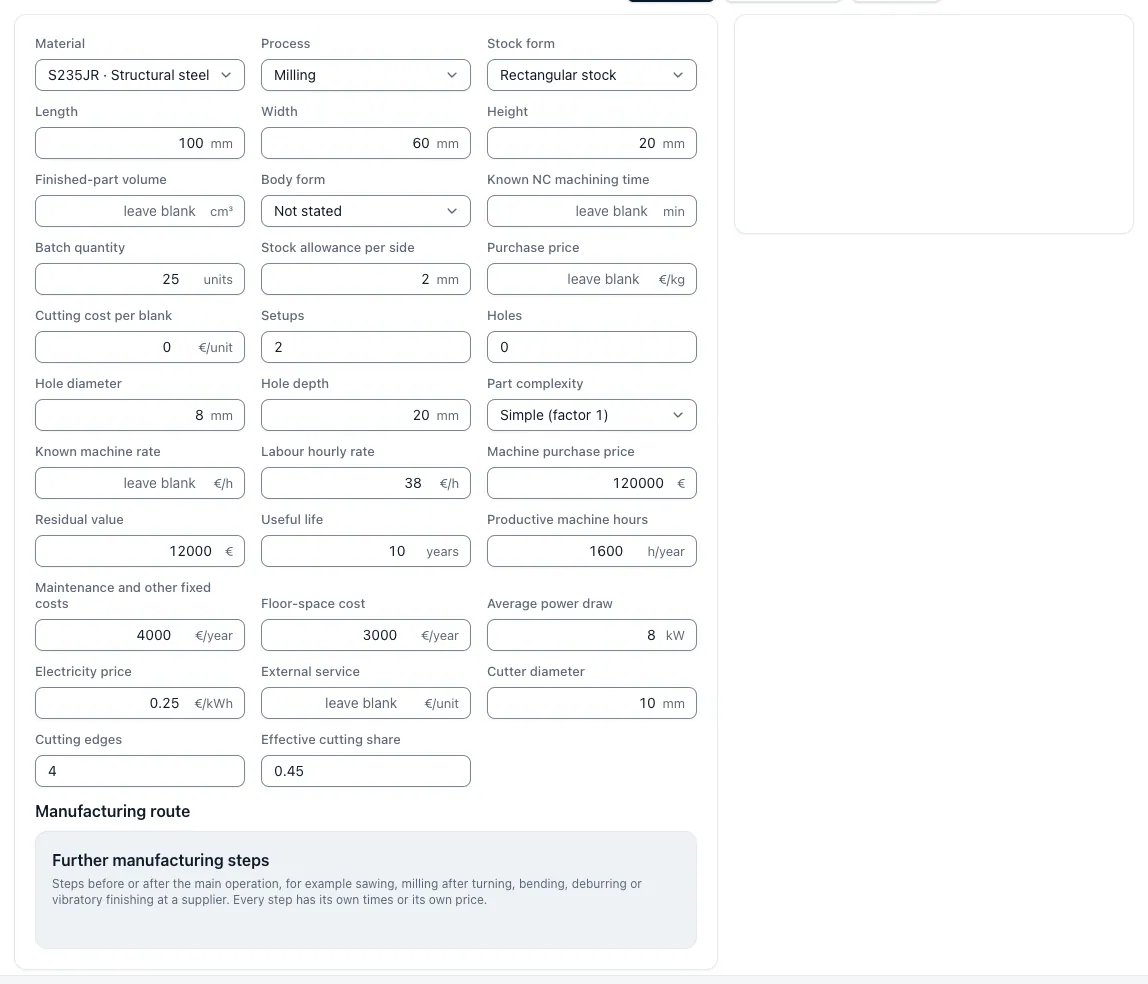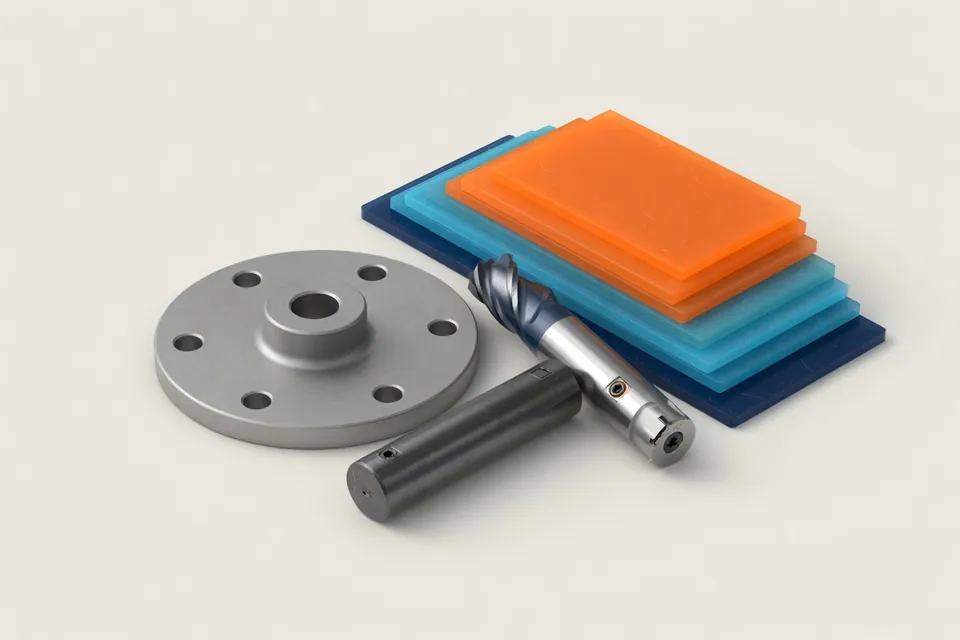
Calculation diagram and calculation path for CNC parts
CNC parts are calculated in a fixed order: first the production path, then the times, then the costs and lastly the price. Drawing, CAD model, material, stock and number of pieces create a preliminary work plan with machine, clamping, tools and tests. Only this technical reference makes a cost-responsible.
Calculation scheme from material to offer price
Most farms calculate parts according to the calculation of the purchase price. Individual costs are directly attributed to the part, overhead costs are added as a percentage:
| Stage | What's in it | Calculating path |
|---|---|---|
| Material costs | Unwrought part, cut, cut, stick residue | Gross weight × kiloprice per unit |
| Production costs | Machine time and operator time per operation | Unit time ÷ 60 × Production hour rate |
| One-off costs per unit | Equipment, programming, device, initial samples | One-off cost ÷ Lot size |
| Other services | Hardening, coating, grinding, external testing | Supplier price per piece, minimum minimum amount of lot size |
| Manufacturing costs | Total costs up to this point | Material + Manufacturing + One-off costs + Foreign performance |
| Administrative and distribution overheads | Costs associated with no job | Production costs × Surcharge rate |
| Cost of production | all costs of the part | Production costs + overheads |
| Profit | Result of the contract | Offer price – cost of production |
| Tender price | Price per piece for the quantity requested | Cost of production (1 – margin) |
It is important that every type of cost occurs exactly once. Anyone who already carries room costs in the machine hourly rate does not charge them as overhead costs again; anyone who calculates the margin from the price divides by (1 – margin) instead of adding it to the cost of production.
Times separated by time type
The time calculation distinguishes main time, side time and set-up time. For a lot size N applies simplified t_piece = t_h + t_n + t_r ÷ N. For 14 minutes main time, 4 minutes side time and 100 minutes set-up time for 20 parts, 23 minutes per part result. Because the set-up time remains separate, each new piece number can be calculated without changing the remaining time shares.
Calculation examples for turning and milling parts
A calculated rotary part with bar section, cycle time per part and scale of 1 to 500 pieces is under Calculation rotary parts. A milling part in one and three clampings with the same relay shows Calculation milling parts. Both examples use the same surcharges to keep the calculation paths comparable.
Turning and milling parts with a calculation
Many parts are neither pure turning parts nor pure milling parts: a shaft with transverse bore and pass spring groove, a flange with hole circle, a housing with rotating bearing bore. For the calculation, it counts on which machine the machining takes place. On a lathe with driven tools, holes and grooves are created in the same clamping; with a separate milling machine, further clamping, own setups and transport are added. Both belong as their own operation in the work plan, so that the additional costs of a second machine remain visible.
Automatically from CAD and drawing
In Pro, the CNC Calculator app creates this process from drawing and STEP model fully automatically as a calculation design with work schedule, times, costs and scaled prices. Each value shows its origin and you release the design; Pro is unlocked on request. More information under Full automatic calculation from drawing and CAD. What matters when selecting a software is the page CNC calculation software.
Key points
CNC-calculation is explained in such a way that inputs, procedures, effects and limits in the CNC-calculation remain comprehensible.
- Finishing path: stock, machine, tensioning, tools and tests are derived from the released requirements.
- Clean time separation: Main, secondary and set-up times remain separate so that number and process changes work correctly.
- Evaluate costs transparently: Material, manufacturing, external services, overheads and margin are not mixed in a flat rate value.