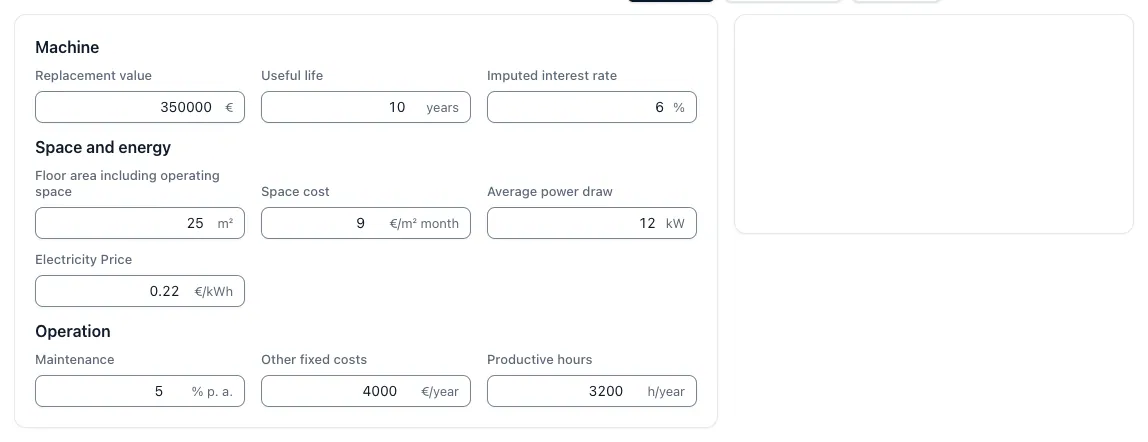
The machine hourly rate is the sum of the machine-dependent annual costs divided by the productive hours plus variable costs per operating hour; in example 53,760 € ÷ 1,800 h + 3.75 € = 33.62 € per hour. Realistic productive hours are decisive: If theoretical rather than actually useable hours are used, the cost rate will be too low.
Formulas
MSS = K_fix ÷ h_produktiv + k_varNumber of hours worked
Annual fixed costs per productive hour plus variable costs per running hour, such as energy.
K_AfA = WBW ÷ NutzungsdauerCalculatory depreciation
Replacement value divided by the planned useful life in years.
K_Zins = WBW ÷ 2 × ZinssatzCalculating interest
Interest is paid on the capital, i.e. half the value, which is tied in the medium.
Machine hourly rate of a CNC milling machine
Example assumptions to illustrate the calculation path, no target values: replacement value €300,000, service life 10 years, 6% calculator interest, 40 m² at €12 per month, maintenance 3% of the replacement value, 1,800 productive hours and 15 kW average power consumption at €0.25 per kWh.
- Depreciation €300,000 10 years€30,000 per year
- Interest 6% on €150,0009,000 € per year
- Room 40 m² × 12 € × 12 months€ 5.760 per year
- Maintenance 3 % of 300,000 €9,000 € per year
- Fixed costs 53.760 € ÷ 1.800 h€ 29,87 per hour
- Energy 15 kW × 0,25 € per kWh3.75 € per hour
Result33,62 € per hour of machinery without personnel
With the same cost and 3,000 instead of 1,800 hours, the set would be considerably lower, even though the machine has not become cheaper. Therefore, only realistically productive hours belong in the denominator.
Type of cost in the machine hourly rate (calculation example)
The assumptions of the example above, divided into cost type, calculation method, amount per year and percentage per productive hour. No indicative values.
| Type of cost | Calculating path | per year | per hour |
|---|---|---|---|
| Calculatory depreciation | WBW ÷ useful life | 30.000 € | 16,67 € |
| Calculating interest | WBW ÷ 2 × interest rate | 9.000 € | 5,00 € |
| Space costs | Area × Rent × 12 | 5.760 € | 3,20 € |
| Maintenance | WBW × set | 9.000 € | 5,00 € |
| Energy | kW × €/kWh per running hour | – | 3,75 € |
| Number of hours worked | Total | 53.760 € | 33,62 € |
Tools, cooling lubricant and compressed air can be added as additional variable costs per hour if they are not calculated as individual costs per order.
How the productive hours change the sentence
The same costs (53.760 € fixed costs per year, 3.75 € energy per running hour), distributed over different numbers of productive hours. Example of calculation, no guideline values.
| Productive hours per year | Fixed costs per hour | Energy per hour | Number of hours worked |
|---|---|---|---|
| 1.200 h | 44,80 € | 3,75 € | 48,55 €/h |
| 1.500 h | 35,84 € | 3,75 € | 39,59 €/h |
| 1.800 h | 29,87 € | 3,75 € | 33,62 €/h |
| 2.400 h | 22,40 € | 3,75 € | 26,15 €/h |
| 3.000 h | 17,92 € | 3,75 € | 21,67 €/h |
The rate does not decrease because the machine becomes cheaper, but because the same fixed costs are distributed over more hours. Only the number of hours that the machine actually runs for orders is loadable.
Machinery costs
Calculate machine costs: fixed and variable costs per hour
Fixed machine costs
Fixed costs arise whether the machine is running or standing: calculation depreciation, calculation interest on the tied capital, space costs, insurance and part of the maintenance. They are determined per year and divided by the productive hours. Therefore, the rate increases when the machine is less used up.
Fix costs per hour = (AfA + interest + space + maintenance) ÷ productive hours
Variable machine costs
Variable costs only arise while the machine is running: energy, cooling lubricant, compressed air and wear-dependent maintenance. They are calculated per hour of running and not divided by the productive hours. In the example, the 15 kW average power consumption is € 0.25 per kWh.
Variable cost per hour = average power × electricity price + additional consumption costs
From machine hourly rate to hourly rate for CNC production
The offer is usually based on a machine and operator. With an assumed wage cost rate of 38 € per hour including non-wage costs, the example is 33.62 € + 38 € = 71.62 € per hour when a person operates a machine. If it is operated by two machines simultaneously, each machine accounts for only half of the wage: 52.62 € per hour. The complete calculation path with multi-machine operation, set-up and set-up and set-off shows the page hour set CNC milling and turning.
Whether overhead costs and profit belong in the rate or come later as an additional charge depends on the calculation scheme of the operation. It is important only that nothing is counted twice.
If machine and hourly rates are maintained in the master data, the fully automatic calculation in Pro calculates each operation with the set of the planned machine and provides a calculation draft that you check and release; Pro is unlocked upon request. The page describes how this works out fully automatically from drawing and CAD.
Understanding formula, examining results professionally
The machine hourly rate is the first component of the price of a production hour. With the labor cost rate of the operator, the production hourly rate, with times and material, becomes the unit price.
Questions and answers
How do you calculate the machine hourly rate?
The annual fixed cost calculation is divided by the productive machine hours. In addition, there are variable costs per hour, especially energy and consumption costs. Personnel costs can be calculated separately.
What is the difference to the production hourly rate?
The machine hourly rate only contains the cost of the machine. The production hourly rate connects it to the labor costs of the operator, even for multi-machine operation, and is the rate with which one hour of production is evaluated on offer.
What productive hours are realistic?
Do not use the theoretical calendar time, but occupied productive hours after standstill, maintenance, setup and organizational losses. An overestimation artificially reduces the calculated hourly rate.
Is there a guideline or a table for machine hour rates?
There are no reliable general benchmarks because the purchase value, useful life, interest rate, area, energy and above all the productive hours per farm fluctuate greatly. Therefore, the tables on this page do not show market values, but the cost types of a calculation example and how the same rate changes with the productive hours; with own figures the own rate is created.
How do you calculate machine costs per hour?
Fixed machine costs such as depreciation, interest, space and maintenance are distributed over the productive hours of a year, variable costs such as energy are incurred per hour of running. In the calculation example, the €29.87 is fixed and €3.75 variable per hour.
Is there any staff costs included?
No. This calculator calculates a machine cost rate without personnel. Operator, programming and testing costs should be supplemented depending on the operational calculation model.