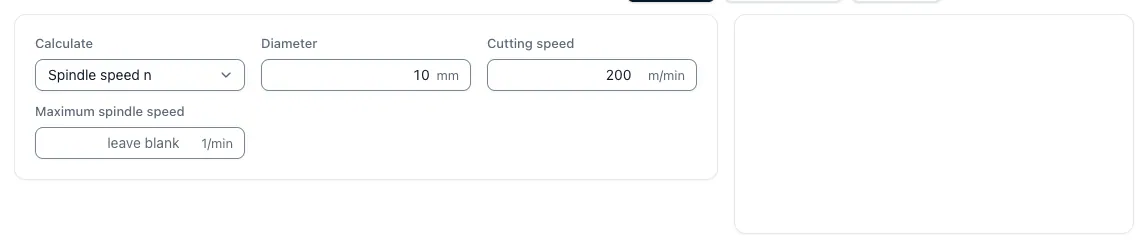
How to calculate vc in m/min
The cutting speed vc is the speed at which the cutting edge moves relative to the workpiece, measured by the effective diameter. It is the size for which tool manufacturers specify their recommendations because wear, temperature at the cutting edge and chipping depend on it.
For turning, use the workpiece diameter at the cutting edge in the vc formula. For milling or drilling, use the effective tool diameter. Enter spindle speed in rpm.
Formula and unit of cutting speed
The cutting speed is the circumference at the effective diameter times the speed. Because the diameter is expressed in millimetres and the cutting speed is expressed in metres per minute, the formula is the factor 1000.
In machining m/min is the usual unit. When grinding, it is usually calculated in m/s, i.e. divided by 60. Data sheets from the USA call Surface Feet per minute (SFM): 1 SFM corresponds to 0.3048 m/min, 1 m/min corresponds to 3.281 SFM.
vc = π × d × n 简 1000
Symbols and units
The same formulae use the speed, feed and cut data pages of this website and the app's tools.
Formula symbols and units of the cutting speed
| Formula symbol | Meaning | Unit |
|---|---|---|
| vc | Cutting speed at effective diameter | m/min |
| d | effective diameter: tool for milling and drilling, workpiece at the cutting edge when turning | mm |
| n | Speed of spindle or workpiece | 1/min |
| v | Circumference speed, for example when grinding; v = vc ÷ 60 | m/s |
| SFM | Surface Feet per minute; 1 SFM = 0,3048 m/min | ft/min |
| d_eff | Effect diameter on ball cutter when delivering a_p | mm |
| vf | Speed of the axle, not the cutting edge | mm/min |
Example calculation for milling and turning
A shaft cutter with 12 mm diameter runs at 4,000 rpm. The cutting speed is π × 12 × 4,000 rpm 1000 = 150.8 m/min, that is 2.5 m/s or about 495 SFM.
Conversely when turning: 180 m/min is intended for a 60 mm diameter shaft. The speed is 180 × 1000 γ (π × 60) = 955 1/min. If the same shaft is turned to 30 mm, the speed doubles at the same cutting speed to 1,910 1/min.
n = vc × 1000 γ (π × d)
Cutting speed during drilling and sawing
When drilling, the drill bit diameter at the cutting edges is important. A spiral drill with a diameter of 8.5 mm at 2,500 1/min cuts with π × 8.5 × 2,500 ÷ 1000 = 66.8 m/min. Towards the drill bit centre, the cutting speed drops to almost zero; the value therefore only applies externally.
The saw blade diameter is the circular saw: a sheet with 250 mm at 100 1/min reaches π × 250 × 100 ÷ 1000 = 78.5 m/min. The band saw does not convert because the belt speed is set directly in m/min. Cutting data and feed for sawing explains the page cutting data saws.
Circumference speed and cutting speed
When cutting, the cutting speed is the circumference speed at the effective diameter, only in m/min instead of in m/s: 150.8 m/min are 2.5 m/s. Formula, examples of grinding disc and pulley and the speed from a speed in m/s are calculated on the circumference speed side.
Guidance values for the cutting speed per material
The table gives starting values for coated carbide (HM), each line having a material with the areas from the material database of the cut data finder of the app. The HSS columns are the same ranges times 0.3, as the finder calculates them for high-speed steel. For the first test, the middle of the range is suitable; it is followed by service life, surface, noise and power consumption.
Cutting speed vc in m/min per material, process and cutting material
| Material | Milling HM | Milling HSS | Turn HM | Rotate HSS | Drilling HM | Drilling HSS |
|---|---|---|---|---|---|---|
| Aluminium EN AW-6082 | 300–800 | 90–240 | 400–1.000 | 120–300 | 150–350 | 45–105 |
| Structural steel S235JR | 150–250 | 45–75 | 180–300 | 54–90 | 80–130 | 24–39 |
| Structural steel S355J2 | 140–230 | 42–69 | 170–280 | 51–84 | 75–120 | 23–36 |
| Remuneration steel C45 | 120–200 | 36–60 | 150–260 | 45–78 | 70–120 | 21–36 |
| Remuneration steel 42CrMo4 | 100–160 | 30–48 | 120–220 | 36–66 | 60–100 | 18–30 |
| Stainless steel 1.4301 | 80–140 | 24–42 | 120–200 | 36–60 | 50–90 | 15–27 |
| Stainless steel 1.4404 | 70–130 | 21–39 | 110–180 | 33–54 | 45–80 | 14–24 |
| Grey cast iron EN-GJL-250 | 100–180 | 30–54 | 150–250 | 45–75 | 80–140 | 24–42 |
| Titanium Ti-6Al-4V | 40–80 | 12–24 | 50–90 | 15–27 | 25–50 | 8–15 |
| Brass CuZn39Pb3 | 200–400 | 60–120 | 250–500 | 75–150 | 100–250 | 30–75 |
| Hardened steel 45–55 HRC | 50–120 | 15–36 | 60–140 | 18–42 | 20–45 | 6–14 |
| Plastic POM-C | 300–600 | 90–180 | 300–600 | 90–180 | 100–300 | 30–90 |
| Plastic PEEK | 200–400 | 60–120 | 200–400 | 60–120 | 80–200 | 24–60 |
Start values for the precalculation, no cut data recommendation; mandatory is the indication of the tool manufacturer. The HSS values are the experience factor of the app, not a separate measurement series. Cutting materials in the cut data finder of the app: coated carbide with the values of the table and high-speed steel (HSS) with about 0.3 × vc with unchanged feed.
Which diameter is included in the invoice
When milling and drilling, it is the tool diameter, when turning the workpiece diameter at the cutting edge. This is smaller with each cut, therefore turning machines usually work at constant cutting speed (G96) and a speed limit, depending on the control, about G50 or LIMS. Without limitation, the speed of the plan turning would increase towards the middle.
With the ball cutter, only a small part of the ball cuts with low axial delivery. The effective diameter is then decisive; with the nominal diameter the actual cutting speed is significantly overestimated.
d_eff = 2 × √(ap × (d − ap))
Typical calculation errors
Most false results do not result from the formula, but from units and the inserted diameter.
- Forgotten factor 1000: With d in mm and vc in m/min the result is otherwise wrong by a factor 1000.
- Radius instead of diameter used: The speed is twice as high as intended.
- When turning, use the finished diameter instead of the diameter at the cutting edge, for example when roughing a large blank.
- With the ball cutter with the nominal diameter instead of the effective diameter expected.
- Transfer values for carbide to HSS tools without deduction.
- The speed limit of the machine is overlooked: If the spindle is limited, the effective cutting speed drops to vc = π × d × n_max ÷ 1000.
- SFM values entered from a data sheet without conversion as m/min.
Cutting speed and service life
The cutting speed increases the temperature at the cutting edge, and the service life decreases disproportionately. The Taylor equation describes this connection: cutting speed times service life high of a material- and cutting material-dependent exponent remains almost constant. A moderate increase in the cutting speed can therefore significantly reduce the service life.
Whether a higher cutting speed is worth it, the comparison of saved machine time and additional tool and change costs decides. The calculation path with example shows the page calculation of service life, the app calculates it in tool service life according to Taylor.
From the cutting speed to the processing time
The cutting speed determines the speed, the time is generated only by the feed. When milling, the feed speed is the product of speed, number of teeth and tooth feed, the main time of the processing path divided by the feed speed.
A higher cutting speed therefore only shortens the time if the tooth feed can be held. If you do not want to calculate the times step by step, under "Full automatic calculation from drawing and CAD" you will find the pro-flow, which creates a calculation draft from drawing and CAD model with the same formulas; you check every value and give free.
vf = n × z × fz t_h = L ו vf
Sources and classification
- Material database and cutting data finder of the CNC Calculator app, booth 28.10.2026
Starting areas of the cutting speed for coated carbide; the HSS columns count on the experience factor 0.3 of the app.
- DIN 6580:1985-10 Concepts of machining technology; Movements and geometry of the machining process
Concepts of cutting and feeding motion on which the formulae of this page are based.
Questions and answers
How do you calculate the cutting speed?
With vc = π × d × n ÷ 1000, where d is the effective diameter in mm and n is the speed in 1/min. A 12 mm diameter cutter at 4,000 1/min has a cutting speed of 150.8 m/min.
Is there a free calculator for the cutting speed?
Yes. The tool "speed and cutting speed" of the CNC calculator app calculates the cutting speed from diameter and speed and vice versa, free of charge in the browser. The cutting data finder of the app provides start values per material.
Which unit has the cutting speed?
In machining meters per minute (m/min). m/s is common when grinding, 1 m/s is equal to 60 m/min. American data sheets call SFM, 1 SFM is equal to 0.3048 m/min.
What is the difference between cutting speed and feed speed?
The cutting speed vc is the speed of the cutting edge in m/min. The feed speed vf is the speed at which the axis moves the tool through the workpiece, in mm/min, when milling vf = n × z × fz. A milling cutter can cut at 160 m/min and only advance around 1.2 m/min.
How to convert SFM into m/min?
SFM times 0,3048 equals m/min, m/min times 3,281 equals SFM. 500 SFM equals 152 m/min. The app calculates this under "SFM and m/min" in both directions.
Which cutting speed is used for steel and aluminium?
As starting values for coated carbide during milling: structural steel S235JR 150 to 250 m/min, remuneration steel C45 120 to 200 m/min, 42CrMo4 100 to 160 m/min, aluminium EN AW-6082 300 to 800 m/min. The manufacturer specification for tool, coating and intervention is binding.
What is the cutting speed for HSS tools?
The app calculates 0.3 × the carbide value for high speed steel. For C45, this results in 36 to 60 m/min instead of 120 to 200 m/min. The tool manufacturer's specification is binding.
How do you calculate the cutting speed when drilling?
With the drill diameter: vc = π × d × n ÷ 1000. A drill with 8.5 mm at 2,500 1/min cuts to the cutting corners at 66.8 m/min. The sectional data drilling shows how to determine the appropriate drill speed in reverse.
Why does a higher speed not automatically deliver shorter times?
The processing time depends on the feed speed vf = n × z × fz. A higher speed shortens the time only if the tooth feed can be held. Lifetime, stability, chip removal and machine power set the practical limit.