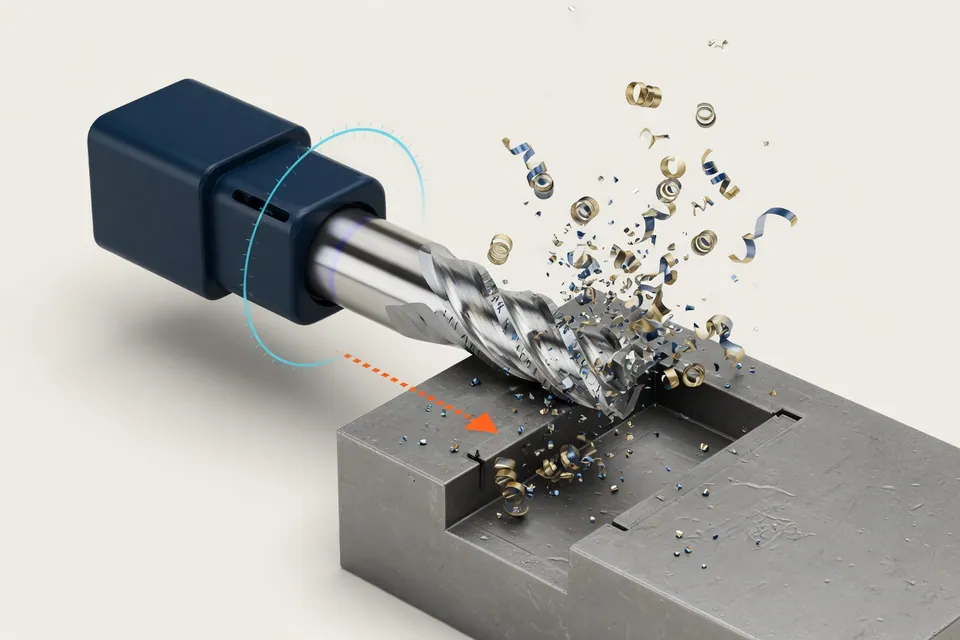
Tool diameter, number of teeth, cutting speed and tooth feed results in speed and feed speed; together with ae and ap, the time machining volume and the required cutting and drive power follow.
Formulas
n = (vc × 1000) ÷ (π × d)Speed
From cutting speed and tool diameter.
vf = n × z × fzFeed speed
Speed, number of teeth and tooth feed result in the web feed.
Q = (ae × ap × vf) ÷ 1000Volume of cutting time
The removed material per minute in cm³.
Pc = (Q × kc) ÷ 60 000Cutting power
The power output is determined by the efficiency.
Shaft cutter Ø 12 mm, four cutting edges, mild steel
vc 150 m/min, fz 0.06 mm, ae 8 mm, ap 3 mm, kc 1,700 N/mm², efficiency 85%.
- RPM n = 150 × 1000 (π × 12)3,979 1/min
- Feed rate vf = 3,979 × 4 × 0.06955 mm/min
- Volume of cutting time Q = 8 × 3 × 955 ÷ 100022.9 cm³/min
- Cutting performance Pc = 22.9 × 1,700 ÷ 60,0000,65 kW
- Drive power = 0,65 0,850,76 kW
ResultAround 3,980 rpm at 955 mm/min feed – performance-free.
The power here is not the limit. For ae = 8 mm and 12 mm tool the intervention is above half the diameter, so a spandick correction is not necessary.
Cutting speed during milling – table per material
Starting ranges of the cutting speed in m/min from the app's material database, one material per line, for coated solid carbide (HM) and for HSS, plus the Kienzle basic value kc1.1 for the performance calculation.
| Material | vc HM (m/min) | vc HSS (m/min) | kc1.1 (N/mm²) |
|---|---|---|---|
| Aluminium EN AW-6082 | 300–800 | 90–240 | 830 |
| Structural steel S235JR | 150–250 | 45–75 | 1.780 |
| Structural steel S355J2 | 140–230 | 42–69 | 1.990 |
| Remuneration steel C45 | 120–200 | 36–60 | 2.220 |
| Remuneration steel 42CrMo4 | 100–160 | 30–48 | 2.500 |
| Stainless steel 1.4301 | 80–140 | 24–42 | 2.350 |
| Stainless steel 1.4404 | 70–130 | 21–39 | 2.400 |
| Grey cast iron EN-GJL-250 | 100–180 | 30–54 | 1.160 |
| Titanium Ti-6Al-4V | 40–80 | 12–24 | 1.450 |
| Brass CuZn39Pb3 | 200–400 | 60–120 | 780 |
| Hardened steel 45–55 HRC | 50–120 | 15–36 | 3.600 |
| Plastic POM-C | 300–600 | 90–180 | 300 |
| Plastic PEEK | 200–400 | 60–120 | 350 |
kc1.1 applies to 1 mm chipping thickness; for thinner chips, kc increases. The cutting data recommendations of the tool manufacturer are binding. Cutting materials in the cut data finder of the app: coated carbide with the values of the table and high-speed steel (HSS) with about 0.3 × vc with unchanged feed.
Speed, feed, removal and unit costs
The speed per cutter diameter and material shows the table under Calculate milling speed, calculating the conversion between tooth feed and feed speed Propulsion. How much material is removed per minute and what it needs in terms of power is below Calculate material removal rate.
For the price, time and hourly rate lead to the calculation milling parts and to the unit costs. The fully automatic calculation from drawing and CAD (Pro) combines these steps from drawing and CAD model to a calculation design; each value remains comprehensible and you release the design.
Origin of the cut values
The values come from the table on this page and thus from the material database of the app; the manufacturer's specification remains binding.
Questions and answers
Is the cutting data calculator milling free?
Yes. The tool "Cutting data Milling" of the CNC Calculator app calculates speed, feed speed, material removal rate and performance free of charge in the browser and without account. Only after a free registration is stored.
How to calculate cutting data for milling?
In three steps: speed n = (vc × 1000) ÷ (π × d), feed speed vf = n × z × fz and material removal rate Q = (ae × ap × vf) ÷ 1000. From Q and the specific cutting force follows the required cutting power Pc = (Q × kc) ÷ 60,000.
Which values do you enter first?
Cutting speed and tooth feed come from the recommendation of the tool manufacturer for material group and cutting material. Tool diameter and teeth number are fixed, ae and ap result from the strategy – only then can speed, feed and power requirements be calculated.
What is the difference between ae and ap?
ae is the radial working action, i.e. the width of the procedure across to the feed direction. ap is the axial cutting depth. When roughing with high feed, a small ae is often combined with large ap, while classical groove milling is ae equal to the tool diameter.
When must the tooth feed be corrected?
As soon as ae is smaller than half the tool diameter, the middle spandick is under the tooth feed. Without spandick correction, the tool cuts too thin, rubs and slips faster. The tool manufacturer specifies the correction factors.
Is the spindle power sufficient for the calculated values?
The app shows cutting and drive power. In practice, however, other factors often limit first: stability of the clamping, the length of the outcrop, the chip removal, the ratters and the tool life.
Sources
- Material database and cutting data finder of the CNC Calculator app, as of 28.10.2026 – starting areas for coated carbide and kc1.1; HSS with the experience factor 0.3 of the app.