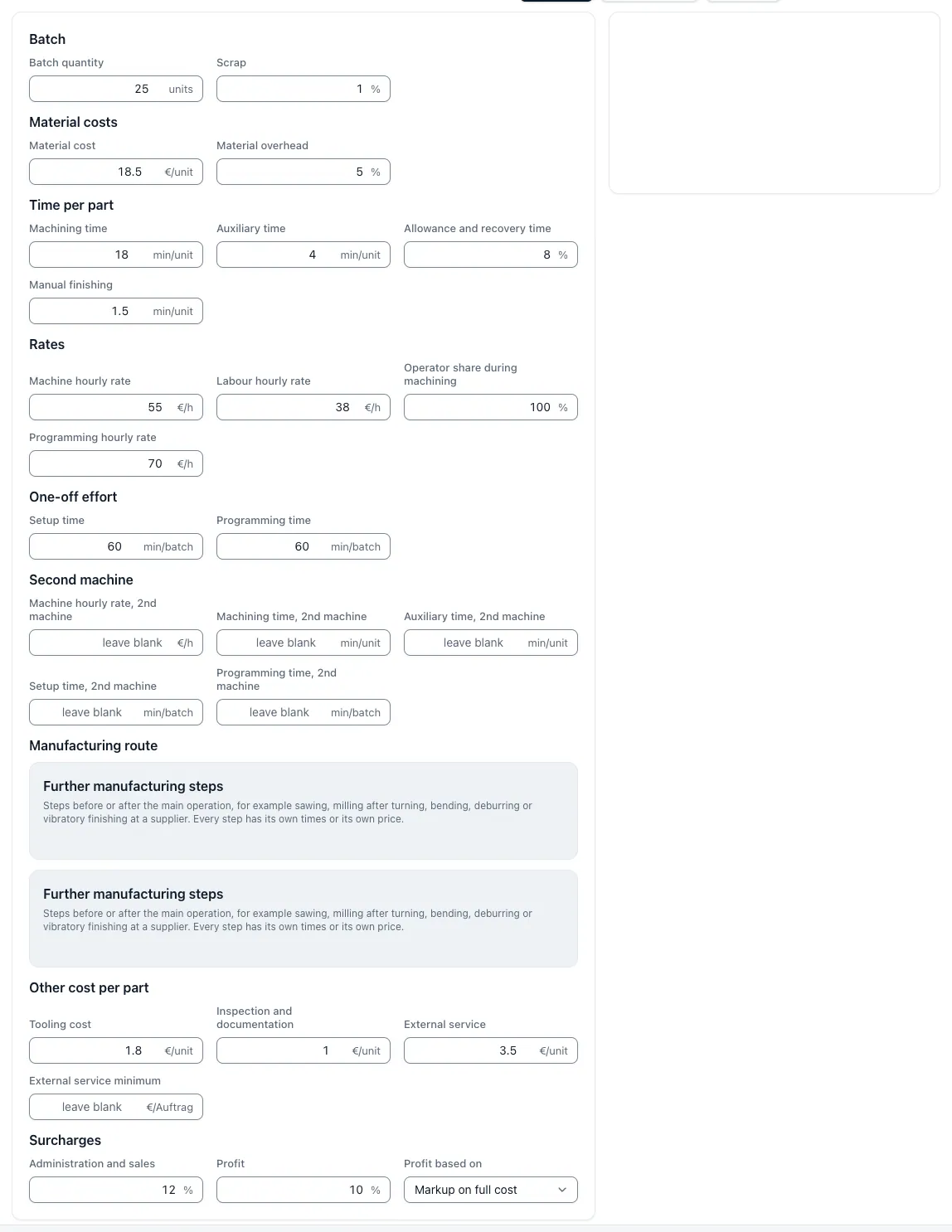
CNC unit costs are generated from material, machine time, the proportional set-up and programming costs, external services and overhead costs; with the target margin, the offer price per part becomes. The set-up percentage decreases with growing lot size, while material and processing time per part remain the same.
Formulas
t_Stück = t_h + t_n + t_r ÷ NTime of piece
Main time and incidental time per part plus the amount of set-up distributed over lot size N.
K_Masch = t_Stück ÷ 60 × StundensatzMachinery costs per part
The cycle time per part in minutes, evaluated with the set for machine and operator.
HK = Material + K_Masch + FremdleistungManufacturing costs per part
Individual costs directly attributed to the part.
SK = HK × (1 + GK)Cost per part
General costs as a supplement to the production costs.
Preis = SK ÷ (1 − Marge)Tender price per part
The margin is calculated from the selling price.
Unit cost of a turnpiece at 20 pieces
Assumptions: bar section Ø 40 × 62 mm from 58 mm finished length, 1 mm flatness and 3 mm flatness width, main time 3.2 min, side time 1.1 min, set up 90 min, assumed production hourly rate 72 €/h, steel with 7.85 g/cm³ at 2.40 €/kg, 18 % overhead costs and 12 % margin.
- Piece time = 3.2 + 1.1 + 90 ÷ 208.8 min
- Machinery costs = 8.8 ÷ 60 × 7210,56 €
- Material (strip)1,47 €
- Manufacturing costs12,03 €
- Cost of production × 1,1814,19 €
ResultOffer price at 12% margin: 16,13 € per piece
Example of calculation with round assumptions, no market prices. Foreign services such as hardening are added as own line, for small lots often with a minimum amount per order.
The same rotation part from 1 to 500 pieces
Only the set-up part changes with the quantity; main and incidental time and the material remain the same per piece.
| Size | 1 piece | 20 pieces | 100 pieces | 500 pieces |
|---|---|---|---|---|
| Set-up per piece | 90.0 min | 4.5 min | 0.9 min | 0.18 min |
| Time of piece | 94.3 min | 8.8 min | 5.2 min | 4.48 min |
| Machinery costs per unit | 113,16 € | 10,56 € | 6,24 € | 5,38 € |
| Material per piece | 1,47 € | 1,47 € | 1,47 € | 1,47 € |
| Production costs per unit | 114,63 € | 12,03 € | 7,71 € | 6,84 € |
| Cost of production with 18 % overhead | 135,26 € | 14,19 € | 9,10 € | 8,08 € |
| Price at 12 % margin | 153,71 € | 16,13 € | 10,34 € | 9,18 € |
Example of calculation with round assumptions. The unit cost calculator of the app calculates the same list using your rates.
One-off costs separately from the costs per part
The most important rule of the unit cost calculation is: What is generated once per order is divided by the lot size, which is generated per part, not. Setting up, programming, device and initial sample testing belong to the first group, material, main time and incidental time to the second. How the set-up time arises from individual steps and with which set it is evaluated, the page calculate cost of the waste shows.
In Pro, the app automatically creates the unit costs from drawing and STEP model as a calculation design with work plan and scale; each value shows its origin, and you release the design. Pro is unlocked on request. The page describes how this happens, fully automatic calculation from drawing and CAD.
Unit costs always apply to a quantity
A unit price without lot size is not comparable. Anyone who checks or delivers an offer, therefore, always mentions the quantity for which setups and programmings were distributed.
Questions and answers
How are CNC unit costs calculated?
Material, machine time, pro rata one-off costs for setups and programming as well as external services form the production costs. Overhead costs are added; the cost of production and the desired margin result in the calculation of the selling price per part.
How much does a CNC part cost?
This depends on material, processing time, lot size and your own sets; there is no general number. In the calculation example, the same rotating part costs 153,71 € and 100 pieces 10,34 € because the setup is distributed over more parts.
Why does the lot size change the unit price?
Contract fixes Costs such as setup, programming and initial sample testing are distributed over more parts for larger lots. Costs depending on material and time are the same for each part.
What is the difference between the premium and the margin?
A surcharge is added to a cost basis. The margin describes the profit share of the selling price. Therefore, the selling price here is divided by one minus margin rate.
Is this a CNC cost calculator for buyers?
He expects the values you enter. Purchasers will receive their own comparison value for an offer; market prices or prices of other providers do not include the app.