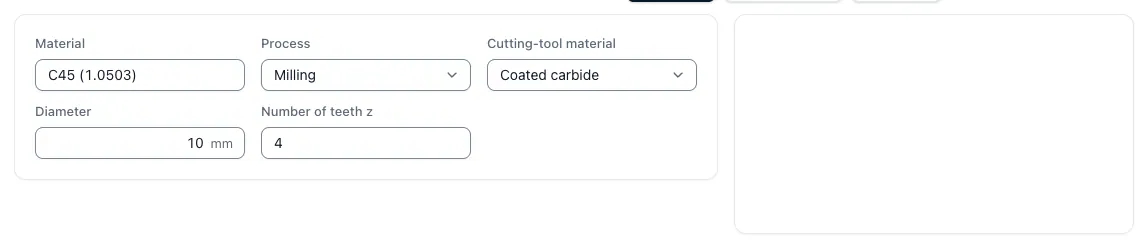
The cutting data calculator of the app provides the usual range for the cutting speed, the appropriate feed, the resulting speed and the specific cutting force for the performance calculation, according to the choice of material, processes and cutting material.
Formulas
n = (vc × 1000) ÷ (π × d)Speed from the selected vc
With the tool or workpiece diameter.
vf = n × z × fzFeeding during milling
When turning and drilling, vf = n × f.
Pc = (Q × kc) ÷ 60 000Connection to power
kc follows from the displayed basic value kc1.1 and the chip thickness h: kc = kc1.1 × h^−mc.
Calculate cutting values: from the choice of material to the speed
Remuneration steel C45, milling with a coated solid carbide shaft cutter Ø 10 mm with four blades. The material database mentions 120 to 200 m/min.
- Start area vc Milling, carbide120–200 m/min
- Start value = middle of range160 m/min
- n = 160 × 1000 ÷ (π × 10)5,093 1/min
- Same with HSS (0.3 × vc)1,528 1/min
- vf = 5,093 × 4 × 0.05 (assumed fz)1,019 mm/min
Resultn ≈ 5,093 rpm, vf ≈ 1,019 mm/min
The tooth feed of 0.05 mm is an acceptance for the bill; the finder of the app proposes it from his database, binding is the catalog of the tool manufacturer.
Starting values per material for coated carbide
Cutting speed in m/min for coated carbide tools and specific cutting force kc1.1, one material per line with the values from the Finder's material database. The table shows 13 of the 28 materials in the app.
| Material | Vc Milling (m/min) | vc Turning (m/min) | vc Drilling (m/min) | kc1.1 (N/mm²) |
|---|---|---|---|---|
| Aluminium EN AW-6082 | 300–800 | 400–1.000 | 150–350 | 830 |
| Structural steel S235JR | 150–250 | 180–300 | 80–130 | 1.780 |
| Structural steel S355J2 | 140–230 | 170–280 | 75–120 | 1.990 |
| Remuneration steel C45 | 120–200 | 150–260 | 70–120 | 2.220 |
| Remuneration steel 42CrMo4 | 100–160 | 120–220 | 60–100 | 2.500 |
| Stainless steel 1.4301 | 80–140 | 120–200 | 50–90 | 2.350 |
| Stainless steel 1.4404 | 70–130 | 110–180 | 45–80 | 2.400 |
| Grey cast iron EN-GJL-250 | 100–180 | 150–250 | 80–140 | 1.160 |
| Titanium Ti-6Al-4V | 40–80 | 50–90 | 25–50 | 1.450 |
| Brass CuZn39Pb3 | 200–400 | 250–500 | 100–250 | 780 |
| Hardened steel 45–55 HRC | 50–120 | 60–140 | 20–45 | 3.600 |
| Plastic POM-C | 300–600 | 300–600 | 100–300 | 300 |
| Plastic PEEK | 200–400 | 200–400 | 80–200 | 350 |
Cutting materials in the app's cut data finder: coated carbide with the table values and high-speed steel (HSS) at about 0.3 × vc with unchanged feed.
From the cut values to the calculation
Calculate the selected starting value Cutting data Milling and Cutting data Rotate Speed, feed, material removal rate and power further; formula and unit explains Cutting speed . The CNC calculation of a part arises from time and hourly rate.
The fully automatic calculation from drawing and CAD (Pro) selects starting values from the same material database and combines them with drawing and CAD model to form a calculation design; each value remains comprehensible and you release the design.
Replace start values no manufacturer specification
The values are areas of experience for pre-calculation and the first start-up test. The recommendation of the tool manufacturer for geometry, coating, cooling and operating conditions remains binding.
Questions and answers
Where do the values in the cut data finder come from?
From the app's material database: Areas of experience for coated carbide tools with stable clamping, per material with minimum, start and maximum value. Select HSS as cutting material, the finder reduces the cutting speed with the experience factor 0.3; the feed remains unchanged.
How to use an area correctly?
For the first test, take the middle of the range and follow it using the life, surface, noise and power consumption. For the calculation, the mean is the more resilient base than the best value.
Why are milling, turning and drilling so different?
Because the duration of the operation and the heat dissipation differ. When turning, the procedure is continuous, interrupted during milling, while drilling, the cutting is in the bore with poor chip removal – which is why the drilling values are lowest.
What does the specific cutting force mean?
kc indicates the force required per square millimeter chipping cross section. The finder shows the basic value kc1.1 for 1 mm chipping thickness and the increase value mc; for thinner chips kc increases according to kc = kc1.1 × h^−mc. It is the bridge from the removal power to the required drive power and varies greatly with the material.
Manufacturer computer or neutral cutting data computer?
Both have their place. The computer of a tool manufacturer knows geometry, coating and approvals of its own tool and provides the binding values for this. A neutral cutting data calculator such as the finder of the app provides tool-independent starting values per material for planning, precalculation and comparison of variants before the tool is established.
Does the finder replace a cut data manager?
No. It delivers start values. A calculation becomes loadable only with its own documented experience values per machine, tool and material charge.
Sources
- Material database and cutting data finder of the CNC Calculator app, as of 28.10.2026 – starting areas for coated carbide and kc1.1; HSS with the experience factor 0.3 of the app.