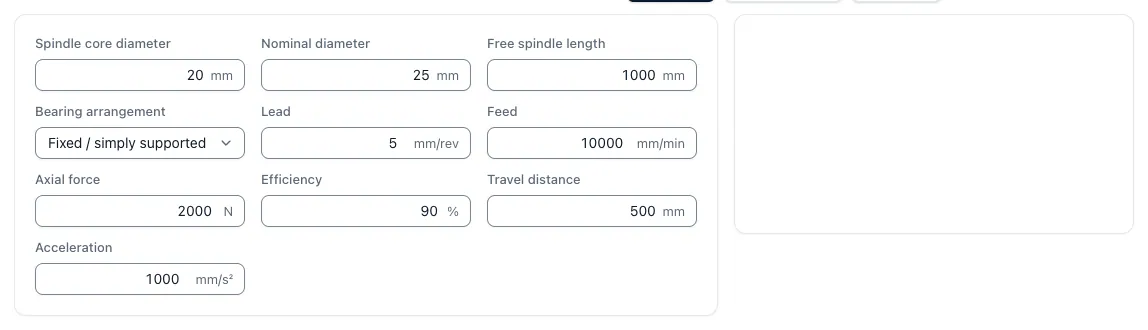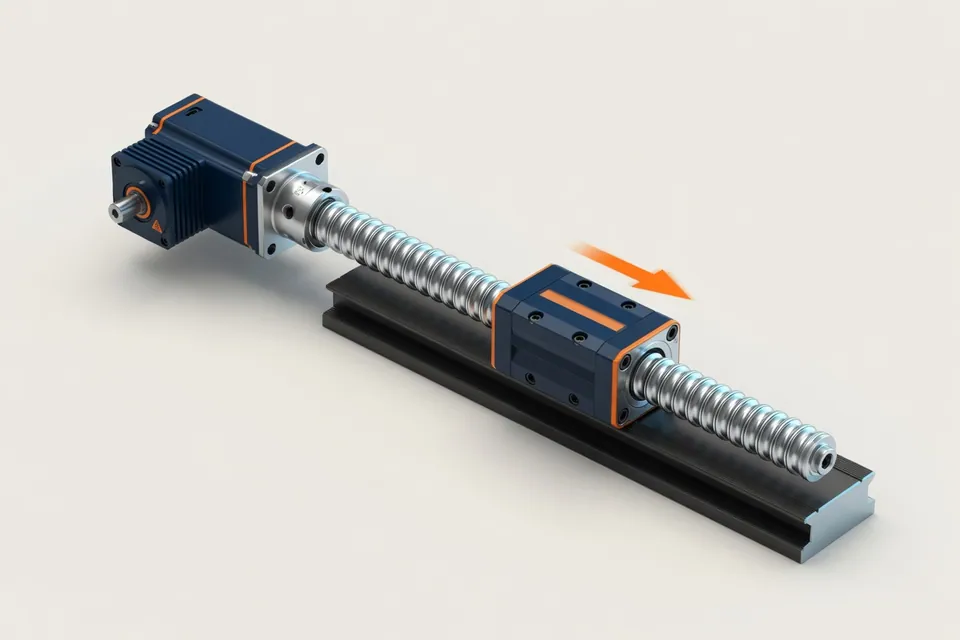
The speed of travel results from engine speed divided by translation times spindle ascent. The resolution follows from engine steps, micro steps and slope. In addition, the computer checks the critical bending speed of the spindle.
Formulas
v = n ÷ i × PDriving speed
Engine speed, transmission and spindle rise.
Schritte/mm = S × M × i ÷ PDissolution of the control
Engine steps, microsteps and transmission.
n_krit ≈ f × d_k ÷ L² × 10⁷Critical bending speed
f depends on the type of storage, d_k is the core diameter.
The axis limits what the process allows
A calculated feed speed is of no use if the axis does not drive it. The slope, limit speed and resolution decide with which cutting values are actually feasible.
Questions and answers
How do you calculate the travel speed?
Speed = engine speed ÷ Transmission × spindle ascent. At 3,000 rpm, gear ratio 1:1 and 10 mm incline, this is 30,000 mm/min, that is 30 m/min.
How to calculate steps per millimeter?
Steps per millimetre = motor steps × micro steps × translation ÷ incline. At 200 steps, 16 micro steps and 10 mm incline, 320 steps per millimetre are obtained, i.e. a computational resolution of around 3 μm.
What is the critical speed?
From it the spindle becomes in bending vibration. It depends on the core diameter, the free length in the square and the type of storage. Long, thin spindles reach their limit clearly before the nominal speed of the engine.
Big or small slope?
Large gradient brings speed, small gradient brings resolution and power. For machining machines, the slope is a compromise between rapid and feed force – the resolution usually delivers today's measuring system, not the spindle.
Is this also true for rack drives?
Meaningfully yes: instead of the slope, the circumference of the pinion occurs per revolution. The critical bending speed is eliminated, but gearing quality and inverted play limit the accuracy.