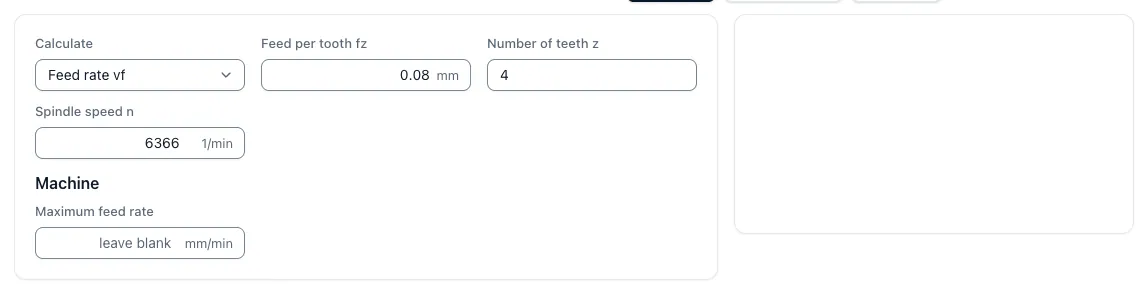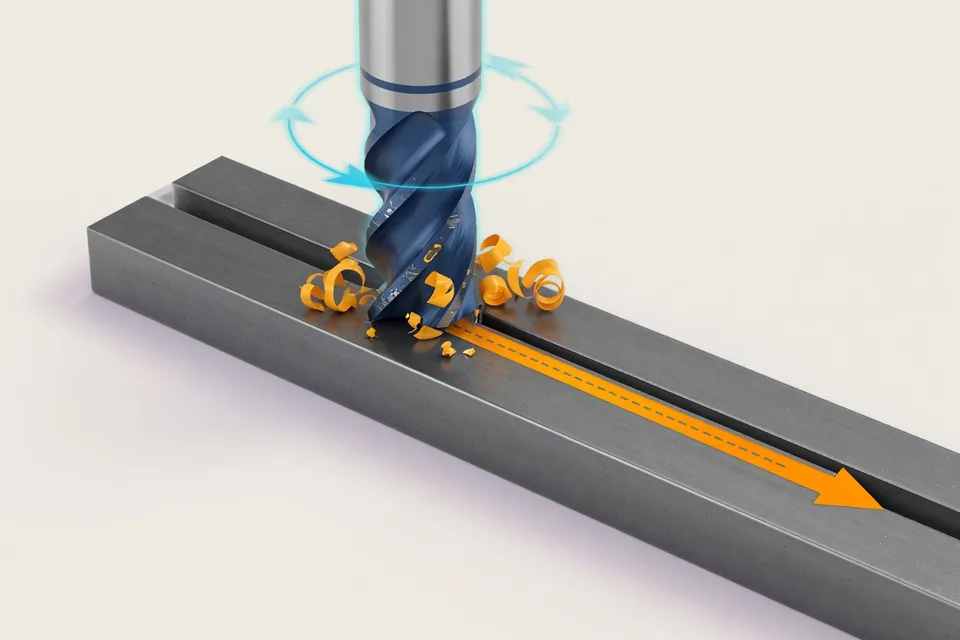
The feed speed is determined by vf = n × z × fz for milling, by vf = n × f for turning and drilling. A milling cutter with four teeth at 5,093 1/min and 0.06 mm tooth feed travels at 1,222 mm/min; the machining distance divided by vf gives the cutting time.
Formulas for feed and feed speed
vf = n × z × fzFeeding speed during milling
vf in mm/min, n in 1/min, z teeth number, fz tooth feed in mm.
f = z × fzFeed per revolution
The reference value for turning and drilling, there is vf = n × f. In the app it is called fn.
fz = vf ÷ (n × z)Tooth feed from feed speed
Check which tooth feed is behind a programmed F value.
t = L ÷ vfCutting time for a path
Machining path L divided in mm by the feed speed results in the main time in minutes.
Feeding speed when milling a groove
A solid carbide shaft cutter with a diameter of 10 mm and four cuttings is used in structural steel. 160 m/min and a tooth feed of 0.06 mm are used.
- RPM n = 160 × 1000 (π × 10)5,093 1/min
- Number of teeth z4
- Teeth feed0,06 mm
- vf = 5,093 × 4 × 0.061,222 mm/min
- Cutting time for 300 mm path15 s
Resultvf ÷ 1,222 mm/min
In case of small radial intervention, the actual spandick is smaller than fz; then the tooth feed is raised according to the manufacturer's specification, otherwise the cutting edge rubs.
Reference values for the tooth feed fz
Starting values for a coated VHM shaft cutter with a diameter of around 10 mm with stable clamping. Smaller tools need significantly smaller values.
| Material | fz Scraping (mm) | fz Arbitration (mm) | Note |
|---|---|---|---|
| Aluminium AlMgSi / AlCuMg | 0,08–0,18 | 0,05–0,10 | High protrusions possible, mind chipping room |
| Structural steel S235 / S355 | 0,05–0,10 | 0,03–0,06 | Too small feed leads to friction wear |
| Remuneration steel C45 / 42CrMo4 | 0,04–0,09 | 0,03–0,05 | Length limits the possible value |
| Stainless steel 1.4301 / 1.4404 | 0,04–0,08 | 0,03–0,05 | Constant intervention against cold solidification |
| Grey cast iron EN-GJL-250 | 0,06–0,12 | 0,04–0,08 | Short-ranged, good-natured in feed |
| Titanium Ti-6Al-4V | 0,03–0,07 | 0,02–0,05 | Discharge heat over the chip |
| Brass CuZn | 0,08–0,16 | 0,05–0,10 | Sharp cutting, high protrusions |
| POM / PA / PEEK | 0,08–0,20 | 0,05–0,12 | Melting risk with too small feed |
In case of radial intervention under half the tool diameter, a spandick correction is required according to the manufacturer's specification.
Feed, feed per revolution and feed speed
Three sizes describe the same process on three levels. The tooth feed fz is the way the tool moves on while cutting a single cutting edge. After a whole turn, all z cutting edges have been cut, the tool has moved on by f = z × fz. The feed speed vf = n × f is this path per minute, i.e. the speed of the axis.
Convert feed: mm/tooth, mm/U and mm/min
Catalogs indicate the tooth feed per cutting edge, lathes indicate the feed per revolution, the CNC program for milling the feed speed per minute. Conversion only requires speed and number of teeth; American data in inches are converted to 25,4.
Conversion of fz, f and vf with example
Example: n = 5,093 1/min, z = 4, fz = 0.06 mm. 1 inch = 25.4 mm.
| Wanted | Formula | Example |
|---|---|---|
| Feed per revolution f (mm) | f = z × fz | 4 × 0.06 = 0.24 mm |
| Feed speed vf (mm/min) | vf = n × f | 5,093 × 0.24 = 1,222 mm/min |
| Tooth feed fz (mm) | fz = vf ÷ (n × z) | 1,222 ÷ (5,093 × 4) = 0.06 mm |
| Feed speed in/min | vf ÷ 25,4 | 1.222 ω 25,4 = 48,1 in/min |
| Tooth feed in inches per tooth | fz 25.4 | 0.06 ÷ 25,4 = 0,0024 in |
The app calculates these conversions in the tool "Convert feed" in both directions.
Distinguishing cutting speed and feed speed
The cutting speed vc is the speed of cutting at the circumference of the tool, given in m/min. The feed speed vf is the speed at which the shaft pushes the tool through the workpiece, given in mm/min. In the example above, the milling machine cuts at 160 m/min, but only pushes at 1,222 mm/min, which is 1.222 m/min and thus well over a hundredth of the cutting speed.
vc determines the speed and thus wear and temperature at the cutting edge over the diameter; the calculation is on the page Calculate the speed. vf determines the time by the wayside.
Calculate feed while turning
When turning, the feed per revolution f is the reference size. A shaft with a diameter of 40 mm at 200 m/min turns at 1,592 1/min; with f = 0.25 mm the feed speed is 398 mm/min, thus a longitudinal section over 120 mm takes about 0.3 minutes.
When turning the plane at constant cutting speed (G96), the speed increases to the middle, and with it the feed speed at the same f. With the same 200 m/min and an assumed speed limit of 4,000 1/min, the spindle reaches the limit at Ø 15.9 mm; from there vf remains at 4,000 × 0.25 = 1,000 mm/min, while the cutting speed continues to decrease to the middle.
The theoretical roughness follows from feed and corner radius; for Rz 6.3 μm with a corner radius of 0.8 mm, a feed of not more than 0.2 mm is obtained. Starting values per material are on the side Cutting data Turning.
vf = n × f_max = √(8 × r × Rz)
Drilling and threading
Feeding during drilling and threading
When drilling and threading, not the tooth feed is expected, but the feed per turn.
Feeding during drilling and threading
The feed rate is vf = n × f, the drilling time is due to drilling depth, tip length and start-up divided by vf. When threaded drilling, the feed rate is necessarily equal to the slope: For M8 with 1.25 mm incline at 600 1/min, it is 750 mm/min.
vf = n × f Threading: vf = n × P
Feed at the thread: incline per revolution
For each thread, the feed per revolution is bound to the slope P, because the tool has to move exactly one gear per revolution. A threaded drill M8 with 1.25 mm slope at assumed 10 m/min turns at 398 1/min; the feed speed is 497 mm/min. If the programmed feed deviates from it, the drill cuts the thread or breaks; thread cycles and balancing chucks only catch small deviations.
When thread turning, f = P applies, but the feed is distributed to several cuts with decreasing delivery. When thread milling, it is different: The milling machine drives a screw web, and the web feed at the tool center has to be corrected compared to the feed at the cutting edge.
Thread: f = P vf = n × P
Check feed speed on the machine
The programmed F value is a setpoint value. What the axis actually drives shows is the actual value display of the control, and the feed override on the control panel also changes it in percent. If the override is not 100 percent, the runtime deviates accordingly from the calculation.
For a control without display, a known path is measured with the stopwatch: If the axis needs exactly 6 seconds for 100 mm, it drives 100 ÷ 6 × 60 = 1,000 mm/min. It is measured on a long straight track, because in short segments, corners and narrow radii, the control slows down over the acceleration limits and does not reach the programmed value. Therefore, the real runtime of a program with many short sets is longer than the distance divided by F; the page G-code runtime calculate shows how the target time of a program arises.
vf = path ◄ time × 60 (way in mm, time in s)
From feed to cycle time per part
The main time is generated from feed speed and tool path; non-cutting times, tool changes, testing and setups are added separately, as shown in the page CNC machining time . For milling parts, the path continues to Calculation Milling parts.
The Fully automatic calculation from drawing and CAD (Pro) combines speed, feed and paths from drawing and CAD model to a calculation design; each value remains comprehensible and you release the design.
Starting values for the tooth feed
The answers count on the sample values of this page; starting values for the tooth feed come from the tool manufacturer.
Questions and answers
What is the formula for the feed speed?
For milling, vf = n × z × fz. For turning and drilling, vf = n × f. The feed rate vf is in mm/min, n is the speed in rpm, z is the number of teeth, fz is feed per tooth and f is feed per revolution in mm. 5,093 rpm, 4 teeth and 0.06 mm give 1,222 mm/min.
What does vf mean?
vf is the feed speed, i.e. the speed at which the machine axis moves the tool or workpiece, in mm/min. In the CNC program, it stands as an F value when feed per minute is active.
How do you calculate the tooth feed?
Use fz = vf ÷ (n × z) to work back from a known feed rate. A cutter with 4 teeth at 5,093 rpm and 1,222 mm/min has a feed per tooth of 1,222 ÷ (5,093 × 4) = 0.06 mm. For new conditions, use the tool manufacturer’s recommended fz.
How do you calculate the feed speed during milling?
The feed speed is vf = n × z × fz. N is the speed in 1/min, z the number of teeth of the tool and fz the tooth feed in millimetres. Example: 3,980 1/min, 4 cuttings and 0.06 mm tooth feed result in 955 mm/min.
How to calculate the feed when turning in mm/min?
With vf = n × f from the speed and the advance per revolution. A shaft with 40 mm at 200 m/min rotates at 1,592 1/min; with 0.25 mm per revolution, this is 398 mm/min. When smoothing, the required square depth limits the advance over Rz ≈ f² ÷ (8 × r).
How do you calculate the feed while drilling?
Also above the feed per revolution: vf = n × f, where f applies to the whole drill, not per cutting edge. When threaded drilling, the feed per revolution is equal to the slope, i.e. vf = n × P.
How do you calculate the feed on the thread?
The feed per revolution is the slope: f = P and vf = n × P. A threaded drill M8 × 1.25 at 398 1/min needs 497 mm/min. When threaded milling, the web feed is converted to the tool center point.
How do you measure the feed speed?
The easiest way to control the current value of the control is through a long straight movement. A known path is measured with the stopwatch: 100 mm in 6 seconds corresponds to 1,000 mm/min. On short segments and corners, the actual value is below the programmed F value due to acceleration.
What unit has the feed?
The tooth feed fz and the feed per revolution f are specified in mm, the feed speed vf in mm/min. The command used by the CNC program to select the feed type depends on the control: on milling machines and many G94 controllers for feed per minute and G95 for feed per revolution, on many lathes G98 and G99, where G94 calls up a plan turning cycle. The programming instructions of its own controller are decisive.
What is the difference between tooth feed fz and feed per turn f?
fz is the feed per edge and revolution, f the feed per revolution of the whole tool; catalogs and the app write it also fn, older tables fu. f = z × fz applies. When turning and drilling is usually calculated f, when milling with fz.
Why is the tooth feed corrected for small surgery?
For small radial intervention (ae smaller than half the tool diameter), the middle spandick is smaller than the tooth feed. Without correction, the tool cuts too thinly, rubs and covers faster. Manufacturers specify factors for fixing the spandick.
What kind of tooth feed is typical of steel?
Typical starting values in steel are about 0.05 to 0.10 mm per tooth for a coated VHM shaft cutter with a diameter of 10 mm. The decisive factors are tool geometry, the length of the collar, the stability of the clamping and the manufacturer's specifications.
How do you get from feed to processing time?
The main time results from the processing path ÷ feed speed. The tool feed speed of the app shows this value for a entered path directly. For the cycle time per part, rapid paths, tool changes, measuring, clamping and the set-up time distributed to the lot size are added.
Sources
- DIN 6580:1985-10 Terms of machining; Movements and geometry of cutting process – terms of cutting and feeding motion.
- Tools Feed speed and feed convert the CNC Calculator app – Calculate the same formulas; the fz reference values correspond to the app's initial values for material groups.