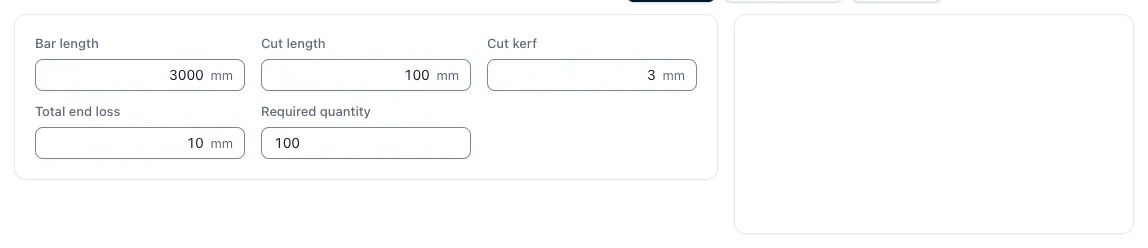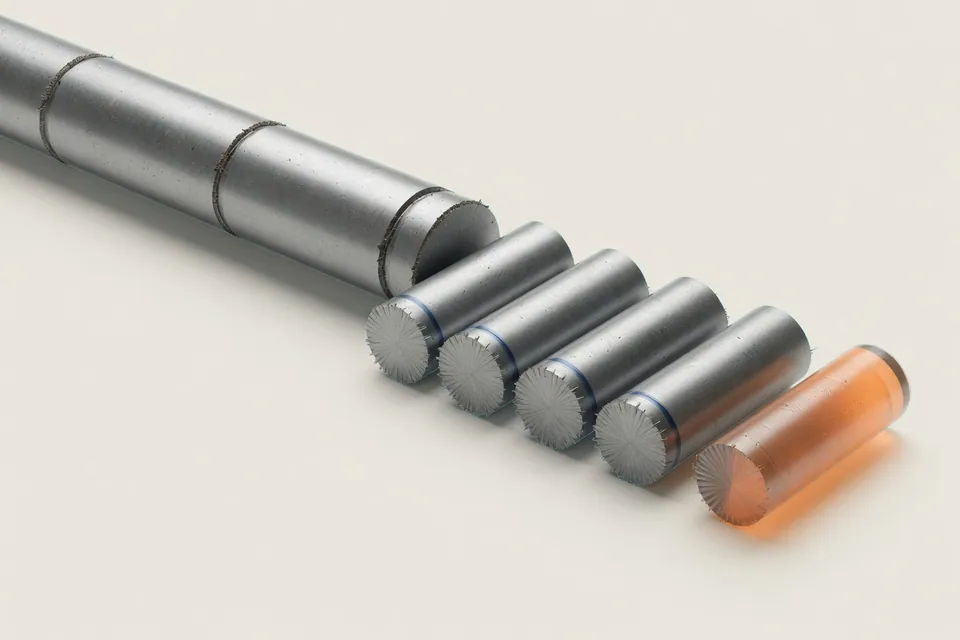
The number of parts per rod is obtained from the length of the bars minus the rest of the clamping and cutting sections, divided by the length of the parts plus the width of the detachment. This results in material utilization, material costs per part and the number of bars required for the batch size.
Formulas
L_nutzbar = L_Stange − Spannrest − AnschnittUsable length
What can actually be processed in the bar loader.
Teilung = Teilelänge + AbstechbreiteDivision per component
The feed path of the bar each manufactured part.
n = abgerundet(L_nutzbar ÷ Teilung)Parts per rod
It only counts what fits in completely.
Materialkosten je Teil = Stangenpreis ÷ nMaterial costs
The blend is thus automatically included.
Casting part 48 mm from Ø 60 round steel, 3 m rod
250 mm clamping residue, 10 mm cutting, 4 mm cutting width, bar weight 66,6 kg, material price 2,40 €/kg.
- Usable length = 3,000–250–102,740 mm
- Division = 48 + 452 mm
- Parts per rod = rounded (2,740 ÷ 52)52 pc.
- Material utilization = 52 × 48 ÷ 3,00083,2 %
- Price of bars = 66,6 × 2,40159,84 €
- Material costs per part = 159.84 ÷ 523,07 €
Result52 parts per rod at 83 percent material utilization – 3.07 € material per turnpiece.
Calculated with the precast weight, it would be only around €2.56 per part. The difference of €0.51 is pure cut and otherwise missing in every calculation.
Dissection is not a secondary issue
For short turning parts, the cutting width decides noticeably on the material costs. Those who expect the finished part weight instead of the rod division systematically calculate the material too low.
Questions and answers
How many pieces do you get from a pole?
The usable length is rod length minus clamping rest minus initial section. The number is determined by the division – finished part length plus de-cut width and plan dimensions. A 3,000 mm bar with 250 mm clamping rest, 10 mm cutting, 48 mm part length and 4 mm cutting width become 52 parts.
What's the cut?
Deviation width per part, plan dimensions, the initial section of the bar and the no longer usable clamping residue in the bar loader. For short parts, the deviation width is the largest item – at 48 mm part length, a 4 mm wide sting chisel already costs around 8 percent of the material.
How to lower the cut?
Narrower cutting width, shorter clamping rest through suitable guidance, longer bars as far as the loader allows, and – most effectively – choose the finished part length in the design in such a way that it fits the division. Also the proceeds from varietal chips and residual pieces are considered.
Why does the Stankenausverwendung belong in the calculation?
Because the material costs per part are divided from the price of the rods by the actually profitable parts – not from the precast weight. Those who expect the precast weight to be the material costs clearly underestimate the material costs for short rotary parts.
How to deal with residual quantities?
The last bar of an order is rarely used fully. Whether the rest is attributed to the order as a cost or as a stock is an operational decision – it should be made uniformly and documented in the calculation.