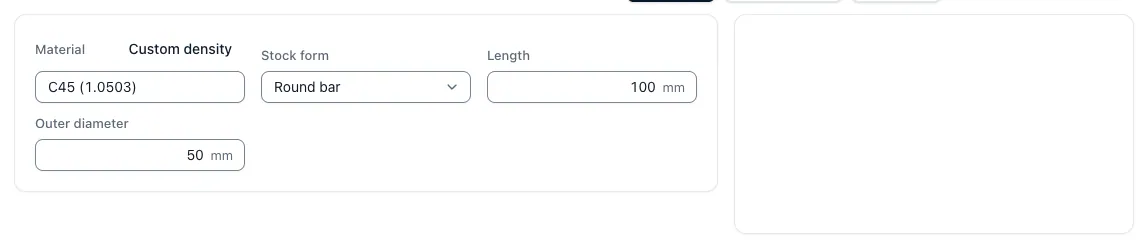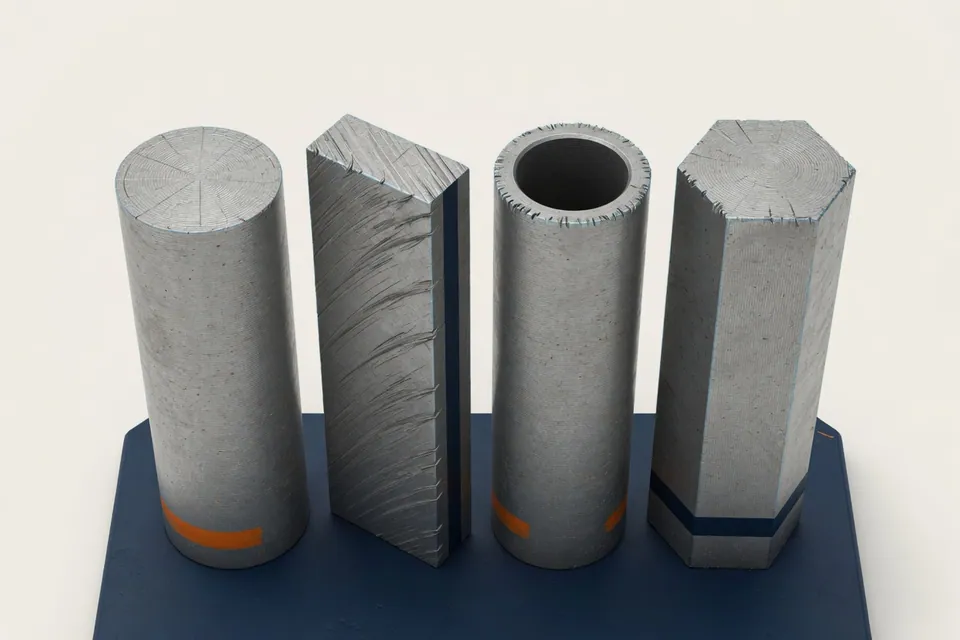
The stock weight is determined by volume × density. Choose stock shape, dimensions, addition and material – the calculator delivers weight, volume, material costs per piece, material utilization and the resulting chip quantity.
Formulas
m = V × ρBasic formula
Volume in cm³ multiplied by density in g/cm³ gives the mass in grams.
V = (π ÷ 4) × d² × LRound rod
Diameter and length in mm give the volume in mm³ – divided by 1000 cm³.
V = (π ÷ 4) × (D² − d²) × LTube
External and internal diameters determine the ring surface of the pipe cross section.
Materialkosten = m × Preis je kgCost of materials per unit
The basis is the stock including addition, not the finished part weight.
Density of common machining materials
Calculation values for the precalculation. The indication of the semi-finished product supplier is decisive for materials with delivery state tolerances.
| Material | Density (g/cm³) | Typical semi-finished product |
|---|---|---|
| Unalloyed steel / alloyed | 7,85 | Round, square and flat steel |
| Stainless steel 1.4301 / 1.4404 | 7,90 | Round rod, sheet metal |
| Aluminium AlMgSi / AlCuMg | 2,70 | Round rod, plate, extruding profile |
| Brass CuZn | 8,45 | Round bar, hexagonal |
| Copper | 8,90 | Round rod, plate |
| Grey cast iron EN-GJL-250 | 7,20 | Cast blank |
| Titanium Ti-6Al-4V | 4,43 | Round rod, plate |
| POM | 1,41 | Round rod, plate |
| PA 6 | 1,14 | Round rod, plate |
| PEEK | 1,32 | Round rod |
Weight and material costs are only part of the unit costs. Setup, processing time, tool consumption and overhead costs are added.
Material costs are included in the calculation, not in a lump sum
The stock shape, addition, material price and material utilisation decide the price noticeably on turning parts. Separately shown, it remains understandable why an offer looks the way it looks.
Questions and answers
How do you calculate the weight of a stock?
The weight is calculated from volume × density. For a round bar, m = (π ÷ 4) × d² × L × ρ. For d = 60 mm, L = 126 mm and steel with 7.85 g/cm³, this results in approximately 2.80 kg. The calculator also takes into account the addition for saw cut and tensile length.
Which density applies to which material?
Usual calculations are 7.85 g/cm³ for steel, 7.9 for stainless steel 1.4301, 2.70 for aluminium, 8.45 for brass, 8.9 for copper, 7.2 for grey cast iron, 4.43 for titanium Ti-6Al-4V, 1.41 for POM and 1.14 for PA 6.
Why is the stock weight important for the calculation?
Material costs are often the second-largest cost block after the machine time for turning parts. They result from raw material weight × material price per kilogram, not from the finished part weight. In addition, the difference shows how much material has to be machined.
How much to add?
A few millimetres are common for saw cutting and flat surfaces as well as sufficient clamping length. In the case of rod material in the bar loader, residual length and cutting per bar are added. These parts belong in the material calculation, not in the processing time.
Does the scrap value of the chips count?
With a high proportion of machining and expensive materials, the proceeds from pure chipping can be calculated. It should be kept as its own position, so that material costs and revenues remain comprehensible.