Only comparable variants are compared
Part, revision, delivery quantity and quality requirements must be the same for all variants. Each machine receives its own set-up and piece times as well as a consistently defined cost rate. Different programming or device costs are added separately if they are not yet included in the time frame.
The computer only uses the specified candidates. It does not use an external database with guaranteed machine services or prices.
Test minimum technical requirements first
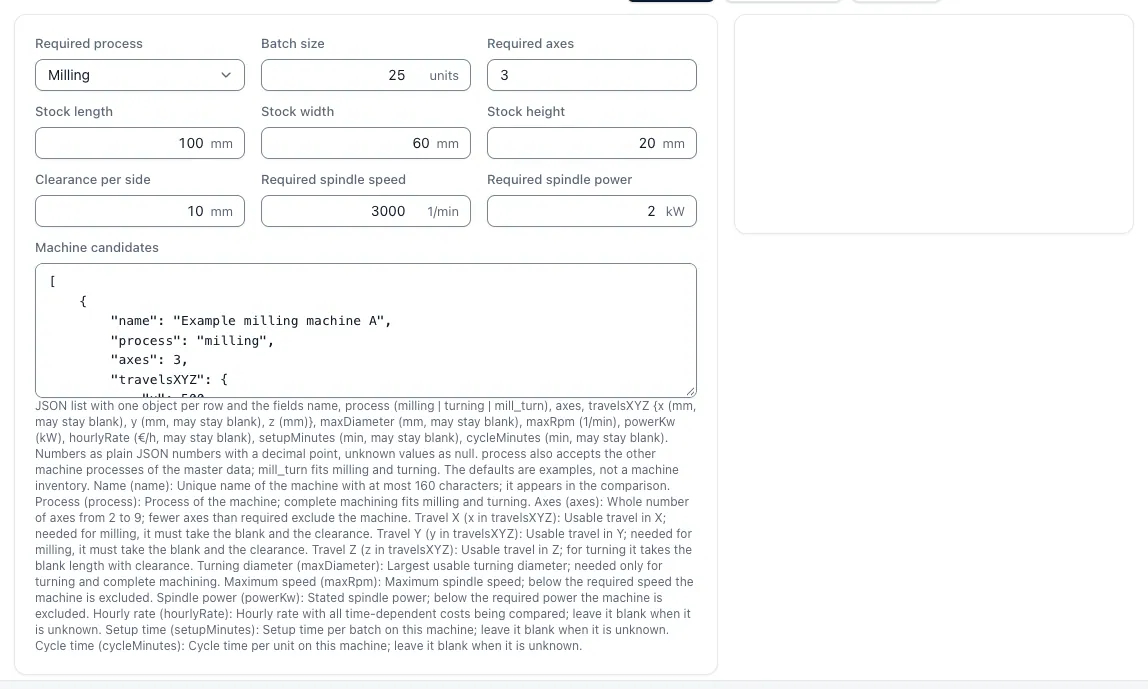
The specified procedures, number of axes, travel distances or rotation diameter, speed and power are compared to the requirements. The required clearance is taken into account. This does not follow a complete collision, clamping or accuracy test.
A technically suitably entered candidate without complete times or hourly rate remains open. It is not placed in the first place as a free alternative.
Sample calculation with two lot sizes
Machine A requires 40 minutes of setup and six minutes of each part at 75 €/h. Machine B takes 70 minutes of setup and four minutes of each part at 100 €/h. In 50 parts the times cost 425 € to A and 450 € to B.
For 200 parts, €1,550 is obtained on A and €1,450 on B. The higher cost rate of B is then offset by its shorter piece time. The figures are freely chosen comparison values; materials, tools and programming are only included if they were expressly taken into account in the respective approach.
K_Los = (t_Rüst + N × t_Stück) × hourly rate < 60
Clear open requirements before a decision
Machine occupancy, suitable tools, released voltage, operator qualification and promised dates are not checked by the cost comparison. Furthermore, the fact that a dimension fits into the travel path does not prove that each area is accessible.
If a candidate remains unevaluated due to missing data, the result is only "the most favorable fully evaluable variant". No ranking can be derived from this over the open alternative.
Sources and classification
- REFA: set-up time
Delimitation of one-off order preparation. The calculation examples and cost rates of this page are own illustrative assumptions.
- Knight / Boothroyd: Fundamentals of Metal Machining and Machine Tools
Study book principles for the economics of machining processes, especially Economics of Metal-Cutting Operations.
Questions and answers
Why can a machine with a higher hourly rate be cheaper?
Because less set-up or cycle time per part can be needed. The entire relevant costs for the same quantity and delivery are decisive.
Does the comparison automatically plan the production order?
No. The computer evaluates the specified requirements and time costs. Availability, scheduling and technical approval remain separate tasks.