Machinery hourly rate, labour cost rate and manufacturing hourly rate
If you ask for the CNC hourly rate, you usually mean the amount that an hour at the milling or lathe is valued on offer. This rate consists of building blocks that should be determined separately. The machine hourly rate distributes depreciation, calculational interest, space, energy and maintenance on the productive machine hours and does not contain any personnel. The wage rate indicates what costs a productive hour of the operator. The manufacturing hourly rate connects both.
The separation has a practical reason: the machine and the operator are not always bound for the same length of time. While the machine is machined, the operator can support a second machine; when the machine is set up, the machine is fully operational. A single flat rate does not reflect these differences. The machine hourly rate calculator of this website explains how the pure machine hourly rate is created.
Production hourly rate = machine hourly rate + wage cost rate × operator's share
Wage cost rate: from gross wage to productive hour
The gross hourly wage is only the initial value. Special payments such as holiday and Christmas money and the employer's shares increase the costs per hour paid. At the same time, not every hour paid is booked on orders: holidays, holidays, sickness and training reduce the presence, meetings, paths and clearing up the predictable proportion of it.
The app's wage rate calculator shows exactly these steps. It calculates the personnel costs of a year from wages, special payments, non-wage costs and hours of the week and divides them through the productive hours. The result is the cost rate that belongs to the manufacturing hourly rate. Overhead costs and profits are added to the calculation at exactly one point; who strikes them at the wage rate and later again in the offer, it calculates twice.
Lohnkostensatz = Personalkosten pro Jahr ÷ (Anwesenheitsstunden × verrechenbarer Anteil)
Operator part of multi-machine operation
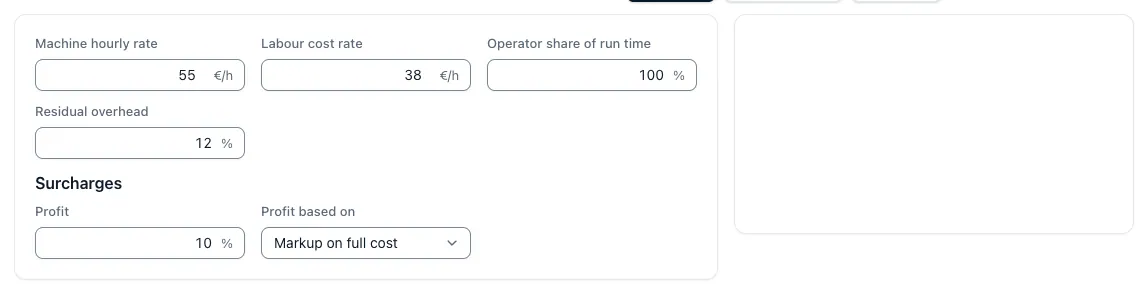
If a person operates two machines, each machine only pays the part of the salary it actually binds. The app asks the operator's share of the running time: 100% for one person per machine, about 50% for two machines per person and significantly less if a tool magazine or pallet changer lets the machine work alone for a long time. You can estimate your own value from a workflow diagram or a multi-moment recording on the machine.
The result is a table with the rate of 100, 75, 50, 33.3 and 25% operator share. Sales and work preparation see how much the organization of operation changes the price of a machine hour without any change in the machine itself.
Production hourly rate by operator's share
Example with round assumptions: 50 €/h machine hourly rate, 40 €/h wage cost rate, 10 % residual overhead costs and 10 % profit surcharge.
| Operator's share of the runtime | Production hourly rate | Offsetting rate |
|---|---|---|
| 100 % | 90,00 €/h | 108,90 €/h |
| 75 % | 80,00 €/h | 96,80 €/h |
| 50 % | 70,00 €/h | 84,70 €/h |
| 33,3 % | 63,33 €/h | 76,63 €/h |
| 25 % | 60,00 €/h | 72,60 €/h |
Production hourly rate = machine hourly rate + wage cost rate × operator share; settlement rate = production hourly rate × 1,1 × 1,1. For setups and ancillary time the full wage cost rate applies.
Separate maturity and set-up rates
The operator is fully bound during setup, insertion and measurement, and the machine is for the order during this time. The app therefore displays, in addition to the production hourly rate for the runtime, a separate set for setup and ancillary time, which adds machine hourly rate and full wage rate. The unit cost calculator uses the same logic: the main time is evaluated with machine and proportional wage, the secondary time with machine and full wage.
If the machine is equipped outside the machine, for example with a pre-setting device or on pallets, the machine is only partially occupied.
Set for set-up and side-time = machine hourly rate + wage cost rate
From the cost rate to the settlement rate
Machine and labour cost rates cover the costs at the workplace. Administration, distribution and other costs that are not assigned to any workplace are added as residual overhead costs, after which the profit. Only this offset rate is the amount you charge for a machine hour. The profit is calculated either as an extra charge on the cost or as a margin from the selling price; with the same percentage, the margin results in the higher price.
Example of calculation with round assumptions, no market values: At 50 €/h machine hourly rate and 40 €/h wage cost rate, the production hourly rate is 90 €/h at full operation, at two machines per operator (50%) 70 €/h. With 10 % residual overhead costs and 10 % profit surcharge, this will be 108,90 €/h and 84,70 €/h respectively. Those who use administration and sales in the unit cost calculator as a supplement will continue to expect the cost rates there, not the settlement rate.
Calculation rate = production hourly rate × (1 + residual overhead costs) × (1 + profit)
Hourly rate for CNC milling
There is no general hourly rate for milling or turning. A 5-axis milling machine and a simple automatic lathe differ in replacement value, space requirements and energy, and two operations with the same machine differ in shift model and load. Therefore, calculate the rate per machine or group of machines and check with the machine utilization calculator, which capacity actually remains according to shifts and technical availability.
For purchasers, this explains why offers for the same part can vary widely: In addition to the processing time, the hours on which a company distributes its machine costs and the proportion of operators that it expects to use per machine differ.
Calculation example using the assumptions of the machine hourly rate page, no market values: 33.62 € per hour for the machine and 38 € per hour for the operator for one person per machine 71.62 € per hour.
If machine and hourly rates are maintained in the master data, the fully automatic calculation in Pro calculates each operation with the set of the planned machine. Pro is available and will be activated on request; the price is mentioned on request.
Questions and answers
What is the difference between machine hourly rate and production hourly rate?
The machine hourly rate contains only the cost of the machine. The production hourly rate adds the operator's wage cost rate, weighted by the proportion of the runtime in which it is bound to this machine.
How do I calculate the hourly rate for multi-machine operation?
They only set the labour cost rate at 50% with the proportion at which the machine binds the operator. For two machines equally supervised, the full wage cost rate continues to apply for setups and incidentals.
Do overheads and profits belong to the hourly rate?
Only if the rate is intended to serve as a set-off in the offer and the surcharges are not elsewhere in the calculation. In the unit cost calculator, administration, distribution and profit are allocated separately, where the cost rates are expected.
How much does one hour of CNC milling cost?
There is no general amount. The hour consists of the machine hourly rate and the operator's share, in the calculation example 33.62 € + 38.00 € = 71.62 € per hour. Offers for the same part differ, because companies distribute their machine costs over different numbers of productive hours, machines are differently expensive and cover overhead costs and profit differently.
Does the app call typical hourly rates for CNC milling?
No. The input fields have starting values so that the invoice shows a result immediately; they are not market values. The rate will only be resilient with the costs and hours of your operation.
Can I save the calculation?
The calculation is done without an account. To save, create a free account. In addition, the result can be copied as a link, downloaded as a Word file or printed.