Provision costs as one-off costs per contract
The set-up costs are the costs that arise once per order, because a machine is set up for this order and then released again. They result from the set-up time and the set-up rate, i.e. the costs of machine and funnel per hour set-up.
Equipment includes everything that a machine prepares for an order and then releases it again: load program, mount clamping agents, set zero points, measure tools, manufacture and release the first part, equip and clean. This effort is incurred once per order, whether five or five hundred parts run afterwards. Equipment costs are therefore not unit costs; only the lot size makes them an amount per part.
The following rule follows for offers: A unit price is always valid for a certain quantity. If retrieved less than calculated, part of the set-up costs are missing.
The offer shows set-up costs in two ways: included in the unit price of the quantity offered or as its own one-off position next to the unit price. The second form makes partial calls and reorders easier to evaluate, because the customer sees which amount is incurred per order. The offer calculation of the app performs set-up and programming time per position as one-off costs.
Costs per unit = set-up time ÷ 60 × set-up ÷ Lot size
Set-up time from individual steps
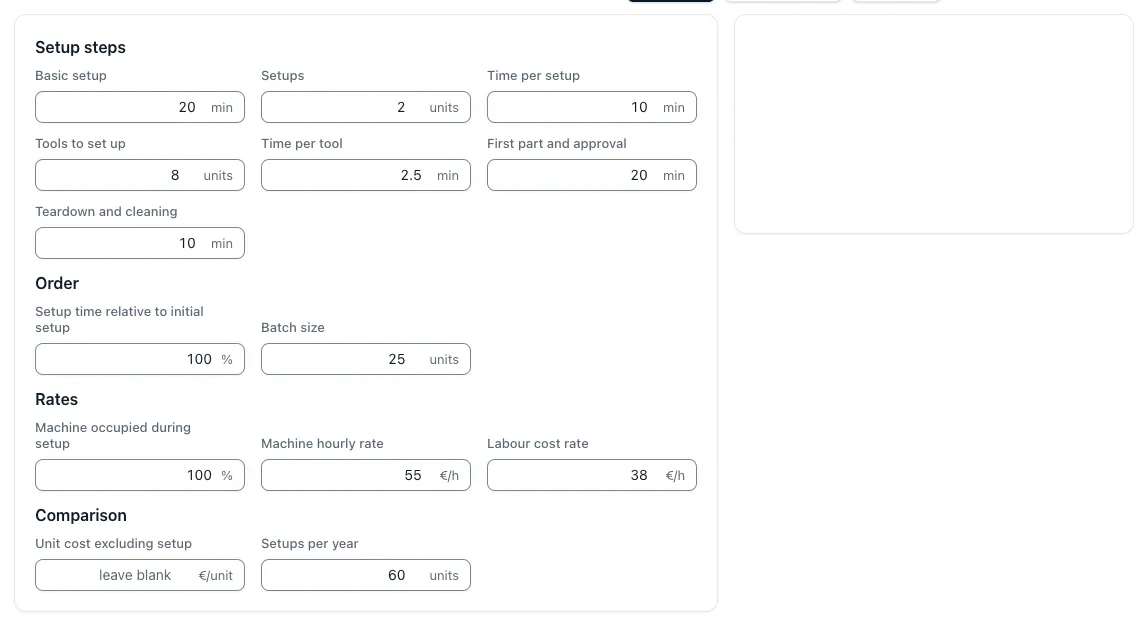
A flat rate like "one hour set-up" hidden where time is created. The set-up cost calculator of the app sets the set-up time from basic equipment, the number of stresses with their time, the number of tools to be re-installed with the time per tool, first part and release as well as equipment and cleaning. Tools that are already measured in the magazine do not count.
For repeat parts with a set-up sheet and existing tool data, steps are eliminated. The computer takes this into account via a proportion compared to the initial upgrade; as an indication, the app lists 50 to 70% for such orders.
Machine and funnel set
When equipped with the machine, it stands and carries its full machine hourly rate. If the machine is prepared outside, such as tools on the pre-setting device or voltages on pallets, the machine is only partially occupied. The computer asks this occupied portion separately and then forms the set of equipment.
Example of calculation with round assumptions: 20 minutes of basic equipment, two clampings of 10 minutes each, eight tools of 2.5 minutes each, 20 minutes of first part and 10 minutes of dismantling result in 90 minutes. At 50 €/h machine hourly rate, 40 €/h labor cost rate and fully occupied machine the set-up rate is 90 €/h, the set-up costs are 135 €. For 25 parts the 5.40 € per piece, for 100 parts 1.35 €.
Rest rate = machine hourly rate × occupied share + wage cost rate
Set-up costs per unit by lot size
The example above: 135 € set-up costs per order and 20 € unit costs without set-ups.
| Lot size | Equipment costs per unit | Unit costs with set-up share | Percentage of the unit costs |
|---|---|---|---|
| 1 piece | 135,00 € | 155,00 € | 87,1 % |
| 10 pieces | 13,50 € | 33,50 € | 40,3 % |
| 50 pieces | 2,70 € | 22,70 € | 11,9 % |
| 100 pieces | 1,35 € | 21,35 € | 6,3 % |
| 500 pieces | 0,27 € | 20,27 € | 1,3 % |
Example of calculation with round assumptions, no guideline values. The set-up part refers to the unit costs including setups.
Set-up percentage and economic lot size
If you also enter the unit costs without set-up, the calculator shows the set-up percentage and the lot size, from which the set-up costs represent a maximum of 5% of the unit costs. In the example with 20 € unit costs without set-up, this limit is 129 parts. A table shows the set-up costs per unit for quantities from 1 to 500.
If you want to distribute the set-ups, programming and devices together over several quantities, use the batch prices. For parts with regular annual requirements, the calculator calculates for the economic lot size according to Andler how large a lot should be if setup costs and storage costs are weighed against each other.
Lot size for 5 % set-up = 19 × set-up costs ÷ Unit cost without set-up
Set-up time: definition, internal and external set-up time
It is the time when a job is prepared for an order and is put back into its basic state after the order. It is once per order, regardless of the number of pieces, and thus stands next to the execution time, which is repeated with each part. In labour law, "Aüstzeit" also means the changing and preparing of the employees; this meaning is not meant here.
Internal set-up time is the part that is only possible when the machine is stationary, for example, align the clamping agents on the table or manufacture the first part. External set-up time can be done while the machine is still working on the previous job, for example measuring tools on the pre-setting device, providing clamping agents or checking the program. For the costs, the internal set-up time counts above all because only it blocks the machine; in the set-up cost calculator, the used machine part shows this difference.
Delimit setup time and tool change time
Not every time around tools belongs to the setup. Setting up and measuring new tools before the application is set-up time. The programmed tool changes during processing repeat themselves with each part and belong in the side-time; changes due to wear are distributed over the application depending on the service life. The tool change time calculator of the app determines both of the change-number, chip-to-span-time, cutting time, service life and quantity. Who additionally packs these times into the set-up time, it counts twice.
Reduce set-up time and evaluate the benefit
The division into steps is also the starting point for a set-up time reduction according to SMED. The procedure is always the same: record the steps of an ongoing order, classify each step as internal or external, convert internal steps in such a way that they run externally, and simplify the remaining internal steps, for example with zero point clamping system, quick tensioners or pre-measured tools. If you measure, you usually find one or two steps with a large proportion, for example, the alignment of each clamping or measuring on the machine.
With the number of setup operations per year, the calculator shows the annual set-up costs and, as a scenario, the savings at 10 % shorter set-up time; in the example of 60 set-up operations, the amount is € 8,100 and € 810 per year. This amount must be used to measure an investment in clamping technology or presetting.
In the fully automatic calculation in Pro, set-up and programming time per tension are part of the work plan of the calculation design and are distributed over each scale quantity; they check and release.
Questions and answers
What are set-up costs?
The set-up costs are the costs that arise once per order for the setting up of the machine and the disassembly afterwards: load program, mount clamping agents, measure tools, manufacture and release the first part, equip them. They are calculated from set-up time and set-up set and distributed over the parts over the batch size.
What is the difference between internal and external setup time?
Internal set-up time only occurs with standing machine, for example when aligning the clamping agents or the first part. External set-up time can be done parallel to the current job, such as presetting tools or providing clamping agents. The machine only blocks the internal set-up time.
How to reduce setup time?
By recording the setup steps of an order, moving internal steps outwards and simplifying the rest, for example with zero point clamping system, quick releasers, pre-setting device and set-up sheet. This is followed by the SMED method. What is worth a shorter set-up time per year, the set-up cost calculator of the app shows.
How do I calculate the set-up costs per piece?
The set-up time in hours times set-up rate results in the set-up costs per order, divided by the lot size the amount per piece. The set-up rate consists of the occupied proportion of the machine hourly rate and the full wage cost rate of the set-up.
What set-up time do I set for repeat parts?
A portion of the initial upgrade because program, set-up sheet and tool data are available. The app lists 50 to 70% as a clue; the value from your recalculation is more reliable.
Are programming costs part of the set-up costs?
They are also one-time costs per order, but are evaluated with the programmer's set and distributed differently for repeat jobs. The app has its own computer for programming costs; in the unit cost and batch prices calculator, set-up and programming times are separate one-time costs.
Does the tool change count for set-up time?
Only the setting up and measuring of the tools before the application. Programmed changes per part belong in the incidental time; wear changes are distributed over the application depending on the service life.