Formula of circumference speed
A point at the circumference is the circumference of π × d per revolution. With the speed n multiplied, the path is per minute. Because the diameter is usually expressed in millimeters and the speed in meters per second, the formula divides by 1000 for meters and by 60 for seconds, i.e. by 60,000.
The same path leads to the target via the angular speed: ω = 2π × n γ 60 in rad/s, and v = ω × r with the radius r in meters.
v = π × d × n ÷ 60,000 (v in m/s, d in mm, n in 1/min)
- m/s in km/h: times 3.6
- m/s in m/min: times 60
- Angular speed: ω = 2π × n ω 60, v = ω × r
Examples: grinding wheel and belt wheel
A grinding disc with a diameter of 300 mm at 1,910 1/min runs at π × 300 × 1,910 ÷ 60,000 = 30.0 m/s, that is 1,800 m/min.
A 200 mm diameter pulley at 1,450 rpm has a circumferential speed of π × 200 × 1,450 ÷ 60,000 = 15.2 m/s, sometimes 3.6, i.e. 54.7 km/h. This is the speed of the pulley as long as it does not slip.
Circumference speed in m/s by diameter and speed
Calculated by v = π × d × n ÷ 60,000 and rounded to a decimal place.
| Diameter d | n 500 1/min | n 1,000 1/min | n 1,500 1/min | n 3,000 1/min | n 6,000 1/min |
|---|---|---|---|---|---|
| 50 mm | 1,3 | 2,6 | 3,9 | 7,9 | 15,7 |
| 100 mm | 2,6 | 5,2 | 7,9 | 15,7 | 31,4 |
| 125 mm | 3,3 | 6,5 | 9,8 | 19,6 | 39,3 |
| 150 mm | 3,9 | 7,9 | 11,8 | 23,6 | 47,1 |
| 200 mm | 5,2 | 10,5 | 15,7 | 31,4 | 62,8 |
| 300 mm | 7,9 | 15,7 | 23,6 | 47,1 | 94,2 |
| 400 mm | 10,5 | 20,9 | 31,4 | 62,8 | 125,7 |
In the case of grinding wheels, the maximum or maximum speed specified on the disc shall always apply, even if the invoice would allow a higher value.
Speed from the circumference speed
As an example of calculation: A 125 mm diameter grinding wheel with an assumed permissible circumference speed of 50 m/s may run at a maximum of 50 × 60,000 γ (π × 125) = 7,639 1/min.
The marking on the disc itself is always binding, not the calculation: If there is a lower maximum speed or speed, it applies, and the spindle of the machine must be limited accordingly.
n = v × 60,000 γ (π × d)
Circumference speed, cutting speed and speed
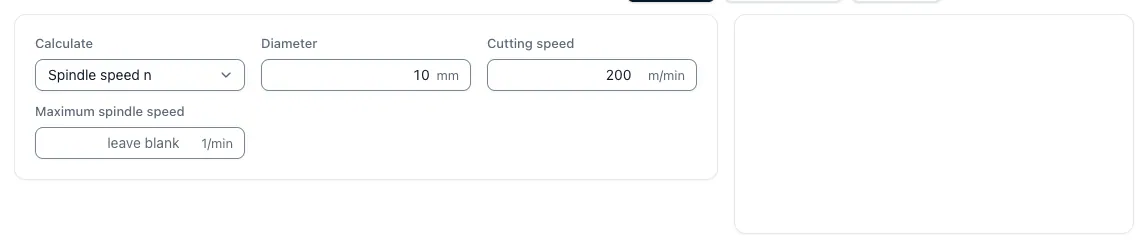
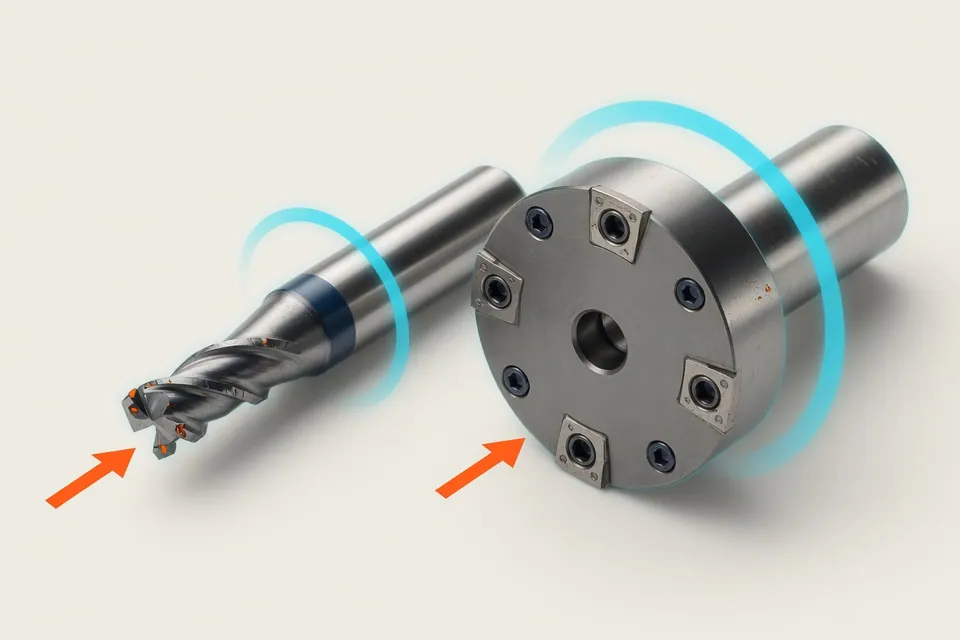
When turning, milling and drilling, the circumference speed at the effective diameter is the cutting speed vc and is specified in m/min: vc = v × 60. Formula, guide values per material and typical errors are calculated on the section Cutting speed.
If you need the speed for tools or workpieces from a cutting speed, you will find formula, speed tables and examples on the speed side. The conversion of the speed to Hertz and rad/s shows the page to the rotational frequency.
Questions and answers
How do you calculate the circumference speed?
With v = π × d × n ÷ 60,000, d in mm and n in 1/min, the result in m/s. A belt with 200 mm at 1,450 1/min reaches 15.2 m/s.
How to convert circumference speed into speed?
With n = v × 60,000 γ (π × d). For 50 m/s on a disc with 125 mm diameter, 7,639 1/min; in the case of a grinding wheel, the maximum speed applies on its marking.
Is circumference speed the same as cutting speed?
When cutting yes: The cutting speed is the circumference speed at the effective diameter, only in m/min instead of m/s. The feed motion is so slow in comparison, that it plays practically no role.
How to convert m/s to km/h?
With the factor 3.6, because one hour has 3,600 seconds and one kilometer 1,000 meters. 15.2 m/s correspond to 54.7 km/h.