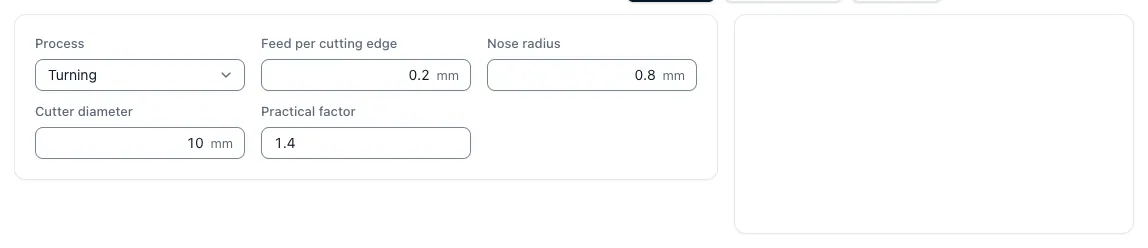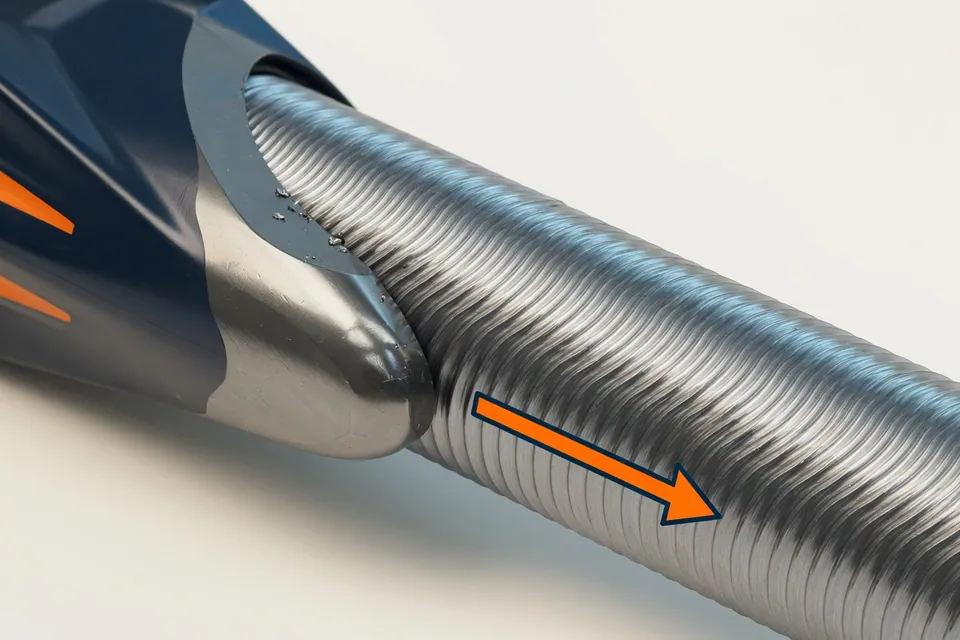
When turning, the approximate formula is Rz ≈ f² ÷ (8 × r). The tool in the app provides the theoretical root depth, a practical value with a multiplier, and the maximum permissible feed rate for a specified Rz value.
Formulas
Rz ≈ f² ÷ (8 × r)Theoretical roughness
f Feed per revolution, r corner radius, both in mm; result times 1000 in μm.
f = √(Rz × 8 × r)Maximum feed
Changed after feed for a required roughness depth.
Ra ≈ Rz ÷ 5Rough mapping
Only for classification, no normative conversion.
Simple turn with 0,2 mm feed
Corner radius 0.8 mm, practical factor 1.4.
- Theoretical root depth = 0.2² ÷ (8 × 0.8) × 10006,25 µm
- Practice value with factor 1.48,75 µm
- Corresponds to Ra ÷ Rz ÷ 51,75 µm
- Maximum feed for Rz 6.3 μm including factor0,17 mm/U
ResultFor a safe Rz 6.3, the feed shall be returned from 0.2 to approximately 0.17 mm/U.
Around 15 percent less feed means around 15 percent more time for the final finishing – this is exactly what this coupling belongs to the calculation.
Surface is a feed decision
The required roughness limits the feed during finishing – and thus the processing time directly. A larger corner radius allows more feed, but increases the passive force and the deflection of lean parts.
Questions and answers
How do you calculate the roughness when turning?
The theoretical root depth follows from the geometry of the cutting tip: Rz ≈ f² ÷ (8 × r), with the feed rate f per revolution and the corner radius r, both in millimetres. For f = 0.2 mm and r = 0.8 mm, approximately 6.3 µm result.
Why is the real value worse than the calculated value?
Because the formula only depicts the kinematics. Construction cutting, vibration, tool wear, material toughness and lack of stiffness also worsen the surface. An impact of 20 to 50 percent on the theoretical value is usual practice.
Which feed can I drive for Rz 6.3?
Changed f = root out (Rz × 8 × r). For Rz 6.3 μm and a corner radius of 0.8 mm this is theoretically about 0.2 mm/U – with a practical factor corresponding to less. The tool of the app shows both values.
What does a larger corner radius bring?
It improves the surface with the same feed and stabilizes the cutting edge. At the same time, the passive force increases, which leads to deflection and ratters in lean waves. As a rule of thumb, the corner radius should be at least twice the feed.
Is this also true for milling?
Not directly. When milling, tooth feed, number of teeth, round run and the web overlap determine the surface. A separate relationship over the web distance applies for plain tracks with ball cutters.