Calculating the path of a milling part via clampings and time shares
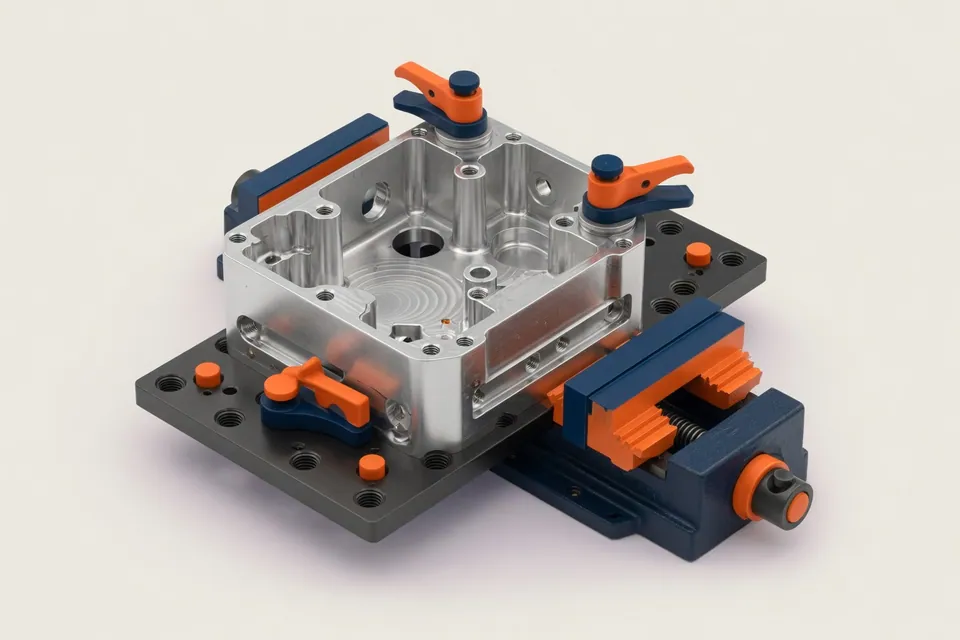
A milling part is calculated by means of its clampings. Geometry, drawing and stock shape are the starting points for a processing sequence: Which surfaces can be reached in which position, which covers have to be created in a clamping process, where does a device need to be installed? Only after that, times per operation are expected, hourly rates are evaluated and supplemented with material, external performance, overhead costs and margin.
Calculating path in four steps
First, the stock: plate, cutting or strand section with dimensions and clamping addition, evaluated with weight and kilo price. Second, the times per clamping, separated by grinding, finishing, drilling, threading and non-cutting times. Third, the one-off cost per order for setups, programming, device and initial pattern, distributed among lot size. Fourthly, the cost rates: unit time times hourly rate plus material and external services results in the manufacturing costs, with overhead costs the cost and with the margin the price.
Self-cost = (material + t × hourly rate + 60 + one-off cost ÷ N) × (1 + GK)
Price = cost of production ו (1 − margin)
Time portions of a milling part
Each time share has its own driver. Whoever calculates it separately, sees if a part costs time due to its volume, its surfaces or its many small features:
| Time share | Formula | What Time Drives |
|---|---|---|
| Scraping | t = V ÷ Q with Q = ae × ap × vf ÷ 1000 | machining volume, achievable time machining volume, tool size |
| Arbitration | t = path ÷ vf with path ÷ area ÷ lateral delivery | Surface, surface indication, delivery, small radii |
| Drilling | t = (drilling depth + start) | Number and depth of drilling, pre-drilling, rubbing |
| Threads | 2 × thread length ÷ (n × P) per thread | Number of threads, inclines, thread drills or milling machines |
| Sidetime | t_n = Change × Change time + Position + Measure | Tool changes, rapid paths, measuring in the machine |
| Equipping per clamping | t_r ÷ N per clamping | Number of stresses, device, touch, lot size |
The roughing formula only carries with large removal. Small inner radii force small tools, deep pockets long elongated lengths and thin walls reduced cutting values; then the real time deviates significantly. A component with forty holes and twenty threads can bind more time at low volume than a large bag.
Example of calculation: one milling part in one and three clampings
Assumptions: 18,50 € Material, 24 min Processing at 72 €/h, 75 min Setup, 180 € Programming, 18 % overhead costs and 12 % margin from the selling price. For the variant with three instead of one clamping, two additional clampings with 20 minutes setups each and 2 minutes spanning and touching per part are assumed; 115 minutes setup and 28 minutes processing per piece are assumed.
| Quantity | Fixed portion, one clamping | Price, a tension | Fixed portion, three clampings | Price, three uplifts |
|---|---|---|---|---|
| 1 piece | 270,00 € | 425,47 € | 318,00 € | 496,27 € |
| 10 pieces | 27,00 € | 99,63 € | 31,80 € | 112,50 € |
| 50 pieces | 5,40 € | 70,67 € | 6,36 € | 78,39 € |
| 100 pieces | 2,70 € | 67,05 € | 3,18 € | 74,13 € |
| 500 pieces | 0,54 € | 64,15 € | 0,64 € | 70,71 € |
The individual part costs 425.47 €, at 100 pieces 67.05 €, although each part is processed for the same length of time. Two additional clampings cost the part in every quantity: for the individual part above all via the setup, in the series over the additional time per part. Example of calculation with round assumptions, no market prices; the same basic assumptions are used by the page Calculate relay prices.
Construction and costs
Many costs of a milling part arise in the construction before a machine runs. Internal radii smaller than a useful tool radius force small cutters with small cutting values. Deep, narrow pockets require long tools that cut more slowly. Tolerances and fine surfaces only on functional surfaces save smoothness and test time. Surfaces that can be reached from one side save tension, and same bore and thread sizes save tool changes. For calculation, this means: Each of these properties belongs as its own assumption in the calculation path, so that a design change visibly arrives in the price.
Automatic drawing and CAD
In Pro, the CNC Calculator app creates this calculation path from drawing and STEP model fully automatically as a calculation design: stock, tensioning, operations, times, costs and batch prices, each value with its origin. They check the design and release it; Pro is unlocked on request. More information under Full automatic calculation from drawing and CAD.
Free of charge calculate the same steps individually: Calculate milling parts online with the tools of the app, without registration. The page shows which factors determine the price of a milling part in practice. Cost of milling parts.
Key points
Milling parts are explained in such a way that inputs, procedures, effects and limits in the CNC calculation remain comprehensible.
- First set tension sequence: Each additional layer means setup, alignment, touch and additional tolerance risk.
- Splitting and sizing: The roughing follows the volume, the levelling of the surface, the radius and the required surface.
- Do not underestimate small-scale processing: Drilling, threading, threading and deburring add up to the greatest time position in many features.