Operations calculated as external performance
Many CNC parts leave operation between two operations or before delivery: for hardening, hardening, finishing or nitriding, for anodizing, galvanizing, browning or coating, for grinding, if your own equipment is missing, or for testing in an external laboratory. In the calculation, these steps work twice. They cost the invoice amount of the supplier, and they change your own production: measure of delay, dimensional allowance for the layer thickness, further tension after hardening, packaging, transport and longer lead time.
If a treatment is only used as a clue next to the title block, it is easily lost. Check each request specifically for hardness information, surface protection, edge condition and required testimonies before you calculate times.
Supplier's billing base in cost per part
Depending on the procedure, suppliers usually charge a minimum amount per order according to weight, area, piece or charge. For the calculation, an amount per part is calculated. The weight is that of the part that goes for treatment, so often the pre-processed part; area and volume result from the drawing or from a STL network that evaluates the app free of charge.
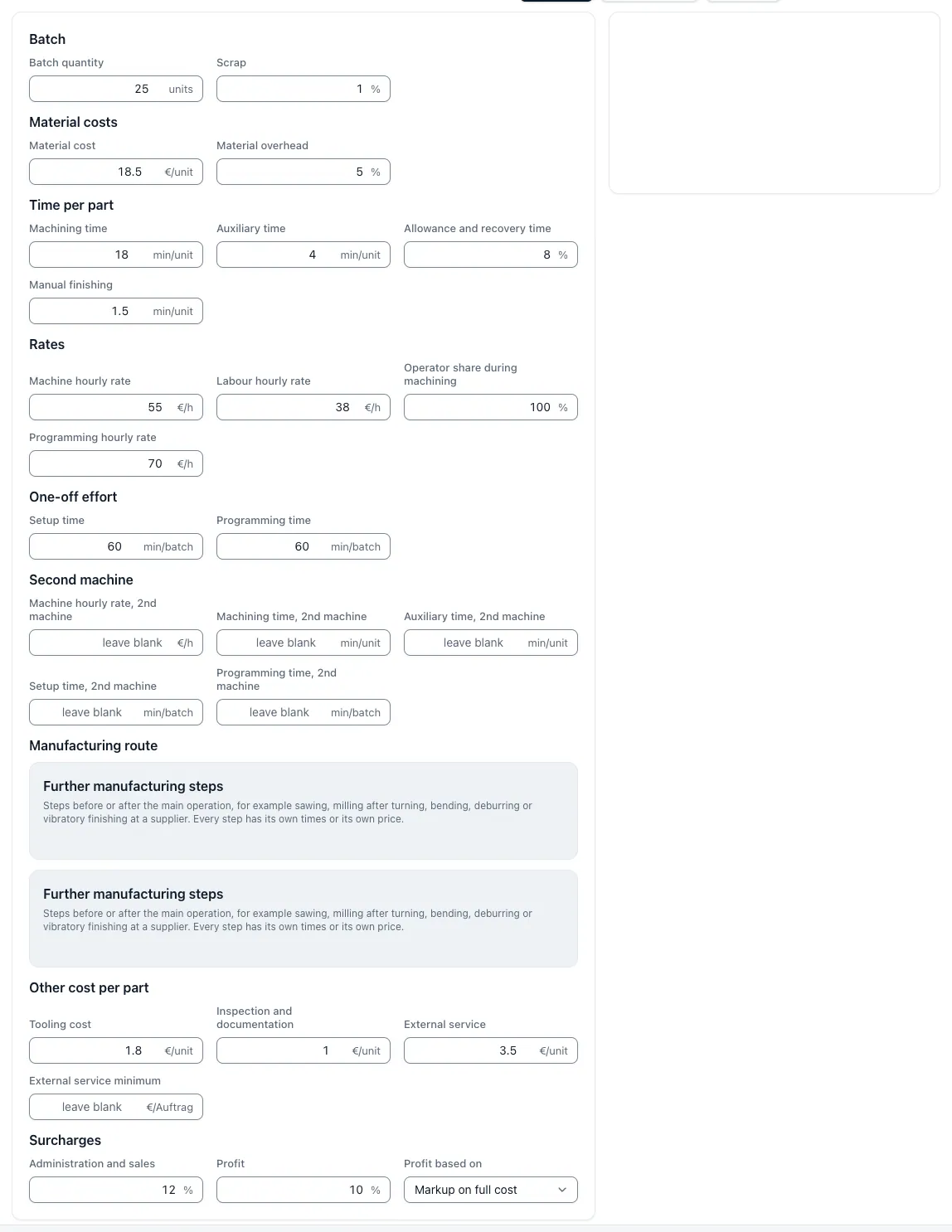
The unit cost calculator of the app expects the external performance per part including freight and optionally the minimum amount per order. If the price per piece is less than the production quantity, the computer sets the difference once per lot and displays it as its own line. Thus, unit price of the external performance and the lower quantity share remain separately recognizable in the cost statement.
Foreign output per lot = max(price per piece × production quantity; minimum amount)
Shortage of non-contributory benefits
Example of calculation with round assumptions and without scrap: A treatment costs 0,80 € per part, the supplier charges at least 150 € per order. For 25 parts the unit price would be 20 €, 150 € will be billed; the difference of 130 € will increase each part by 5,20 €. For 250 parts it is 200 €, the minimum amount will no longer matter. The effect is equal to the set-up percentage and therefore belongs in each set-up.
The scaled-up price calculator carries out external performance as an amount per piece. Check for the small scaled-up quantities in the unit cost calculator whether a minimum amount applies there. If several orders go together to the supplier, the minimum amount is distributed over more parts; calculate this only if the bundling is planned and the delivery date allows it.
Freight, handling and scrap
In addition to the invoice amount there are costs that are not included in any supplier invoice: packaging, back and forth transport, accompanying documents, check of receipt of goods after return and time tracking. The unit cost calculator does not charge any material overheads for external services; the surcharge for administration and distribution, on the other hand, affects the entire production costs. Anyone who evaluates his own expenses separately, calculates it in the amount per part before he enters it, and does not cover it additionally by the surcharge.
The Committee distributes the computer to the good parts, even in the case of external performance. If the Committee is predominantly pre-treatment, this is a cautious assumption. A part that is delayed after hardening or fails during hard grinding, however, weighs heavily because it has already borne all the added value.
Extent and sequence of work after heat treatment
Hardened parts are usually pre-processed, treated and then processed hard, by grinding or hard turning. For this purpose, the part needs a measure, which covers measure delay and a reserve for clean grinding. The app calculator for the measure after heat treatment transfers a specified delay in percent and a reserve per side to an additional dimension and a preparation measure. With its starting values, 100 mm reference measure, 0.2% delay and 0.1 mm reserve per side, an additional dimension of 0.4 mm is obtained.
The computer does not explicitly predict the delay itself: the percentage must come from experiments, the release of the hardening or its own process history, and form delay may require further reserves. In the calculation, this means more material, an additional operation with own setups and measurements after treatment. In the case of coatings, clarify whether the drawing dimensions apply before or after the coating, and, in the case of fit, maintain the layer thickness.
Total dimensions = reference measure × delay ÷ 100 + 2 × reserve per page
In-house production or purchase of work
Whether a sanding course remains in the house or is awarded, it is not the full costs that decide, but the costs that actually change as a result of the decision. The computer for self-production or purchase compares additional fixed costs and variable costs of self-production with purchase price and one-time purchase costs and shows the critical quantity, in which both are equally expensive. If the own machine is a bottleneck, the lost cover contribution of repressed orders is added.
K_igen = fixed costs_en + quantity × (variable costs + shortness time × missing cover)
Questions and answers
How do I calculate hardening when the hardening is calculated by weight?
Calculate with the weight with which the part goes to hardening, mostly the pre-processed part, multiply it with the kilo price and charge freight per part. The minimum amount per order is entered separately in the unit cost calculator.
Is a surcharge on external benefits included in the calculation?
If procurement, transport and inspection in your own company cause costs, yes. It is crucial that this cost is only recorded once: either in the amount per part or in the surcharge for administration and distribution.
Why is heat treatment so expensive for small lots?
Because the minimum amount of the supplier is per order and is distributed over a small quantity in a few parts. The unit cost calculator shows this difference as its own line per lot.
Can the app calculate the hardness delay?
No. The computer transfers a default value that you know from trial, supplier specification or experience to a measure. It does not provide a prediction of the delay.