Require tooling effort to the right quantity
A specially built tool can be sold separately, assigned to a frame order or transferred via an expressly agreed quantity. An expected annual quantity is not a secured acceptance. This assumption must therefore be distinguished from the actual lot ordered.
Wear parts, regrinding and maintenance are running costs and are not automatically covered by the one-time purchase.
Good parts per stroke and productive lifting number
From productive strokes per minute and good parts per stroke, the computational unit performance results. Feeding, removing, interruptions and scrap limit the actual achievable performance. A machine maximum without material and tool is not a time limit for the order.
Example of calculation for an agreed series
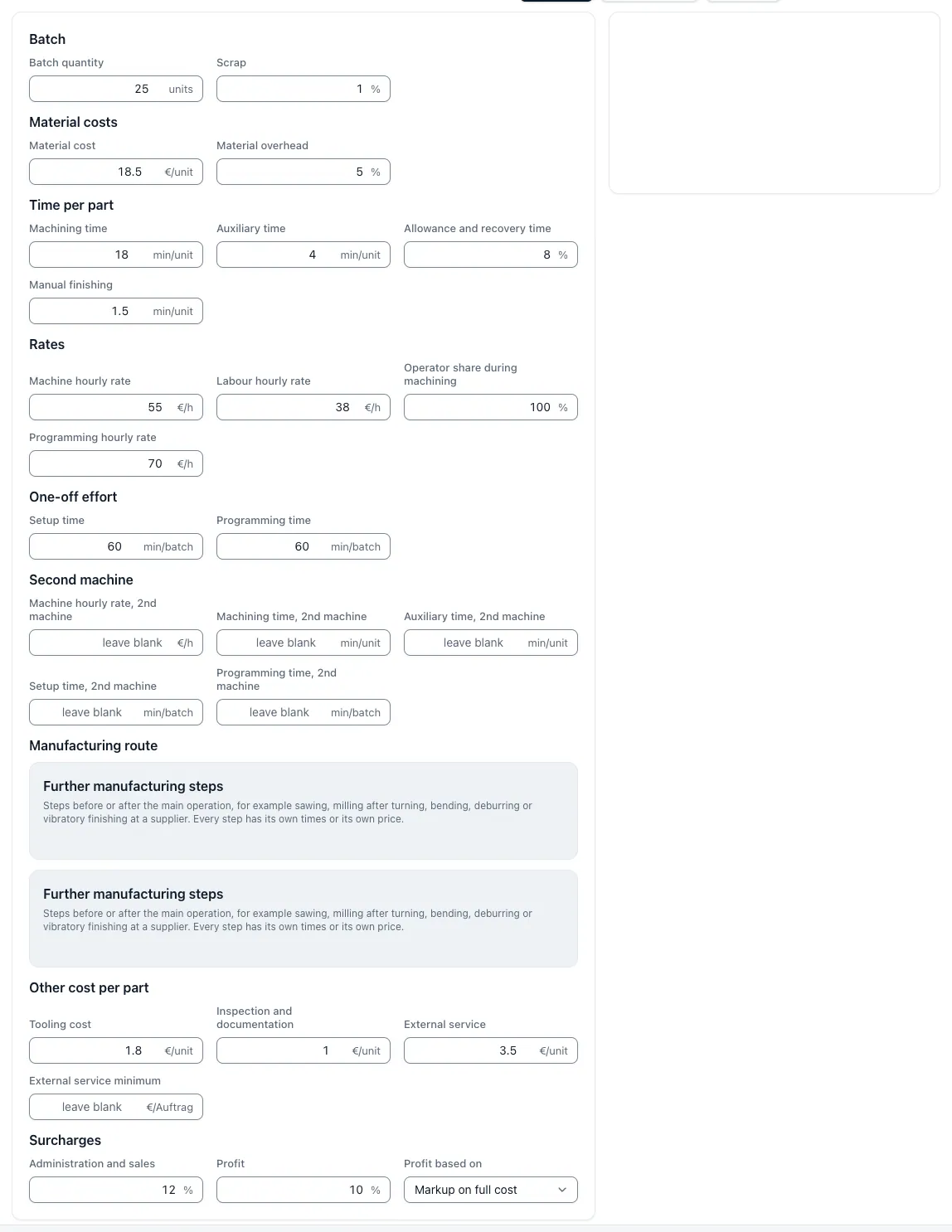
An accepted tool costs €6,000 and is distributed to legally calculated 20,000 parts: €0.30 per part. For 30 productive strokes per minute and two good parts per stroke, the pure cycle time is one second per part. At €72/h, the €0.02 per part.
With 100,000 instead of 20,000 parts, it would be €0.06 part of the tool. This comparison does not say anything about stand quantity, post-milling or delivery obligations; their costs and requirements are additionally recorded.
Tool share = tool costs ÷ agreed levy amount
Material utilization and production route
For strip material, part arrangement, feed distribution, bridges and edge areas determine the consumption. A rectangular plate comparison does not replace this design. Deburring, cleaning, bending, coating and testing remain their own operations if the delivered part needs them.
Questions and answers
Should the tool be included in the unit price?
This is a commercial agreement. The decisive factor is a clearly named levy amount and the transparent separation of purchase and running tool costs.
Does the calculator detect punching power and tool design?
The computers linked here evaluate costs and quantities. The technical tool design and the release of the machine must be carried out separately.