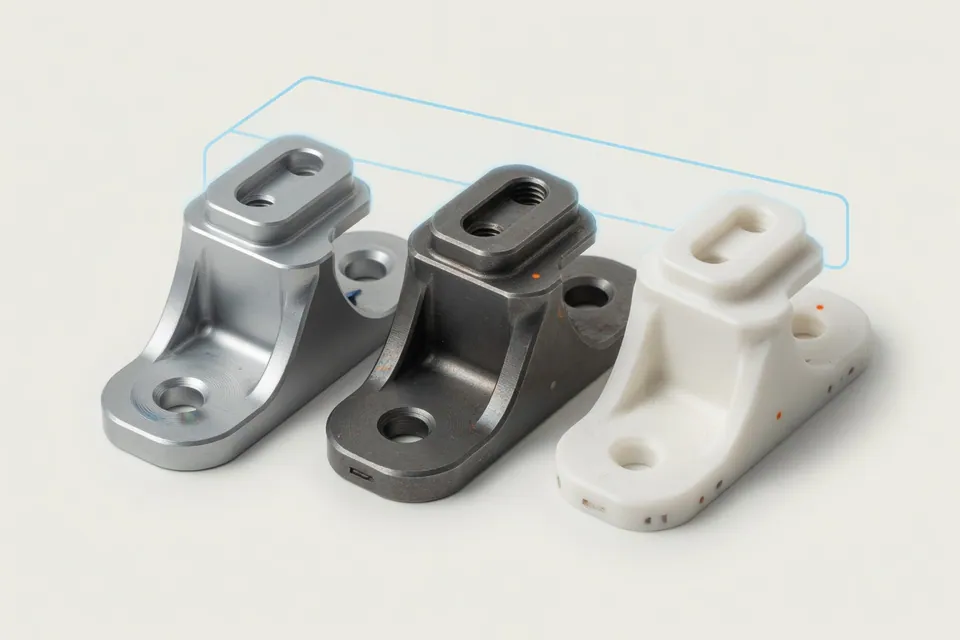
Similarity of form and production context
How geometric similarity is measured
Two components are geometrically similar if their shape is similar to the characteristics that count for the respective question. There are three approaches to this with increasing effort.
Characteristic values are easiest: envelope dimensions, volume, surface and their ratios can be calculated from any volume model. They find parts of a similar size and shape, but they do not distinguish between a shaft and an equally large block with holes.
Features go one step further. Recognized holes, pockets, grooves and turning diameters describe how a part is made, and are closer to the calculation. Their quality depends on the model quality; simplified models without holes or threads distort the feature counting.
Form-based methods calculate a kind of fingerprint from the entire geometry and compare these fingerprints with each other. They also find parts that are differently named or differently structured, but do not say anything about material, tolerances or quantity. For the calculation, such a result is therefore always only the first filter.
Finding similarity in construction and calculation
| Construction | Calculation | |
|---|---|---|
| Objective | reuse existing parts, avoid double constructions | Use times, work sequence and costs of a known part as a starting point |
| Criteria | Shape, dimensions, function, standard parts | Shape and dimensions plus material, process, machine, quantity, tolerances, surfaces |
| Result | an existing part instead of a new construction | a reference proposal with visible differences to the new request |
| Risk | hardly, the part is already released | old assumptions or outdated cost rates are updated unchecked |
The same search technique serves two different purposes. In the calculation, the production context decides whether a form-like part is suitable as a reference at all.
Reference suggestions in your own working environment
In the own working environment for manufacturing companies, CNC Kalkulator proposes a reference part according to fixed rules for a calculation. A candidate must be in the same working area and have the same process, the same material and the same machine. Each finished dimension may not differ more than 25 percent, the quantity at most by a factor of two. Confirmed references are available before unconfirmed, because only confirmed actual times can be transferred into a calculation.
For each proposal, the calculation shows the basis for comparison: the deviation of each measure in percent, the quantity ratio and the applicable limits. Thus, it is recognizable why a part is considered similar. A reference is only taken over when it has been explicitly selected.
Reference as proposal, release by humans
A found reference shortens the calculation, because work sequence, machine and documented assumptions do not need to be recollected. However, it does not replace the test of the new request: a deeper bag, an additional cross hole, narrower tolerances or a different batch size change setup, processing and testing effort. The old calculation remains unchanged, the new one is created as its own stand and remains recognizable which value comes from the reference.
How reference parts are searched and compared in the product is shown in the page Reference parts and previous calculations, the sequence of a specific request of the application case Deriving offer from a similar reference part. The information taken from the model and drawing describes the page for the CAD data transfer.
Key points
Similarity is explained in such a way that inputs, procedures, effects and limits in the CNC calculation remain comprehensible.
- Connect form and context: Geometric resemblance becomes a useful reference only with material, process, machine and batch size.
- Make differences visible: Dimensions, quantity and requirements are compared before something is taken over.
- Releasing remains with the human: A reference is a suggestion; it is only accepted after conscious selection.