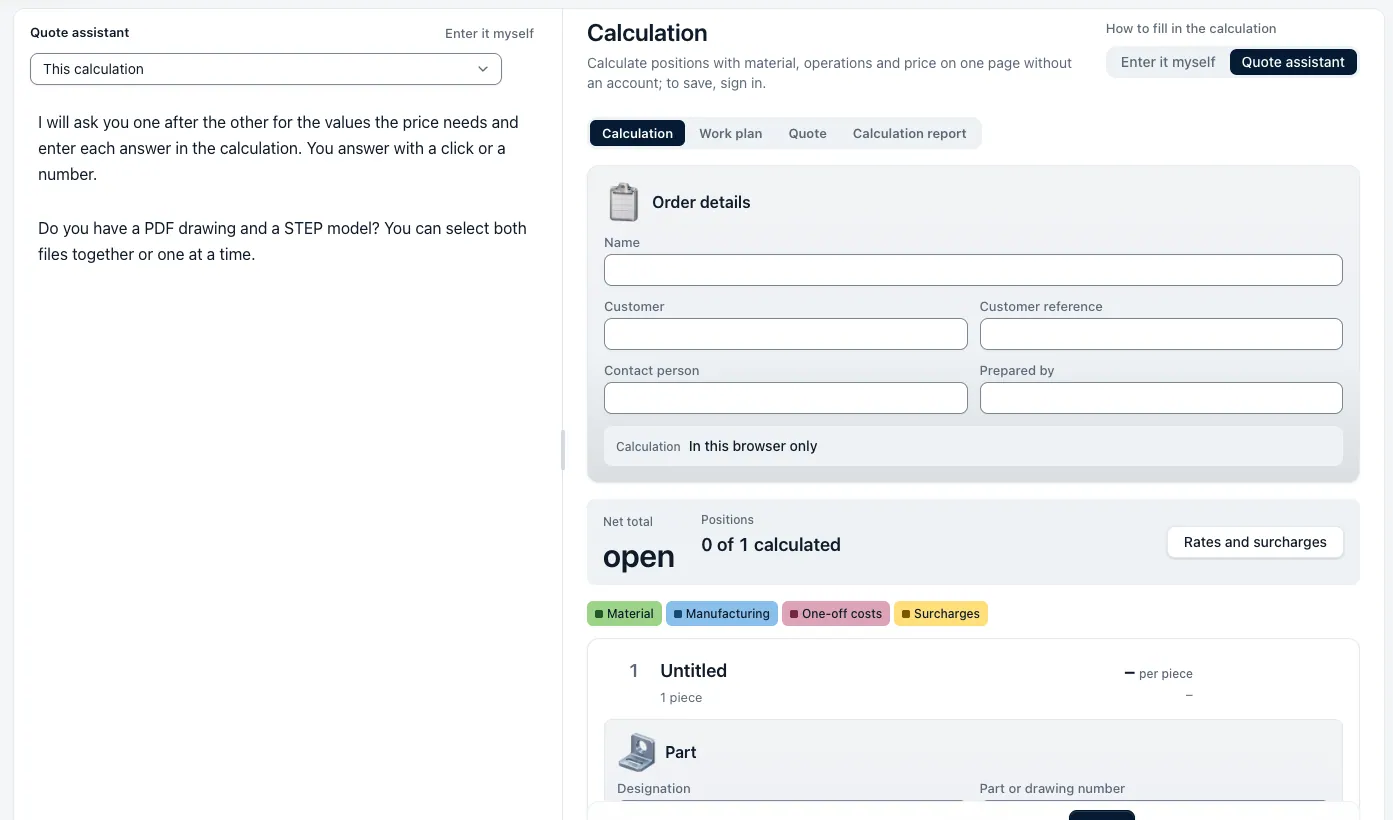
Explanations of each number of calculations
Why was a second clamping applied? What tolerance causes additional testing effort? Why does the set-up time per piece decrease with a larger batch size? Such questions arise again and again in everyday life. The optional assistant answers them directly in the context of the open calculation and the corresponding component revision.
Instead of a general answer, he shows which drawing specification, which CAD-feature, machine profile or which calculation rule is behind a value. Connections such as tool changes, fixed set-up costs or quality-related additional steps are explained intelligibly. Thus, calculation, work preparation and sales can classify the same calculation level faster.
Where an information is missing or not clearly assigned, this uncertainty becomes visible. The assistant does not supplement any supposedly appropriate values and does not change any machine, tool, time or cost set independently. Proposals only become effective when a qualified specialist checks and confirms them.
Questions and answers remain connected with calculation level and revision. If something is subsequently corrected, the reason and the processor are comprehensible. This shortens the coordination, facilitates the induction and helps in the customer's discussion without replacing the technical approval. Your team will find the origin of a number faster and can decide specifically whether data needs to be supplemented or assumptions adapted.
Benefits for your team
Questions about calculation reduce search work, make assumptions comprehensible and create a reliable basis for the offer.
Explaining Calculating Paths
Time shares, upswings and surcharges are broken down into comprehensible technical languages.
See Sources
Answers refer to drawing, CAD character, root date or the calculation rule used.
Definitely decide
Open information shall be clearly identified; changes shall be made only after technical confirmation.