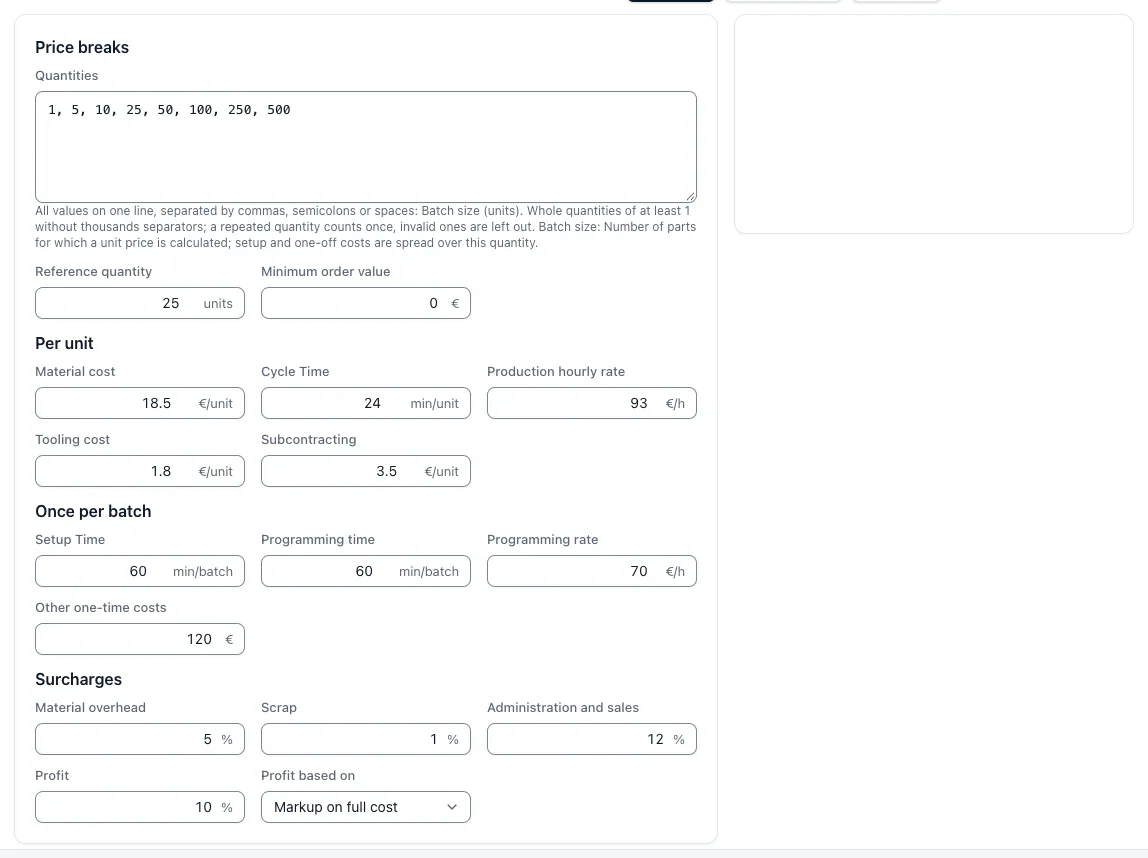
Seasons with explainable price history
The unit price of a CNC component does not automatically decrease equally in every higher scale. One-time expenses such as work preparation, programming and setup are distributed over more parts. At the same time, larger lots can require additional tool changes, intermediate tests, material batches or more complex logistics. A good lot size calculation shows both effects instead of a flat-rate quantity discount.
The basis remains a technically plausible production route. For each quantity requested, set-up costs and other one-off positions are distributed, while material, main and non-cutting times are calculated per part. Minimum order quantities, cutting, trimming, external treatments and packaging can have their own quantity logic. If a lot is divided or manufactured over several machines, this assumption also belongs visibly in the scenario.
This creates a season whose price course can be explained. Sales and calculations recognize the amount of the set-up portion hardly in importance and which cost block dominates afterwards. If the customer changes its demand quantity, it can continue to work on the same technical basis. Cover contribution, risk and market price remain as commercial release separate from the technically determined costs.
A quantity scale is always bound to its requirements. Material price, delivery time, capacity and external services can change; even scraps or testing costs cannot be scaled as desired. Therefore, offered lot sizes should contain concrete validity and open points. This makes the price argument more resilient to customers and protects internally against supposed economies of scale that do not occur in production.
Formula, example and table for 1 to 500 pieces are calculated under Stagger prices, the special case of very small quantities under calculate small lot sizes. In Pro, the scale belongs to the fully automated calculation draft; more on this under Full automatic calculation from drawing and CAD.
Result of the application
In case of "Evaluate a request batches", existing data are combined with a clear decision and a visible result.
Distribute one-off costs
Programming, setup, device and initial samples have different effects on the item depending on the quantity.
Realistic calculation of unit costs
Material, machine time, handling, tool wear and external performance are evaluated according to the quantity.
Establishing differential prices
Sales recognizes where economies of scale arise and which commercial decisions remain separate.