One-off expenditure for small lots and for the item
For small batch sizes, the one-time effort decides on the price. Equipment, programming, device and first part testing are required per order, whether a part or a hundred are manufactured afterwards. Anyone who calculates small batches must make this proportion visible per piece and decide whether to pass it on fully, require a minimum quantity or apply a lower amount surcharge.
Economically calculate small batch sizes
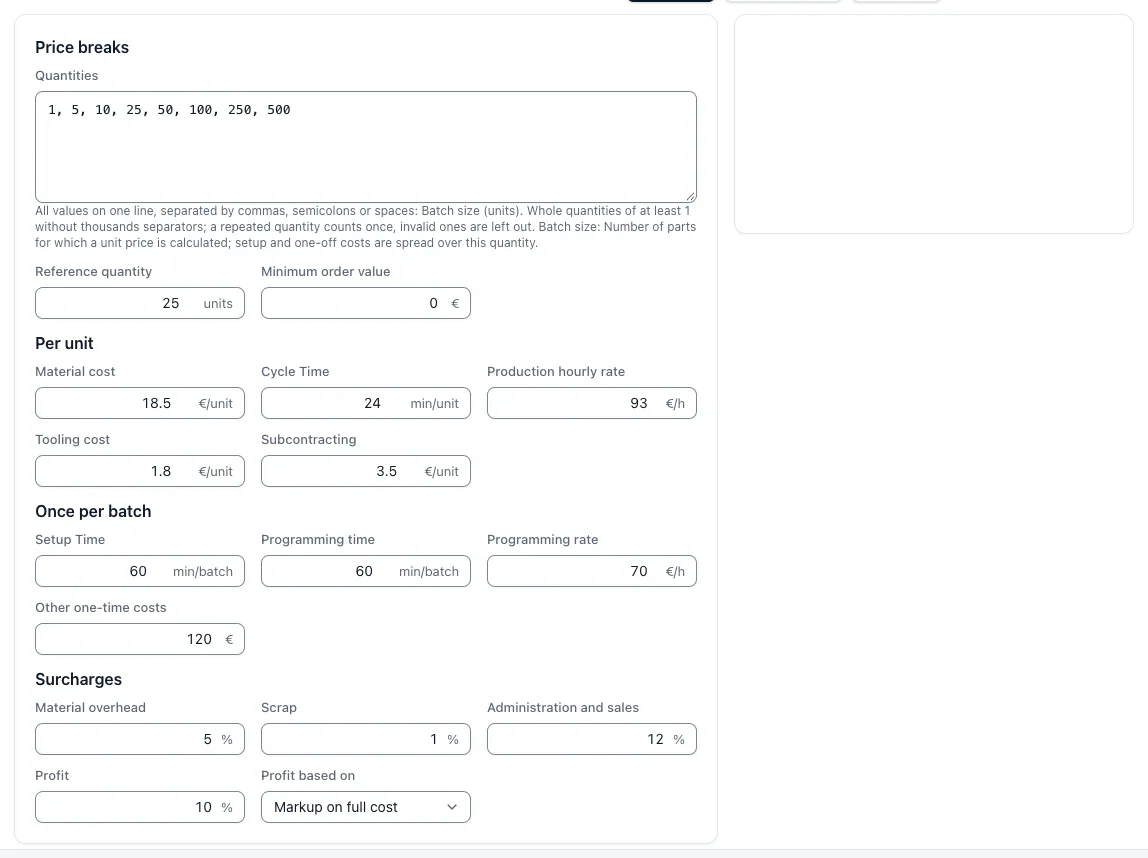
The milling part of the page Calculate the price of the relay shows the effect: 18.50 € material, 24 minutes processing at 72 €/h, 75 minutes setup, 180 € programming, 18 % overhead costs and 12 % margin from the selling price. The one-time cost is 270 € per order.
| Lot size | Fixed percentage per piece | Cost per unit | Proportion of one-off costs | Price per piece |
|---|---|---|---|---|
| 1 piece | 270,00 € | 374,41 € | 85,1 % | 425,47 € |
| 5 pieces | 54,00 € | 119,53 € | 53,3 % | 135,83 € |
| 25 pieces | 10,80 € | 68,56 € | 18,6 % | 77,91 € |
For one piece, the one-off costs represent 85.1% of the costs before overhead costs, for five pieces a good half, for 25 pieces less than a fifth. Example of calculation with round assumptions, no market prices.
Fixed percentage per piece = (early time × hourly rate ו 60 + single effort) ו N
Minimum quantity and minimum quantity supplement
Instead of placing the one-off effort on a few parts, many farms set a minimum quantity or a minimum quantity surcharge. A minimum quantity determines the quantity of the plant offering a part at all; a minimum quantity surcharge is a fixed amount per order below a quantity. Both should derive from the actual one-off effort and be in the offer as their own position so that the customer can see which amount is incurred per order and from which amount it is not applicable.
A hardening, which charges at least 150 € per order, costs 30 € for five parts of each part. This amount belongs to each batch in which it reaches.
Lot size 1
In the case of a single part, such as a prototype, a spare part production or a device, one piece carries the entire one-time effort. Here it is worth reducing the effort itself: simple clamping agents instead of a device, machining on a machine instead of on two existing tools and program blocks. For the calculation the same formula with N = 1 applies; the programming time is often the largest single item.
Economic lot size
If you produce a part regularly, you can choose the lot size yourself. Large lots reduce the set-up percentage, but increase stock and capital retention. The economic lot size according to Andler weighs both: Q = √(2 × annual demand × set-up costs ÷ Stock costs per unit and year). The calculator Economic lot size calculates it with your values. The composition of set-up time and set-up rate shows calculate cost of set-up.
In Pro, the CNC Calculator app distributes the one-time effort in the fully automatic calculation draft to every quantity requested; you check and release it. Pro is unlocked on request. For more information, see Complete automatic calculation from drawing and CAD.
Key points
Lot sizes are explained in such a way that inputs, procedures, effects and limits in the CNC calculation remain comprehensible.
- Make one-off effort visible: Set up, program and first part check as your own position per job, do not hide in the hourly rate.
- Referring minimum quantities: Minimum quantity and minimum quantity supplement from the actual one-off charge.
- Select batch size consciously: For repeat parts, weigh the set-up share and storage costs against each other.