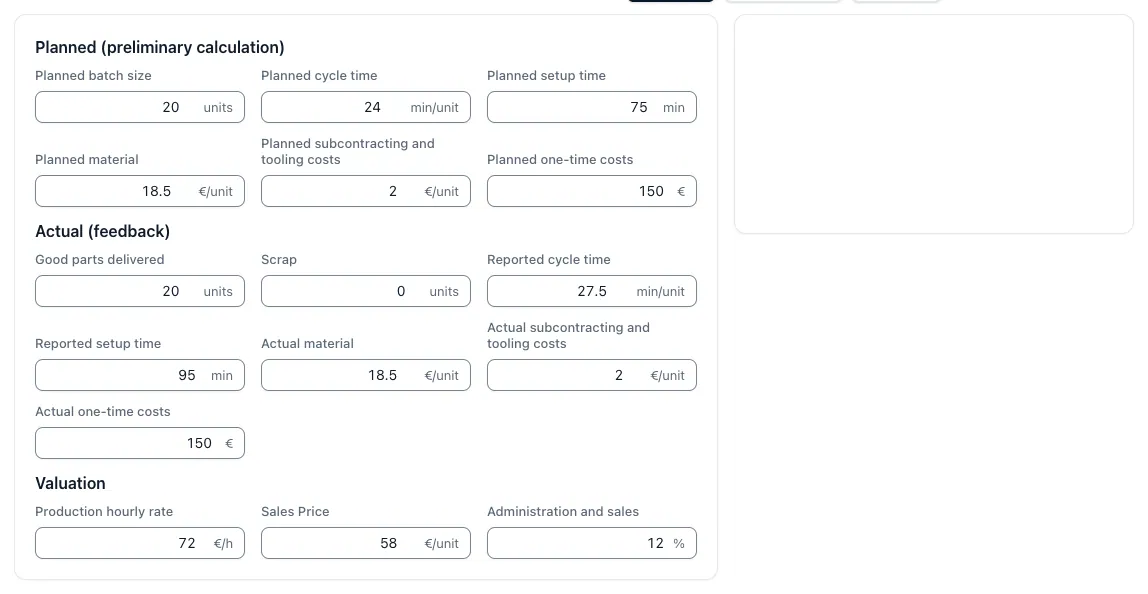
The recalculation compares plan and actual time, including the proportional setup. The calculator shows the relative deviation, the additional or lower costs per piece, the actual manufacturing costs, the remaining cover contribution and the effect on the entire order.
Formulas
t_Plan = t_Stück + t_Rüsten ÷ NPlanned time per piece
The set-up portion belongs to both sides of the comparison.
Abweichung = (t_Ist − t_Plan) ÷ t_PlanRelative deviation
Positive values mean extra effort compared to planning.
Δ Kosten = (t_Ist − t_Plan) ÷ 60 × StundensatzCost effect per unit
The time difference is evaluated with the machine hourly rate.
DB = Preis − Material − t_Ist ÷ 60 × StundensatzFinancial contribution per unit
What remains after the actual manufacturing costs.
Order of more than 20 pieces with moderate time overrun
Planned 24 min per piece and 75 min set-up, reported 27.5 min per piece and 95 min set-up. Hourly rate 72 €/h, selling price 58 €, material 18.50 €.
- Plan per piece = 24 + 75 ÷ 2027,75 min
- Is per piece = 27,5 + 95 ÷ 2032,25 min
- Deviation = 4,5 - 27,75+16,2 %
- Additional costs per unit = 4.5 ÷ 60 × 725,40 €
- Actual production costs = 18.50 + 32.25 ÷ 60 × 7257,20 €
- Financial contribution per unit = 58–57.200,80 €
ResultThe order loses 108 € compared to the planning – of the cover fee is 0,80 € per piece left.
The deviation seems small, but almost completely eats the contribution from the cover. That's why the target-actual comparison in money is more meaningful than in percent.
From the deviation a learning effect becomes only with cause
A number alone does not improve any calculation. Only the assignment – false assumption, changed process, malfunction or data error – makes the target-actual comparison a reliable correction for future offers.
Questions and answers
What is a recalculation?
The recalculation compares the planned values of the precalculation with the actual reported times and costs of a completed order. It answers two questions: How large was the deviation, and what did it cost the order?
How to calculate the deviation correctly?
The time per piece is compared, including the proportional setup: (actual cycle time per part + actual cycle time per part ÷ amount) against (plan cycle time per part + plan cycle time per part ÷ amount). Those who compare only the cycle time per part, overlooks set-up deviations – especially in small lots the most common reason for losses.
When is the target and is it comparable?
Only with the same operation, same machine, same component revision, same lot size and the same time definition. If the feedback contains breaks, faults or side works that were not planned in the planning time, one compares two different things.
What do you do with the result?
The deviation is separated according to cause: incorrect assumption in the calculation, changed process, malfunction or data error in the feedback. Only the first category justifies an adjustment of the calculation basis – and also the only one after technical approval.
From what deviation should one react?
The decisive factor is not a fixed percentage, but the effect on the coverage contribution and the repetition frequency. A deviation of 15 percent for a single item is manageable; the same deviation for a repeat part with 500 pieces per year is a systematic error.