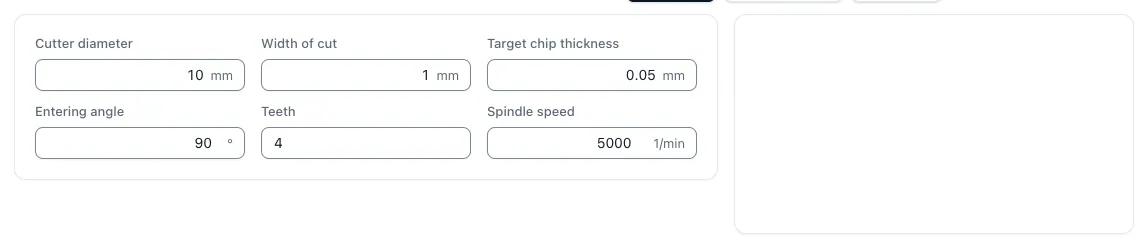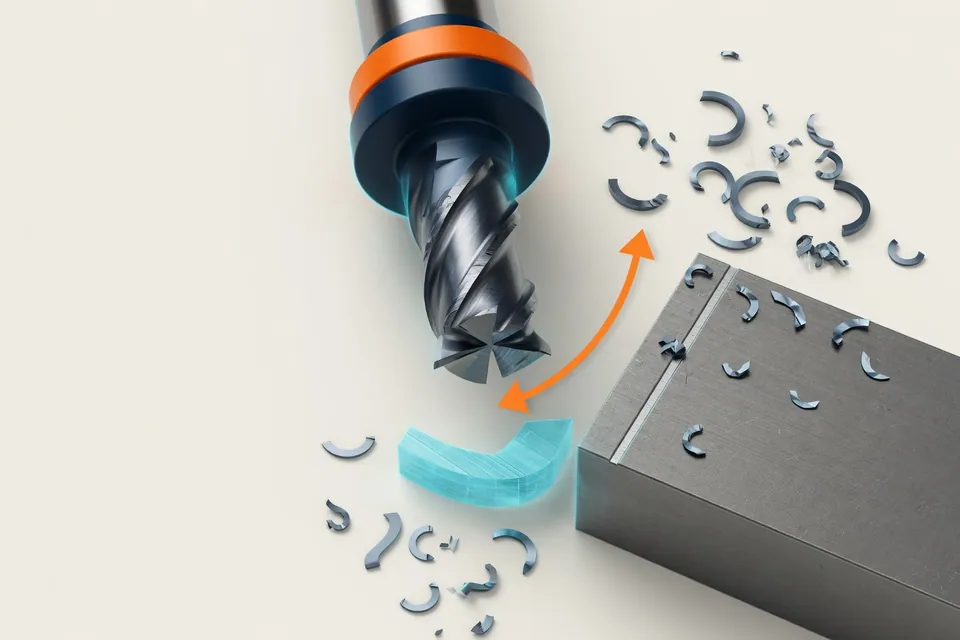
If ae is less than 50 % of the diameter of the cutter, the middle spandick is smaller than the programmed tooth feed. The app's tool corrects fz geometrically and covers the resulting web feed at the entered machine limit.
Formulas
φ = arccos(1 − 2 × ae ÷ D)Angle of intervention
For radial intervention ae under half tool diameter D.
K = 1 ÷ sin(φ)Correction factor
The smaller the procedure, the larger the geometric correction factor.
fz,korr = hZiel × KCorrected tooth feed
The desired middle spandick is calculated back to the programmed tooth feed.
vf = fz,korr × z × nTrain feed
Corrected tooth feed, cutting number and speed result in vf.
Ø 12 mm, ae 1.2 mm, desired spandick 0.05 mm
Four cuttings at 6,000 rpm and machine limit 3,000 mm/min.
- Radial procedure ae ÷ D10 %
- Arccos angle of intervention(1 – 2 × 0.1)36,9°
- Correction factor 1 = sin (36.9°)1,67
- Corrected tooth feed 0.05 × 1.670,083 mm
- Track feed 0.083 × 4 × 6,0002000 mm/min
ResultFor 0.05 mm mean spandick, the result is 0.083 mm.
Before taking over, maximum fz and vf of the tool manufacturer, as well as acceleration, concentricity and stability, must be tested.
Correcting does not mean increasing limitless
The correction factor describes only the intervention geometry. Cutting load, concentricity, machine, tool holder and the approvals of the manufacturer remain the binding limits.
Questions and answers
What is radial chip dilution?
With radial intervention below 50% of the diameter of the cutter, the chip does not reach the nominal thickness fz. In order to obtain the desired medium spandick, the programmed tooth feed can be increased mathematically.
When does fz have to be corrected?
The geometrical correction is less than D for ae 2. The correction factor is one for 50 % or more. In very small procedures, the factors increase strongly and must be limited by tool, machine and process.
Why is there a feed limit in the computer?
The pure geometry knows neither cutting stability nor spindle dynamics, acceleration or permissible manufacturer-vf. The limit prevents a mathematically large correction value from being taken over unchecked as machine value.
Does the bill also apply to ball or high feed cutters?
Only limited. These tools also require axial spandick correction from the intervention, cutting shape and angle of attack. Use the specific tool manufacturer's information for this.
Does the speed change?
No. The radial chip dilution primarily corrects tooth and web feed. The speed continues to follow from cutting speed and tool diameter.