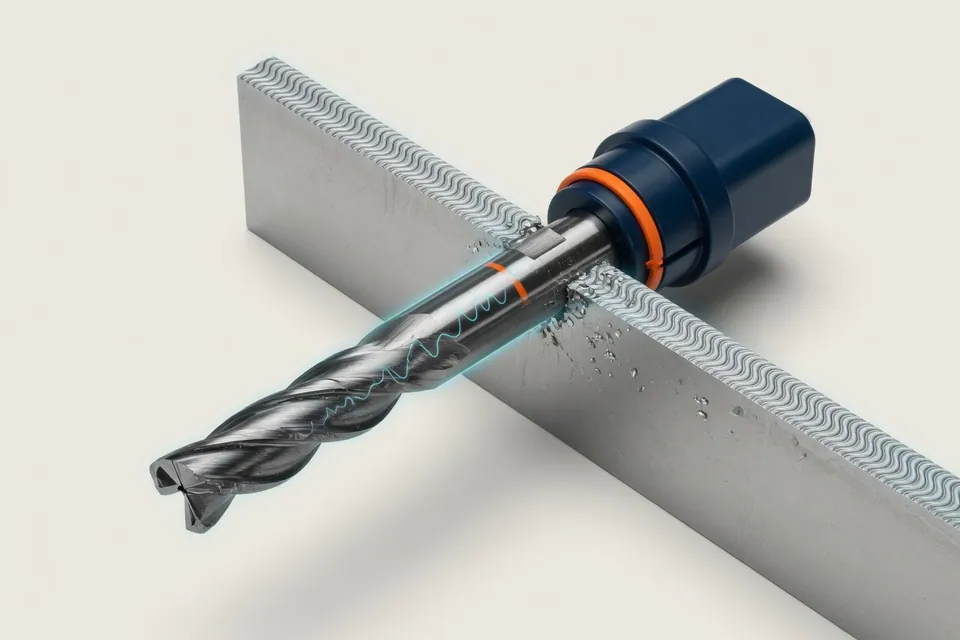
The screening compresses outcrop ratio, ae/D, ap/D and system stiffness to a comprehensible risk class. It shows the first useful lever, but deliberately does not claim an exact stability limit without measurement data.
Formulas
λ = L ÷ DAchievement ratio
A compact leading indicator of the bending stiffness of the tool system.
Eingriff radial = ae ÷ DRadial load
Large loop angle increases process force and feedback.
Eingriff axial = ap ÷ DAxial load
More active cutting length increases the dynamic excitation.
fTPF = n × z ÷ 60Tooth passerby frequency
Excitation frequency from speed and cutting number.
Ø 12 mm, 60 mm elongation, ae 6 mm and ap 12 mm
Four cuttings, 6,000 rpm, medium system stiffness.
- Elongation ratio L ÷ D5,0
- Radial procedure ae ÷ D50 %
- Axial procedure ap ÷ D100 %
- Passage frequency 6.000 × 4 .60400 Hz
- First constructive actionReduce elongation
ResultThe combination is clearly conspicuous and should be defused or practically validated before offering.
The percentage result is a transparent heuristic risk index, no physical probability of occurrence and no stability limit.
Practical levers in case of rat risk
The order prioritizes robust, easily verifiable measures before experimental parameter changes.
| Lever | Effect | Test |
|---|---|---|
| Shorten elongation | Stiffness increases strongly | Tool and holder collision-free? |
| Stiffen the tension | Move workpiece mods | Strength and accessibility? |
| reduce ae or ap | Process force decreases | Recalculate residual material and maturity |
| Inequal division / vibration attenuation | Excitation is distributed | Tool sharing and concentricity |
| Speeds vary | Excitation frequency shifts | Only controlled and within vc limit |
For series processes and critical components, measurement, documented test matrix or real stability analysis are the better basis.
Ratters is a system problem, not a single number
Tool, recording, spindle, machine, workpiece, tension and cutting process together form the dynamic system. Screening is an early warning for calculation and work preparation.
Questions and answers
Is it safe to predict ratters with a simple formula?
No. A robust stability card requires modal data from tool, recording, spindle, machine and workpiece. The computer is therefore deliberately a screening: it shows striking combinations, but does not replace FRF measurement or stability-lobe analysis.
Which inputs increase the rat risk?
Above all, a high ratio of the length of the tool to the diameter of the tool, large radial and axial interventions as well as a yielding tension.
What should be changed at high risk first?
First shorten the elongation and attach tools, mounting and workpiece stiffer. Then adjust intervention or delivery. Another speed can help, but should be based on machine or measurement data.
What does tooth pass-by frequency mean?
It indicates how often a cutting edge comes into the procedure per second: fTPF = n × z ÷ 60. If this stimulation is unfavourable to a natural frequency of the system, regenerative rattling can arise.
Why is the assessment deliberately conservative?
Without a measured frequency response, decisive process data are missing. A careful screening is more useful than an apparent, but non-reliable, limit speed as an offer and planning warning.