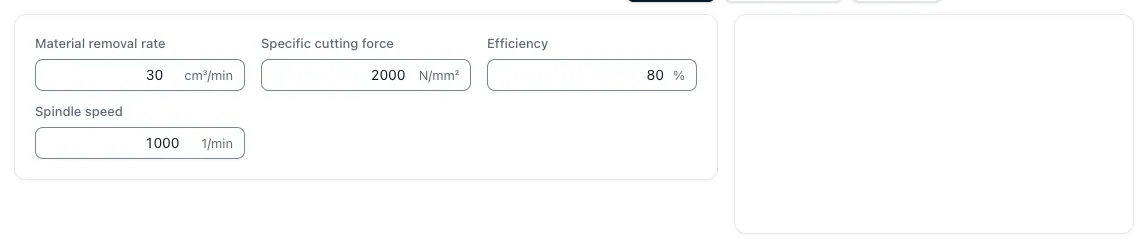
The cutting power follows from Pc = (Q × kc) ÷ 60,000 in kW. The efficiency results in the drive power, the cutting power via the cutting speed and the torque required for the spindle.
Formulas
Pc = (Q × kc) ÷ 60 000Cutting power
Q in cm³/min, kc in N/mm², result in kW.
Pan = Pc ÷ ηDrive power
The efficiency is usually between 0,80 and 0,90.
Fc = Pc × 60 000 ÷ vcCutting force
Decisive for deflection, clamping agents and ratters.
M = P × 9550 ÷ nTorque
Shows whether the spindle works in the usable speed range.
Grinding with 45 cm³/min in structural steel
kc 1,700 N/mm², vc 180 m/min, tool 16 mm, efficiency 85 %, available spindle power 15 kW.
- Cutting power Pc = 45 × 1,700 ÷ 60,0001,28 kW
- Drive power = 1.28 ÷ 0.851,50 kW
- Cutting force Fc = 1.28 × 60,000 ÷ 180425 N
- RPM n = 180 × 1000 (π × 16)3,581 1/min
- Torque M = 1.50 × 9550 ÷ 3,5814,0 Nm
ResultAround 1.5 kW of drive power – about 10 percent of a 15-kW spindle.
The machine is not the limit here. At 425 N cutting force, however, the view on elongation and clamping agent is worthwhile.
Performance is rarely the first limit
Before spindle performance, stability, clamping agents, chip removal and service life are usually limited. The performance calculation shows, however, whether a planned strategy is even mobile on the existing machine.
Questions and answers
How to calculate the required power?
Pc = (Q × kc) ÷ 60,000 with the material removal rate Q in cm³/min and the specific cutting force kc in N/mm² results in the cutting power in kilowatt. The drive power is Pc divided by the efficiency, typically 0.80 to 0.90.
How do you get the cutting power?
About Fc = Pc × 60,000 ÷ vc, with cutting power in kW and cutting speed in m/min. The cutting force is the size that acts on tools, clamping agents and workpiece – it decides on deflection and ratters.
Why is the torque critical at small speeds?
Because power is the product of torque and speed. At low speed – for example, when grinding large diameters or threading – the same power requires multiple torque. Many spindles only deliver their rated power above a limit speed.
What to do if performance is not enough?
Reduce cutting volume: smaller cutting depth, smaller operation or lower feed. With the same Q, the combination of small ae and large ap is usually cheaper for tool and process stability.
Does the bill also apply to hardened materials?
The formula applies, but the specific cutting force increases significantly. In hard machining over 45 HRC, wear and not performance is the practical limit.