Machine utilization from orders and capacity
The capacity utilization is a planning size: How many hours of the available machine time are occupied by orders? The occupancy of an order is set-up time plus quantity times cycle time per part, the capacity working days times shifts times hours per shift times machines, reduced by the technical availability.
The app also derives the machine requirements from the target utilisation. A target utilisation below 100 percent keeps a reserve for rapid orders, faults and rework free.
Auslastung = Σ (Rüstzeit + Menge × Stückzeit) ÷ (Tage × Schichten × Stunden × Maschinen × Verfügbarkeit)
Calculation example Occupancy with the default settings of the app
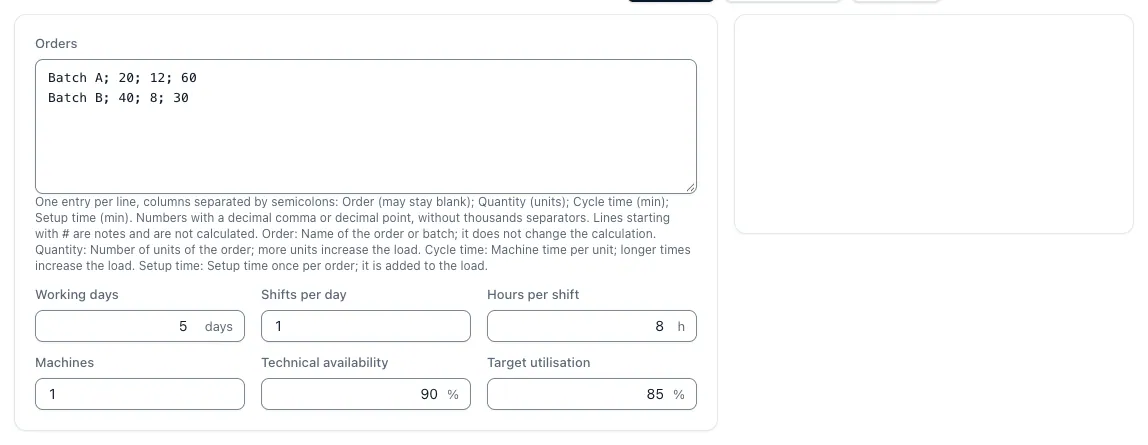
Lot A has 20 parts to 12 minutes and 60 minutes set-up time, Lot B 40 parts to 8 minutes and 30 minutes set-up time. Together the 300 + 350 = 650 minutes or 10,833 hours occupancy.
A machine in one shift operation with 8 hours on 5 days and 90 percent technical availability offers 36.0 hours capacity. The capacity utilization is 10.833 36.0 = 30.1 percent; with 85 percent target capacity one machine is sufficient.
OEE from availability, performance and quality
The OEE, German total plant effectiveness, evaluates a production already completed. Availability is the runtime after standstills in relation to the planned production time, performance the produced quantity times ideal cycle time per part in relation to the runtime, quality the good quantity in relation to the produced quantity. The product of the three factors is the OEE; it can also be calculated directly as a good quantity times ideal cycle time per part divided by the planned time.
With the app's default settings, 450 minutes of scheduled time, 55 minutes of standstill, 3.5 minutes of ideal cycle time per part, 98 parts produced and 3 scrap parts, 87.8 percent of availability, 86.8 percent of performance and 96.9 percent of quality, together 95 × 3.5 ÷ 450 = 73.9 percent OEE.
OEE = Availability × Performance × Quality = Good quantity × Ideal cycle time per part ÷ Planned production time
Capacity utilization is not OEE
The capacity utilization asks whether there are enough orders for the capacity and expects planned times. The OEE asks how well the planned time was actually used and expects measured downtimes, quantities and scrap. A machine can be fully used and still have a low OEE when downtimes, slow cycles or scrap consume the planned time.
The app does not specify any target values for the OEE. A comparison is only useful if planning time, downtime and ideal cycle time per part are defined in the same way.
What the utilization means for the machine hourly rate
The machine hourly rate distributes the fixed costs of a machine over their productive hours. If the load is reduced, less hours bear the same costs, and the rate per hour increases. If you expect the hourly rate to be too high, you calculate too cheaply.
The OEE calculator shows the estimated losses directly: In the example 450 − 95 × 3.5 = 117.5 minutes are lost, at 72 €/h loss cost rate this is 141,00 €. The calculator calculates how productive hours enter the hourly rate.
Sources and classification
- CNC Calculator App: Machine utilization
Formulas and pre-settings of the load calculation from which the first example comes.
- CNC Calculator App: OEE and system losses
OEE relationship, loss time and default settings of the second example.
Questions and answers
How do you calculate the machine load?
Occupancy by jobs divided by available capacity. Occupancy is per order set-up time plus quantity times cycle time per part, capacity days times shifts times hours times machines times technical availability. In the example of the app are the 10,833 h 36.0 h = 30.1 percent.
How to calculate the OEE of a CNC machine?
OEE = Availability × Performance × Quality or direct Good quantity × ideal production time ÷ planned production time. 95 Good parts for 3.5 minutes in 450 minutes of planning time result in 73.9 percent.
What is the difference between utilization and OEE?
The capacity utilization compares planned order hours with the capacity that OEE assesses how effectively the planned time was actually used. Both indicators complement each other and cannot be converted into one another.
Which OEE is good?
The app does not specify any value for this. OEE numbers can only be compared with the same definition of scheduled time, downtime and ideal cycle time per part; the course on the same machine is more meaningful.