The denominator of the machine hourly rate
The machine hourly rate distributes the annual cost of a machine over its productive hours. The meter, i.e. depreciation, interest, space, maintenance and energy, can be determined from supporting documents. The denominator is the actual decision: How many hours does the machine actually run for orders per year? This page deals with the denominator; formula, cost types and a fully calculated example are below Calculating machine hourly rate.
Productive hours instead of shift time
Productive hours are the hours in which the machine works on or is equipped for jobs. Maintenance, faults, times without a job, missing personnel and test runs go off from the scheduled shift time. If you put the shift time in the denominator instead, you calculate a too low rate, and the machine does not earn its costs per year.
Whether setup is one of the productive hours depends on how it is evaluated in the offer: if setup is calculated with the machine hourly rate, it belongs in the denominator; it is not billed, not.
Capacity utilization as denominator of hourly rate
The utilization of the time used is proportional to the time available. The time available is the shift model, i.e. working days times shift hours; the time used is the time when the machine is running or being equipped for orders.
Utilization = Occupied time ÷ Available time × 100
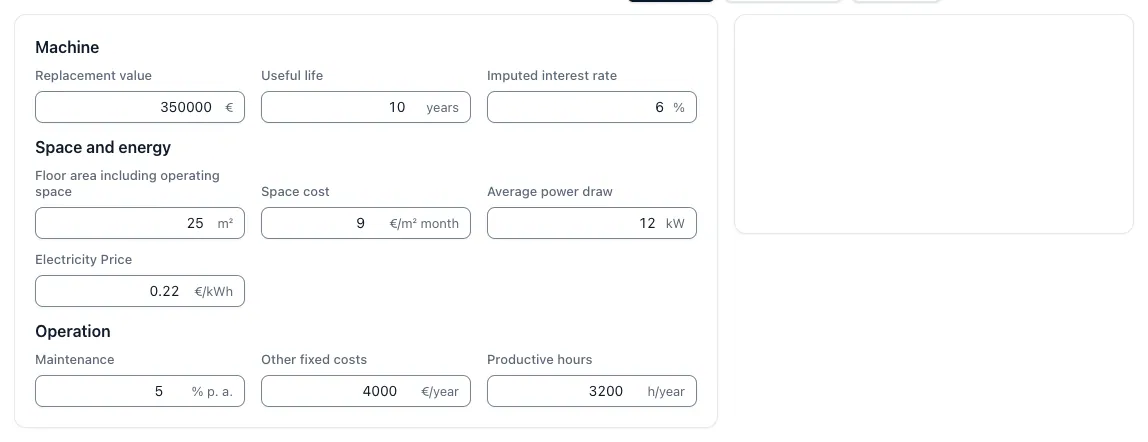
In the calculation example with 53,760 € fixed costs per year and 3.75 € energy per operating hour, the available time is set at 220 working days in two shifts of 8 hours each, i.e. 3,520 hours:
| Productive hours per year | Capacity utilization at 3.520 h available time | Number of hours worked |
|---|---|---|
| 1.200 h | 34,1 % | 48,55 €/h |
| 1.500 h | 42,6 % | 39,59 €/h |
| 1.800 h | 51,1 % | 33,62 €/h |
| 2.400 h | 68,2 % | 26,15 €/h |
| 3.000 h | 85,2 % | 21,67 €/h |
The same machine costs more than twice an hour if it runs one third instead of five sixths of the available time. Example of calculation with round assumptions, no guideline values.
Capacity utilization and OEE differ
Capacity utilization and overall plant efficiency (OEE) measure different things. Capacity utilization asks how much of the available time is covered by orders at all. OEE asks how well the planned production time is used and multiplies three factors: availability, i.e. runtime in relation to the planned time, performance, i.e. actual output, and quality, i.e. good parts in relation to all parts.
OEE = Availability × Performance × Quality
For the hourly rate, utilization counts because it determines the denominator. The OEE shows where capacity is lost within the time occupied, and is more of a tool of production control.
Multi-machine operation in hourly rate
If one person is looking after several machines, the machine hourly rate does not change itself, but the rate per hour of production. Each machine bears only the proportion of the wage to which it binds the operator. With the assumptions of the calculation example, 33.62 € per hour of machine and 38 € wage rate, one person per machine has a rate of 71.62 € per hour, with two machines equally supervised 52.62 € per hour. The complete calculation path with set-up rate and set-off shows hourly rate of CNC milling and turning.
Keep the sentence up to date
For each machine or sufficiently similar group of machines, the rate is documented with the date of validity. New financing, major repairs, changed energy prices or another shift model require a new calculation. Scenarios with different utilization help with investment decisions, but remain separate from the released base rate. In the fully automatic calculation in Pro, each operation calculates with the maintained set of the planned machine; more on this under Fully automatic calculation from drawing and CAD.
Key points
Hourly rate is explained in such a way that inputs, procedures, effects and limits in the CNC calculation remain comprehensible.
- Start productive hours: Shift time is adjusted for maintenance, malfunctions, missing orders and other non-productive times.
- Example open usage: Keep documented and available time separately, so that the denominator of the sentence remains comprehensible.
- Keep current hourly rate: Changes in costs and capacity utilization are recorded, valid and responsible.