Formula for the final dimension height
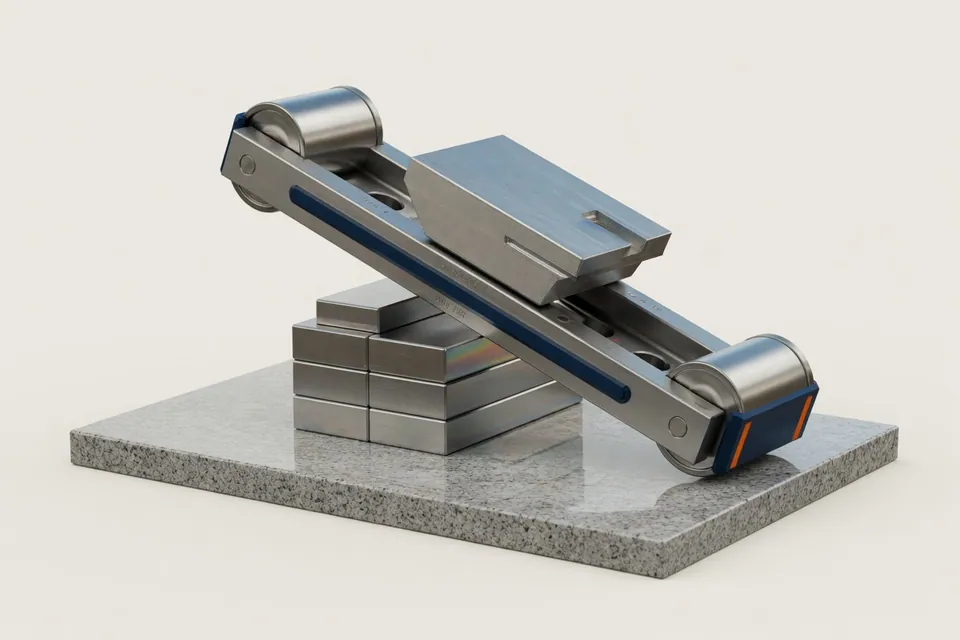
A sine bar lies with a roll on the measuring plate and with the other on a final measurement stack. Roll distance L, final measurement height h and inclination angle α form a right-angled triangle: L is the hypotenuse, h the countercathete. This follows the final measurement height for a desired angle.
L is the distance of the centre points of the roller, not the total length of the ruler. Backward is the result of an existing final dimension height of the set angles with α = arcsin(h ÷ L).
h = L × sin α α = arcsin(h ו L)
Final dimensions for 100 mm and 200 mm roll distance
The table shows the final dimension height for frequently set angles, calculated with h = L × sin α. The app shows four decimal places; for the final dimension combination counts which dimensions the existing set offers.
Final dimension height at sinus lineal by angle
| Angle α | h at L = 100 mm | h at L = 200 mm |
|---|---|---|
| 1° | 1,745 mm | 3,490 mm |
| 2° | 3,490 mm | 6,980 mm |
| 5° | 8,716 mm | 17,431 mm |
| 10° | 17,365 mm | 34,730 mm |
| 15° | 25,882 mm | 51,764 mm |
| 20° | 34,202 mm | 68,404 mm |
| 30° | 50,000 mm | 1000,000 mm |
| 45° | 70,711 mm | 141,421 mm |
Rounded to three decimal places. For other angles and roll spacings, the sine bar calculator of the app calculates.
Sample calculation with the default settings of the app
The defaults are a 100 mm roller spacing and 30°. The gauge block height is 100 × sin 30° = 50.000 mm, and the horizontal projection is 100 × cos 30° = 86.603 mm. Use the fewest blocks from the available set to build the required height.
What limits accuracy
The accuracy of the set angle depends on the roll distance, the tolerances of the final dimensions and the roll distance, the cleanliness of the support surfaces and the temperature. A longer ruler distributes the same height error to a greater distance and therefore adjusts the angle more precisely.
At 100 mm roll distance and 30°, 0.001 mm height error results in approximately 2.4 angle seconds, at 60° already around 4.1 angle seconds, because cos α is smaller with the angle. End dimensions and ruler should have the same temperature; how much steel per Kelvin expands, the side shows for thermal expansion.
Δα ≈ Δh ÷ (L × cos α)
Questions and answers
How high must the final measurement be for 10°?
At 100 mm roll distance 17,365 mm, at 200 mm roll distance 34,730 mm. Calculated with h = L × sin α.
What final dimension does a sine bar need for 30°?
Exactly half of the roll distance, because sin is 30° = 0.5: 50,000 mm at 100 mm and 100,000 mm at 200 mm.
How do I calculate the angle from the final height?
With α = arcsin(h ÷ L). A final stack of 25,882 mm below a 100 mm ruler results in arcsin(0,25882) ᐅ 15°.
Why do big angles become less accurate?
Because an error in the final height shifts the angle by Δh γ (L × cos α) and cos α becomes smaller with an increasing angle. The same height deviation at 60° causes the double angle error as at 0°.