Contributions refer to the same measure
The calculator describes a simplified budget of a length measurement in millimetres with sensitivity factors one. Repeat scattering, display step, calibration uncertainty and another limited residual deviation are converted into standard contributions.
Known systematic deviations must be corrected beforehand. An effect already contained in another article must not be entered again in full.
Convert standard contributions correctly
For the mean of n independent repetitions, the known standard deviation s is divided by √n. A separately considered rounding step d results in equally distributed rounding d/√12. The extended calibration uncertainty is divided by its factor mentioned in the calibration certificate.
An independently assumed equal-distributed half width ±a delivers a/√3. Calibration and systematic residual contributions are not smaller by the same display being read more frequently.
u_c = √[(s/√n)² + (d/√12)² + (U_Kal/k_Kal)² + (a/√3)²]; U = k × u_c
Example of a long-term measurement budget
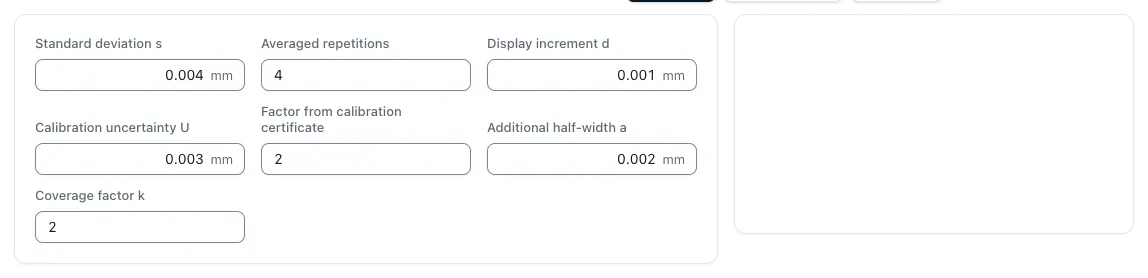
This is assumed to be s = 0.004 mm, four independent repetitions, d = 0.001 mm, a calibration uncertainty of 0.003 mm with factor 2 and another half width of 0.002 mm. The combined standard uncertainty is around 0.002769 mm.
With a specified expansion factor k = 2, 0,005538 mm, increased uncertainty follows. The result is reported together with the corrected measured value, the measured size and the factor. The sample inputs do not prove any properties of a concrete measuring device.
Measurement uncertainty budget of the calculation example
| Contribution | Input | Distribution | Divisor | uᵢ |
|---|---|---|---|---|
| Repeated mean scattering | s = 0.004 mm, n = 4 | normal | √4 = 2 | 0,002000 mm |
| Display resolution | d = 0,001 mm | Rectangle | √12 ≈ 3,464 | 0,000289 mm |
| Calibration according to sham | U = 0.003 mm, k = 2 | normal | 2 | 0,001500 mm |
| Further residual deviation | a = ±0,002 mm | Rectangle | √3 ≈ 1,732 | 0,001155 mm |
| Combined standard uncertainty u_c | √Σuᵢ² | 0,002769 mm | ||
| Increased uncertainty U | k = 2 | 0,005538 mm |
All sensitivity factors are one. The contributions are added squarely; the inputs are assumptions of the example, no properties of a concrete measuring device.
Separation of Over-surplus Probability and Decision
k = 2 stands only under appropriate distribution and freedom assumptions for approximately 95 percent coverage. The calculator does not estimate these prerequisites from a measurement series. In case of correlated contributions or other sensitivities an extended budget is necessary.
Whether a result meets a tolerance is then to be assessed on the basis of the agreed decision rule. An uncertainty of zero with completely empty or zero-set contributions does not prove an unsafe measurement.
Sources and classification
- NIST: Combining uncertainty components
Quadratic combination of independent standard contributions; additional terms are required for correlation.
- NIST: Type B uncertainty
Conversion of limited or documented uncertainty contributions.
- NIST: Expanded uncertainty and coverage factors
The importance of the expansion factor and the preconditions for a probability of overlapping.
Questions and answers
What is a measurement uncertainty budget?
A list of all contributions to the uncertainty of a measurement, such as repeat scattering, resolution, calibration uncertainty and temperature, each as standard uncertainty of the same measurement size. The independent contributions are grouped squarely to the combined standard uncertainty.
How to calculate the extended measurement uncertainty?
The combined standard uncertainty is multiplied by a well-founded extension factor k: U = k × u_c. In the calculation example of this page, 0.002769 mm with k = 2 results in an extended uncertainty of 0.005538 mm.
Does frequent measurement make the whole budget smaller?
No. Only the independent random contribution of the reported mean decreases with n. Calibration and systematic contributions do not disappear by repetition.
Is k = 2 always equal to 95 percent security?
No. The approximation requires appropriate statistical requirements. The factor is specified in the computer, not automatically justified.