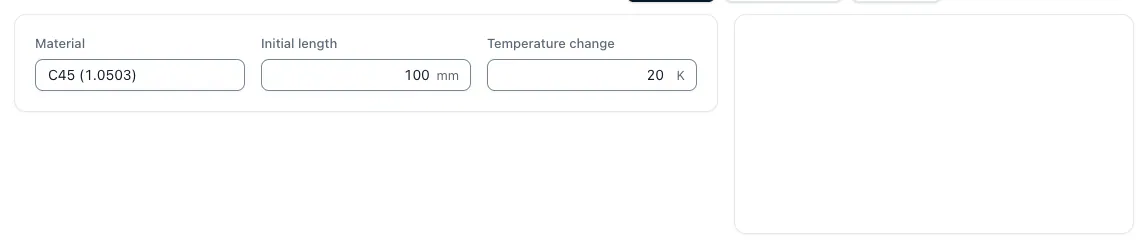
Formula for the extension of length
A component expands in each direction proportional to its length and temperature change. The linear coefficient of expansion α indicates how many micrometers a metre per Kelvin lengths. For small temperature ranges as they occur in production and measuring space, this linear approximation is sufficiently accurate.
With α in μm/(m·K), L in mm and ΔT in K ΔL in mm is obtained when the product is divided by 1,000,000. A cooling is a negative ΔT and shortens the part by the same amount.
ΔL = α × L × ΔT
Example of calculation: aluminium and steel at 10 K difference
A milling part made of EN AW-6082 is 200 mm long and comes out of the machine at 30 °C; later it is measured at 20 °C. With α = 23.4 μm/(m·K) it is warm by 23.4 × 200 × 10 ÷ 1,000,000 = 0.047 mm longer than at reference temperature. The same part of C45 with α = 11.5 μm/(m·K) grows only by 0.023 mm.
For comparison: The tolerance of a fitting hole Ø 200 H7 is 46 μm. The temperature at the warm aluminium part consumes already around the whole tolerance of such a fit. Those who measure warm and correct to measure, the part produces after cooling too small.
Expansion coefficients for steel, aluminium and plastics
The table shows the guide values of the app's material database, the same coefficient in mm/(m·K) as is customary in house technology, the change in length of a 100 mm long dimension at 10 K and the change in length per meter at 50 K. Plastics stretch about four to fifteen times more strongly than steel, and the value also depends on grade, filler and humidity.
Coefficient of expansion and change in length per material
| Material | α in μm/(m·K) | ΔL at 100 mm and 10 K | α in mm/(m·K) | ΔL per metre at 50 K |
|---|---|---|---|---|
| Structural steel S235JR (1.0038) | 12 | 12 µm | 0,012 | 0,6 mm |
| Remuneration steel C45 (1.0503) | 11,5 | 11,5 µm | 0,0115 | 0,58 mm |
| Stainless steel X5CrNi18-10 (1.4301) | 16 | 16 µm | 0,016 | 0.8 mm |
| Grey cast iron EN-GJL-250 | 10 | 10 µm | 0,01 | 0,5 mm |
| Aluminium EN AW-6082 | 23,4 | 23,4 µm | 0,0234 | 1,17 mm |
| Brass CuZn39Pb3 (2.0401) | 20,9 | 20,9 µm | 0,0209 | 1.05 mm |
| Titanium Ti-6Al-4V (3,7165) | 8,6 | 8,6 µm | 0,0086 | 0,43 mm |
| POM-C | 110 | 110 µm | 0,11 | 5,5 mm |
| PA 6 | 90 | 90 µm | 0,09 | 4,5 mm |
| PEEK | 47 | 47 µm | 0,047 | 2,35 mm |
| PE-HD | 180 | 180 µm | 0,18 | 9 mm |
Standard values for room temperature from the app's material database. The values from the data sheet of the concrete material apply to design and tight tolerances.
Length expansion of plastic
The material database of the app lists four plastics with a coefficient of expansion: POM-C with 110, PA 6 with 90, PEEK with 47 and PE-HD with 180 µm/(m·K). A 1 m long part made of POM-C will lengthen by 110 × 1,000 × 30 ÷ 1,000,000 = 3.3 mm when heated to 30 K, while an equally long steel part made of C45 will only lengthen by 0.35 mm.
For plastics, the coefficients are indicative for unfilled varieties at room temperature. Glass fibres or other fillers reduce the expansion, often depending on the direction, and polyamides also change their dimensions with the moisture absorbed. Therefore, for fit dimensions on plastic parts, measuring and operating temperature and, if necessary, the humidity condition are part of the drawing.
Area and volume expansion
An isotropic material expands equally in all directions. For small temperature changes, an area therefore grows about twice as much, a volume about three times the linear coefficient. An aluminium cube made of EN AW-6082 with a side length of 100 mm, i.e. 1,000,000 mm³, grows by 3 × 23.4 × 10⁻⁶ × 1,000,000 × 10 = 702 mm³ at 10 K.
The length change of individual dimensions is usually important for production and measurement. The volume expansion becomes important when a cavity is filled, for example, in the case of oil in a closed housing or in the case of casting compounds, where the volume coefficient of the filler, not that of the housing, applies.
ΔA ◄ 2 × α × A × ΔT ΔV ◄ 3 × α × V × ΔT
Longitudinal expansion of steel at greater warming
A 500 mm long shaft made of S235JR, which warms up by 40 K during operation, becomes by 12 × 500 × 40 ÷ 1,000,000 = 0.240 mm longer. If it is clamped between two fixed bearings, forces arise from it; therefore, long waves have a batch and a fixed bearing. For this design, the temperature in operation, not the temperature in the measuring room, is required.
At large temperature ranges, such as when shrinking or treating heat, α is no longer constant, and structural changes also change the volume. Then the linear formula is only a rough Anhalt.
What this means for measurement and tolerance
Measurements and tolerances on the drawing apply according to ISO 1 at 20 °C. For narrow tolerances, part and measuring medium are therefore brought to room temperature before the measurement, or the measurement is corrected mathematically. If part and measuring medium have the same material and the same temperature, the expansions are largely eliminated; for aluminium parts and steel measuring instruments, the dimensions do not.
This is shown in the calculation as time: cooling before final measurement, a flat cut after tempering or an air-conditioned measuring room. The app's measurement uncertainty calculator can record how much the temperature contributes to the measurement result as its own contribution.
Sources and classification
- ISO 1:2022 – Reference temperature for geometric product specifications
Dimensions and tolerances apply at the reference temperature of 20 °C. The expansion coefficients are indicative values from the app's material database; the examples are own calculations.
Questions and answers
How do you calculate the length expansion?
With ΔL = α × L × ΔT. α, the coefficient of expansion in μm/(m·K), L is the length in mm and ΔT is the temperature change in K; the product divided by 1,000,000 is ΔL in mm. 200 mm aluminium at 10 K: 0.047 mm.
How much does steel expand per meter and degree?
An unalloyed steel such as C45 with α = 11.5 µm/(m·K) expands by 11.5 µm, or 0.0115 mm, per metre and kelvin. S235JR structural steel expands by 12 µm per metre and kelvin. A 50 K increase adds 0.58 mm per metre of C45.
How large is the coefficient of expansion of steel?
For unalloyed and low alloy steels it is about 11 to 12 μm/(m·K), in the material database of the app for example 11,5 for C45. Austenitic stainless steel such as 1,4301 expands significantly with 16 μm/(m·K).
Why do plastics stretch so much?
Their coefficients are multiples of steel, for example 110 μm/(m·K) for POM-C and 180 μm/(m·K) for PE-HD in the app. A 100 mm long measure of PE-HD changes by 0.18 mm at 10 K.
At which temperature do drawing dimensions apply?
At 20 °C, the reference temperature according to ISO 1. If a part is measured warmer or colder, the expansion of part and measuring medium shall be taken into account.