What the app's material database contains
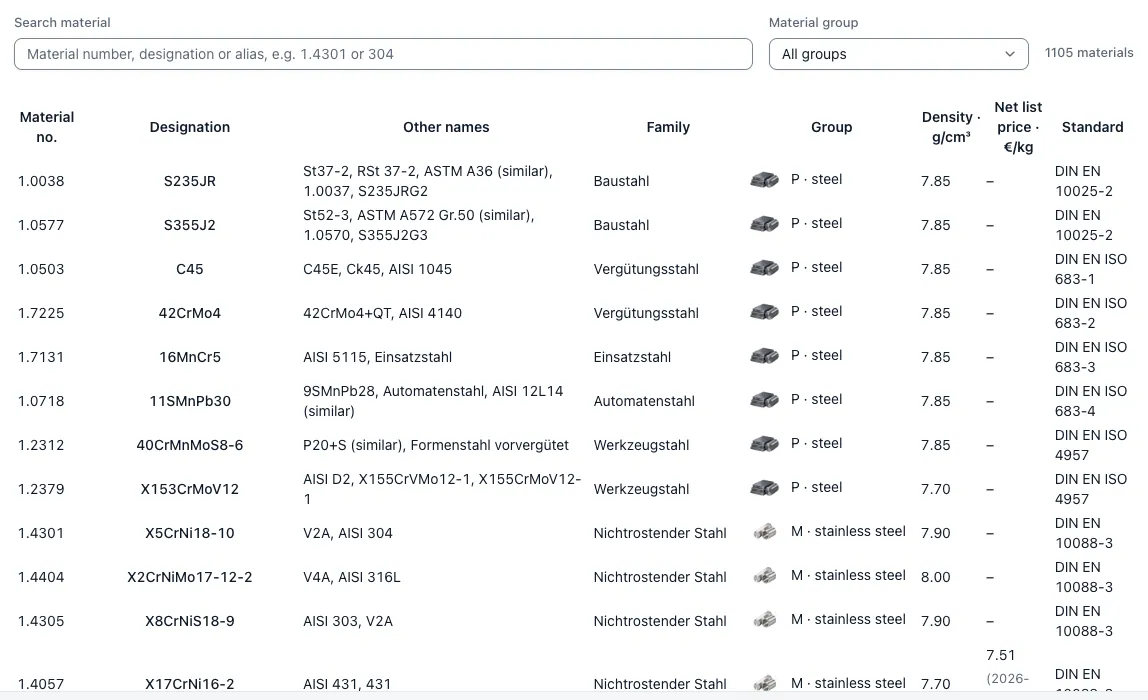
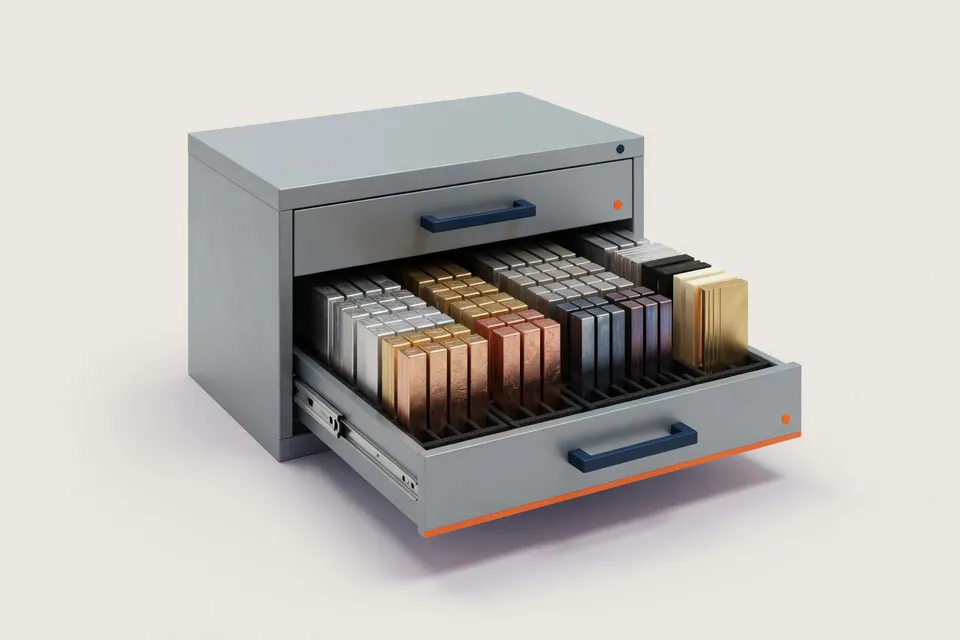
The material database is the list of all materials with which the app deals: steels, stainless steels, castings, aluminum, copper materials, titanium, nickel alloys and plastics. Search is done by material number, short name or another designation; the search field also understands inputs such as "316L" or "V2A". Use is free and without an account.
For each material, the list shows material number, short name, further designations, family, material group according to ISO 513 (P, M, K, N, S, H, with O for plastics and composite materials), density in g/cm³ and standard. Where a price is researched, there is a dated net small quantity price of a dealer with source; this is not an offer, without research the field remains empty. As of 13.11.2026 the database lists 1,015 materials.
The density is directly used by the supply bot, the AI offer and the stock weight calculator. Densities and assignments are indicative values for the calculation; delivery status, factory certificate and manufacturer's specifications have priority.
Read material number according to DIN EN 10027-2
For steels, DIN EN 10027-2 defines the numbering system, currently in the July 2015 issue. The first digit is the main material group, 1 stands for steel. After the point, the two-digit steel group number and the counting number follow. In 1,4301 1 is the main steel group, 43 the steel group and 01 the counting number. With the 2015 issue, the counting number was extended by two digits, because some steel groups were fully occupied.
Non-ferrous metals also carry material numbers in the database, such as 3.2315 for the aluminium alloy EN AW-6082, 2.0401 for the brass CuZn39Pb3, 3.7165 for Ti-6Al-4V and 2.4668 for the nickel alloy NiCr19Fe19Nb5Mo3. These numbers do not regulate DIN EN 10027-2; the standard only applies to steels.
Material numbers for stainless steel
The table shows frequently sought-after stainless steels as they are in the app's material database. The density is the benchmark with which the app expects stock weight and material costs.
Material numbers for stainless steel in the material database
| Material number | Short name | Other names | Density in g/cm3 |
|---|---|---|---|
| 1.4301 | X5CrNi18-10 | V2A, AISI 304 | 7,9 |
| 1.4305 | X8CrNiS18-9 | AISI 303 | 7,9 |
| 1.4404 | X2CrNiMo17-12-2 | V4A, AISI 316L | 8,0 |
| 1.4571 | X6CrNiMoTi17-12-2 | AISI 316Ti, V4A | 8,0 |
| 1.4462 | X2CrNiMoN22-5-3 | Duplex, UNS S31803, UNS S32205 | 7,8 |
| 1.4529 | X1NiCrMoCuN25-20-7 | Alloy 926, US N08926, 6Mo steel | 8,1 |
| 1.4547 | X1CrNiMoCuN20-18-7 | US S31254, 6Mo steel | 8,0 |
Values from the app’s material database, as of 13 November 2026. AISI, UNS and other equivalent designations are for comparison. Check suitability before substituting a grade.
Comparison of materials and replacement material
European material numbers and American designations such as AISI are not 1:1 correspondences. Chemical limits, strength values and delivery forms differ in detail, even if the varieties are named the same in everyday life. The database identifies comparable but not identical designations with "(similar)"; this is expressly not an exchange release.
For a replacement material, the calculator compares the app's properties of two materials side by side. It prepares the technical test; whether a replacement is permitted, decides the design or the customer.
Density weight of flat and strip steel
The weight of a flat or strip steel is width times thickness times length times density. A strip of S235JR with 50 mm width and 2 mm thickness has a volume of 50 × 2 × 1.000 = 100.000 mm³, i.e. 100 cm³. With 7.85 g/cm³, the meter weighs 0.79 kg; the same tape of 1.4301 with 7.9 g/cm³ weighs 0.79 kg.
Round material, pipes and cuttings with machining dimensions are calculated by the stock weight calculator; it takes over the density from the same database.
m = b × t × L × ρ
Sources and classification
- DIN EN 10027-2:2015-07 – Designation systems for steels, Part 2: Numbering system
Structure of the material numbers for steels. Material numbers, short names, aliases and densities of the tables are from the material database of the app; delivery status and factory certificate have priority.
Questions and answers
Which material number has 6Mo?
6Mo is not a single variety, but a collective name for high-alloy austenitic steels, named after their molybdenum content. In the material database of the app, two varieties carry this alias: 1.4529 (X1NiCrMoCuN25-20-7, Alloy 926) and 1.4547 (X1CrNiMoCuN20-18-7, UNS S31254). Which is meant clarifies the drawing or the order.
What does 1.4 mean in the material number?
The 1 is the main material group steel, the 4 is the first digit of the steel group number. All stainless steels in the material database have numbers starting with 1.4; in reverse, heat-resistant, heat-resistant steels and cast steel grades are also among the 1.4 numbers.
Where can I find the density of 1.4301?
In the app's material database: 1.4301 (X5CrNi18-10, V2A) stands there at 7.9 g/cm³. This value is also expected by the quote assistant and the stock weight calculator.
How do I calculate the weight of strip steel?
Width × Thickness × Length × Density. A strip 50 × 2 mm made of S235JR weighs 0.79 kg per metre at 7.85 g/cm³. All dimensions calculated in mm result in mm³; divided by 1,000 it is cm³, multiplied by density in g/cm³ grams.
Are AISI 316L and 1.4404 the same?
AISI 316L is listed in the material database as a further designation of 1.4404. However, the standards are not equivalent in terms of exchange clearance; in the case of acceptance, certificate and replacement, the material specification of the drawing applies.