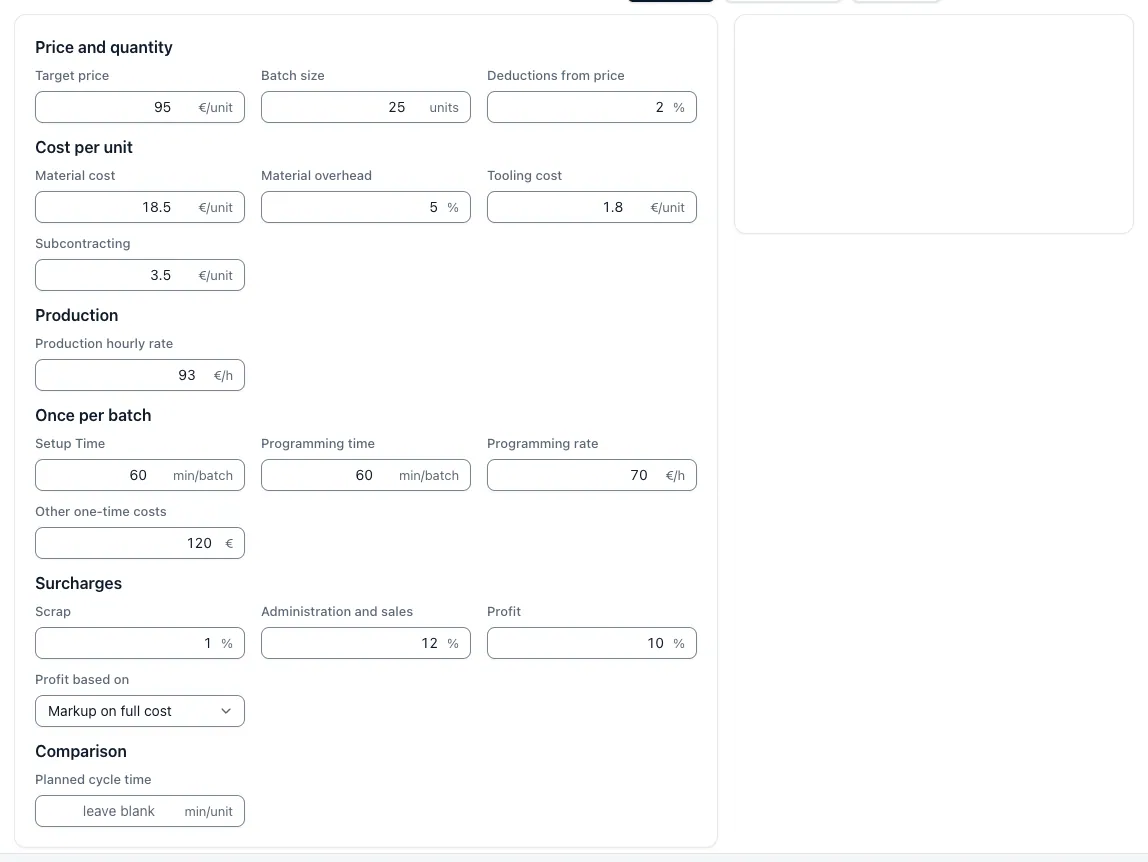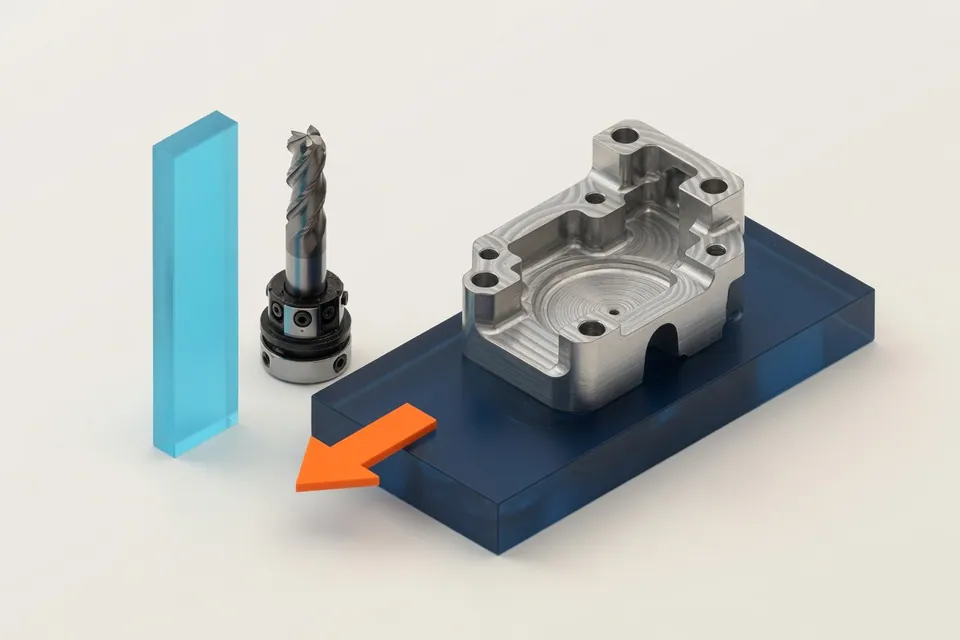
The price is fixed for the reverse calculation. After deduction of margin, overhead costs, material, external performance and set-up share, a budget for machine time remains – divided by the hourly rate, this results in the maximum permissible processing time per piece.
Formulas
Zulässige Selbstkosten = Preis × (1 − Marge)From price to cost
The margin shall be deducted from the selling price, not added.
Zulässige Herstellkosten = Selbstkosten ÷ (1 + GK)Calculate overheads
The overhead charge will be removed backwards.
Budget = Herstellkosten − Material − Fremdleistung − RüstanteilBudget for machine time
What remains after all other positions.
t_max = Budget ÷ Stundensatz × 60Maximum allowed time
The budget in minutes machine time per piece converted.
Customer demands 45 € per piece at 20 pieces
18,50 € Material, no external performance, 72 €/h Machine hourly rate, 75 minutes set-up time, 18 % overhead costs, 12 % target margin.
- Permissible cost = 45 × (1 − 0.12)39,60 €
- Permissible manufacturing costs = 39.60 ÷ 1.1833,56 €
- Set-up percentage per piece = 75 + 60 × 72 + 204,50 €
- Budget for machine time = 33.56 − 18.50 − 4.5010,56 €
- Permissible time = 10.56 ÷ 72 × 608.8 min
ResultThe part may take a maximum of 8.8 minutes of machine time per piece.
If the realistic processing time is 24 minutes, the target price cannot be presented with this process – in contrast, 200 instead of 20 pieces would be available for about 12.2 minutes.
The target price answers another question
The forward calculation says what a part costs. The reverse calculation says how fast you have to be – and thus makes it visible whether a required price can be reached at all with the planned process.
Questions and answers
What is a reverse calculation?
The price is fixed in the reverse calculation and the permissible costs are derived from it. Margin, overhead costs, material, external performance and the set-up portion are deducted from the required sales price. What remains is the budget for machine time – converted with the hourly rate, which results in the maximum permissible processing time per piece.
What do you need this for in contract manufacturing?
If a customer calls a target price or a competitive price is known, the reverse calculation shows immediately whether the order with the planned process is feasible. It answers the question "How fast would we have to be?
What if the time allowed is below the realistic?
Then there are three honest options: change the process (other machine, less tension, larger batch size, cheaper stock), consciously reduce the margin and document it, or cancel it. Depreciate the time afterwards, the problem only shifts to production.
Why is the margin calculated from the selling price?
Because a margin is defined as a share of the selling price, a premium is defined as a share of the cost of production. 12 percent margin corresponds to around 13.6 percent surcharge. Those who confuse both lose exactly this difference in the result.
What is a target price formula?
In purchasing, a target price formula is a price formula that derives the reasonable price of a part from its characteristics, such as weight, material and scope of processing. In the calculation, it refers to the reverse calculation from the required price to the permissible costs and the permissible processing time, as on this side. In trading, the target price is also the price before deduction of discount, i.e. the price when paying in the payment destination.
How does the lot size affect the target price?
Very strong: the set-up percentage per piece decreases with increasing quantity and releases budget for machine time. A price that is impossible with 20 pieces can be comfortable with 200 pieces. Therefore, each target price includes a lot.