Price of a milling part from clampings, time and one-off costs
The price of a milling part is determined in the same order as its production. First, the stock is: plate, cut or strand section including dimensions and clamping addition, evaluated with weight and material price. Then, the processing follows per clamping, separately after grinding, pre-sharpening, finishing, drilling, threading and deburring. Only at the end, the one-off expenditure for programming, device and initial samples, as well as overhead costs and margin distributed over the batch size, is added.
Size of an example
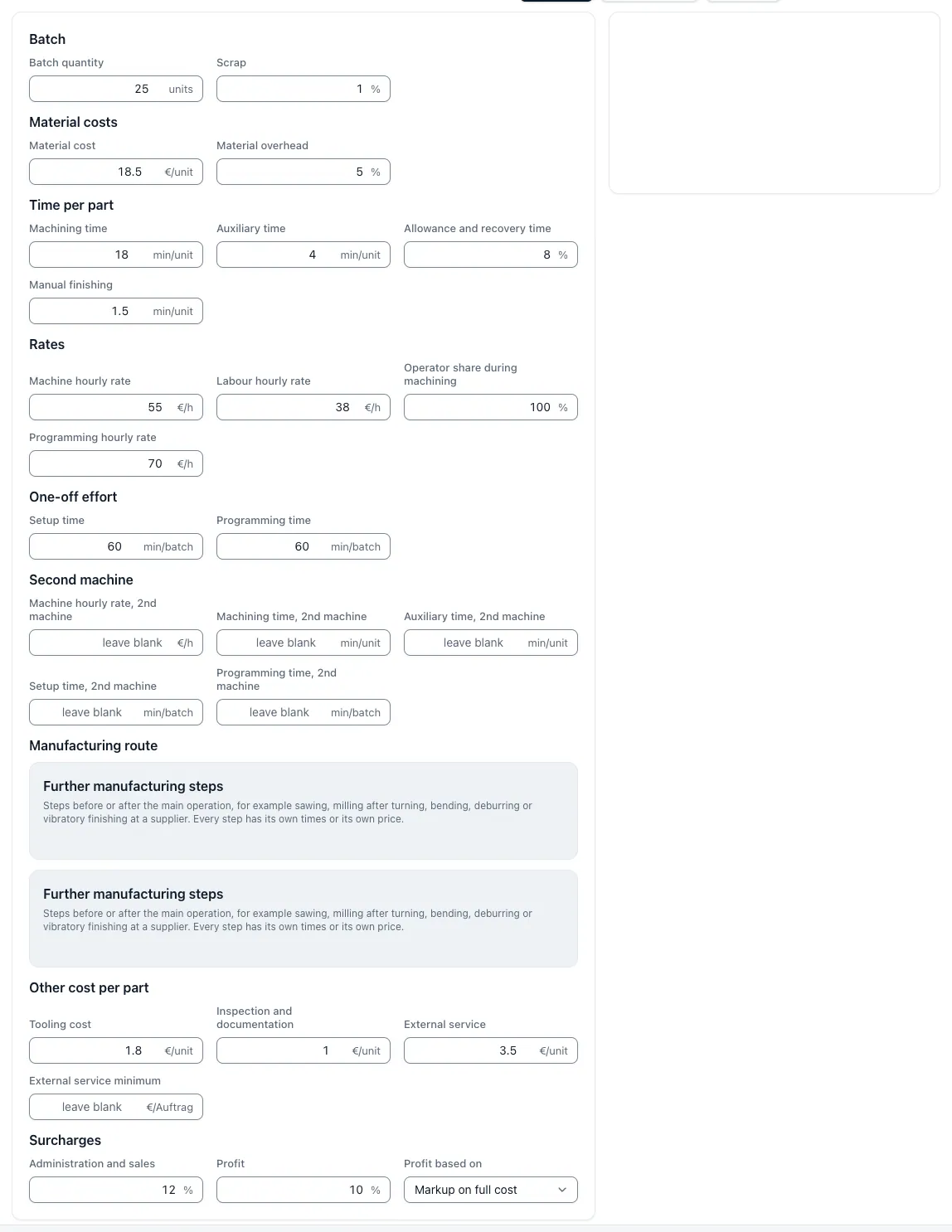
An aluminium milling machine with 24 minutes processing time, 18.50 € material content and an hourly rate of 72 €/h results in 28.80 € production costs plus material, i.e. 47.30 € per piece before one-off costs and surcharges. 75 minutes of setup and 180 € programming result in 270 € per order: for 20 pieces 13.50 € per piece, for five pieces 54 €. With 18 % overhead costs and 12 % margin, the part costs 425.47 € for one piece, for 100 pieces 67.05 €. The processing is identical in all cases – the price difference arises exclusively from the distribution of fixed parts. The whole season and one variant with three clampings are under Calculation milling parts.
What drives the price of a milling part upwards
In terms of design, there are four main things that drive time: additional clamping, small inner radii that force small tools and thus small cutting values, deep pockets with long collar lengths, and a high number of holes and threads. A component with little machining volume, but forty holes and twenty threads can be significantly more expensive than a component with large but simple pocket processing. In addition, tight tolerances, fine surfaces, foreign performance such as anodizing or hardening and the required documentation.
Making offers comparable
The same rule applies to reliable offers as when turning: first the time per operation, then the price. Who compares offers, pays attention to the same quantity, the same revision, the same scope of delivery and the same test scope – and whether scaled prices have a plausible course. You can check the calculation path with the unit cost calculator and the relay price calculator with your own numbers; the path shows without registration Milling parts online calculate.
In Pro, the CNC Calculator app from drawing and STEP model automatically creates a calculation design with voltages, times, costs and relays that you check and release; Pro is unlocked on request. Read more under Full automatic calculation from drawing and CAD.
Key points
Price formation is explained in such a way that inputs, procedures, effects and limits in the CNC calculation remain comprehensible.
- Stress count: Each additional layer brings setup, alignment, touch and a new tolerance risk.
- Time before price: Only when the time is per work, the hourly rate is a reliable number.
- To disclose one-off costs: Program, device and initial samples are offered as their own position.