Lowering depth of a cone lowering
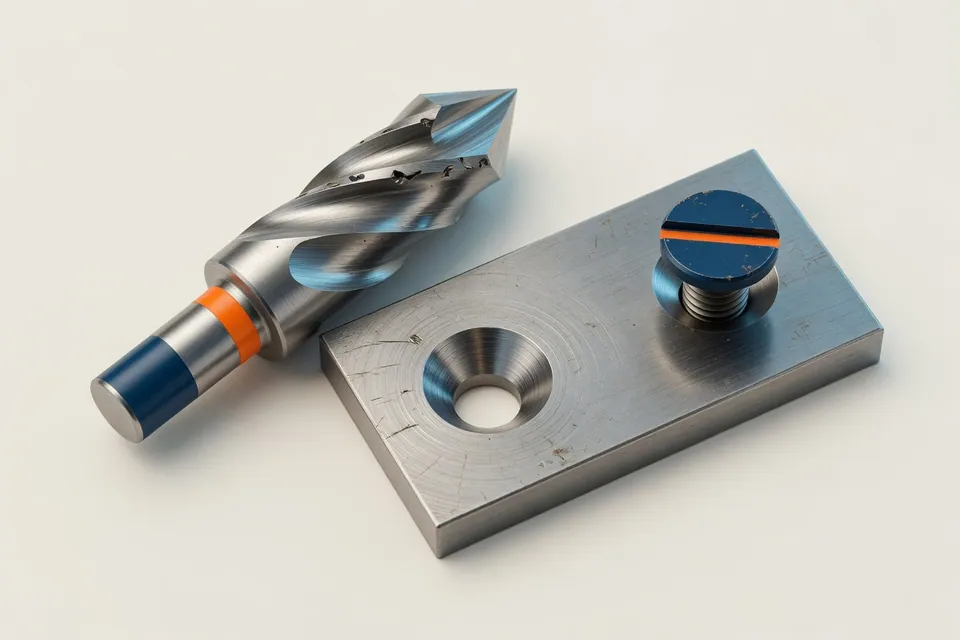
The cone lowering connects the sink diameter D at the surface via a cone with the total angle α with the drill diameter d. The axial depth between both diameters follows from the half cone angle. At 90° tan 45° is equal to one, and the sink depth is half the diameter difference.
Example with 20 mm diameter on an 11 mm bore: At 90° the depth (20 − 11) is 2 = 4.5 mm, at 120° only 2.6 mm. Larger angles therefore require less axial depth for the same diameter. The calculator expects both diameters and the total angle and reports when the diameter of the cone is smaller than the bore.
t = (D − d) ו (2 × tan(α 简 2))
Z-depth of the sinker in the NC program
The depth of the drop describes the workpiece, not the position of the tool. A pointed cone sinker dives deeper than the lowering is deep because its tip is protruding into the bore. For the programmed Z depth of the tip, the path from the tip diameter d_s of the tool to the sink diameter counts.
For a sharp 90° tool, the Z depth is half the countersink diameter, or 10 mm instead of 4.5 mm in the example. If the tip has a flat, enter its diameter as the small diameter. At 90°, changing the Z depth by 0.1 mm changes the countersink diameter by 0.2 mm. The tool angle must match the drawing angle to achieve the specified depth and diameter.
z_tip = (D − d_s) ו (2 × tan(α 简 2))
Cylinder lowering from head dimensions and free space
For cylinder head screws, a cylindrical lowering with a flat base is produced.The calculator cylinder lowering is based on the actual largest head diameter and the head height of the screw used and adds the desired clearance: radial on each side, axially under the head. For head Ø 10 mm, 6 mm head height, 0.5 mm radial and 0.3 mm axial clearance, a lowering of Ø 11 × 6.3 mm is achieved.
The result is a geometric derivation from your head dimensions, not a standard lowering. Washers, tool access, residual wall thickness and component strength check separately; if the reduction in the drawing is dimensioned, the drawing applies.
D = d_head + 2 × s_radial · t = h_head + s_axial
Fase at bore and edge
A chamfer is usually given as axial depth times angle, about 0.5 × 45°. The chamfer calculator of the app calculates the angle to the axis the radial width b and the slanted length s. At 45° depth and width are the same, the slanted length is 0.71 mm. At 30° to the axis and the same depth the width shrinks to 0.29 mm.
For a fase at the bore edge with a 90°-sink, the thread and the lowering calculation are related: a hole Ø 8.5 mm with 0.5 mm fase gets a sink diameter of 8.5 + 2 × 0.5 = 9.5 mm, the sink depth is 0.5 mm.
b = h × tan α · s = h ו cos α
Reductions in unit time and costs
The cutting time of a reduction is short. Expensive is it about the round around: another tool change, the restart of each hole and, if necessary, a work on the back. In many holes, these downtimes count more than the downtime itself.
An example with assumed values: 24 cone-downs of 4.5 mm depth, driven at 200 mm/min, need about 1.4 seconds cutting time per reduction. With 4 seconds positioning time per bore and a tool change of 6 seconds, approximately 2.2 minutes per part come together, of which only about a quarter on average.
It is therefore worth the calculation to carry downs and threads as your own position with number, tool change and positioning time. The tool change time and the main time drilling with rapid flow between the holes provide the building blocks for this in the app.
Questions and answers
How deep must a 90° reduction be?
At 90°, the depth of the sink is half the difference between the diameter of the sink and the diameter of the drill: t = (D − d) 2nd For Ø 20 mm on an 11 mm bore, this is 4.5 mm.
How deep must a cone lowering be for M6?
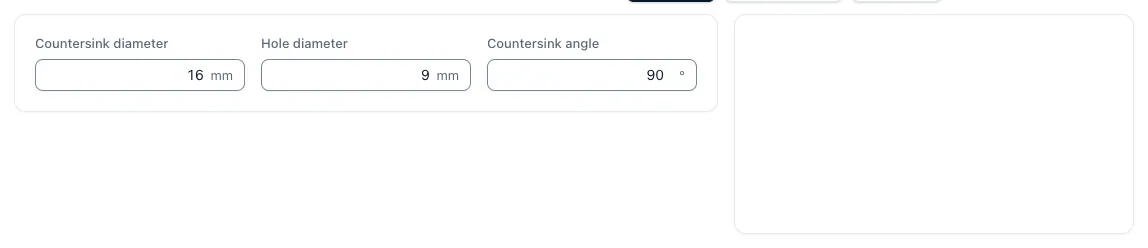
This depends on the sink diameter, the drawing or data sheet of the countersunk screw; the app does not contain any standard lowerings. At 90° t = (D − d) 2 applies. With the through hole 6.6 mm (range medium, as in the thread table) and for example a sink diameter of 13 mm from the drawing are the (13 − 6,6) 2 = 3,2 mm. The calculator cone lowering is preloaded with 16 mm, 9 mm and 90°; enter your values there.
Which diameter is part of my countersunk screw?
The head diameter is in the data sheet or in the standard of the screw, the lower dimension in the drawing. The app calculates the geometry from these dimensions, but contains no tables with standard reductions.
Why is the Z-depth in the program larger than the depth of the sink?
Because the tip of the sinker rises into the bore. The tool tip is programmed, i.e. the path from the tip diameter to the sink diameter. At 90° and pointed tool this is the half sink diameter.
How do I calculate a fase 1 × 45°?
At 45° to the axis, axial depth and radial width are the same, i.e. 1 mm here. The slanting length is 1 cos 45° ᐅ 1.41 mm.