Drill speed from cutting speed and diameter
The cutting speed vc applies to the cutting corners, i.e. to the full drill diameter. At the middle, it falls off and is almost zero at the cross-cutting. The speed follows from vc and diameter D, the feed speed from the feed per revolution f. A spiral drill has two main cuts, each of which therefore carries half of f.
If the machine limits the speed, the drilling calculator continues to calculate the maximum speed and shows the actual cutting speed achieved. This applies in particular to small drills: A carbide drill with a diameter of 3 mm would take about 8,490 1/min in 42CrMo4 with the starting value. At a spindle with 8,000 1/min, vc drops to 75 m/min, the feed speed accordingly.
n = vc × 1000 γ (π × D) · vf = f × n
Speed table Drilling by drill diameter
The table calculates the drill speed for the middle of the start area "vc Drilling" the app's material database, for coated solid carbide drills with internal cooling. The larger the drill, the smaller the speed, because the diameter is in the denominator of the formula.
Speed table Drilling by drill diameter (hard metal)
Drill speed n in 1/min, in brackets the cutting speed at which was expected.
| Drills Ø | S235JR (105 m/min) | C45 (95 m/min) | 1.4301 (70 m/min) | EN AW-6082 (250 m/min) | CuZn39Pb3 (175 m/min) |
|---|---|---|---|---|---|
| 2 mm | 16.711 | 15.120 | 11.141 | 39.789 | 27.852 |
| 3 mm | 11.141 | 10.080 | 7.427 | 26.526 | 18.568 |
| 4 mm | 8.356 | 7.560 | 5.570 | 19.894 | 13.926 |
| 5 mm | 6.685 | 6.048 | 4.456 | 15.915 | 11.141 |
| 6 mm | 5.570 | 5.040 | 3.714 | 13.263 | 9.284 |
| 8 mm | 4.178 | 3.780 | 2.785 | 9.947 | 6.963 |
| 10 mm | 3.342 | 3.024 | 2.228 | 7.958 | 5.570 |
| 12 mm | 2.785 | 2.520 | 1.857 | 6.631 | 4.642 |
| 16 mm | 2.089 | 1.890 | 1.393 | 4.974 | 3.482 |
| 20 mm | 1.671 | 1.512 | 1.114 | 3.979 | 2.785 |
Starting values for the planning; mandatory are the data of the drill manufacturer. Without internal cooling and deep drilling, the values are lower. Values above the maximum speed of the spindle are not mobile.
Speed table for HSS drills
For drills made of high-speed steel, the app's calculator reduces the cutting speed to 30 percent of the carbide value, with unchanged feed. The speeds are reduced in the same ratio.
Speed table Drilling by drill diameter (HSS)
Drill speed n in 1/min for HSS drills, in brackets the cutting speed.
| Drills Ø | S235JR (31.5 m/min) | C45 (28.5 m/min) | 1.4301 (21 m/min) | EN AW-6082 (75 m/min) | CuZn39Pb3 (52.5 m/min) |
|---|---|---|---|---|---|
| 2 mm | 5.013 | 4.536 | 3.342 | 11.937 | 8.356 |
| 3 mm | 3.342 | 3.024 | 2.228 | 7.958 | 5.570 |
| 4 mm | 2.507 | 2.268 | 1.671 | 5.968 | 4.178 |
| 5 mm | 2.005 | 1.814 | 1.337 | 4.775 | 3.342 |
| 6 mm | 1.671 | 1.512 | 1.114 | 3.979 | 2.785 |
| 8 mm | 1.253 | 1.134 | 836 | 2.984 | 2.089 |
| 10 mm | 1.003 | 907 | 668 | 2.387 | 1.671 |
| 12 mm | 836 | 756 | 557 | 1.989 | 1.393 |
| 16 mm | 627 | 567 | 418 | 1.492 | 1.044 |
| 20 mm | 501 | 454 | 334 | 1.194 | 836 |
Experience factor of the app, not a separate measurement series; binding are the data of the drill manufacturer.
Calculate speed for centring drills and flax sinkers
The formula remains the same, the diameter is decisive. The cutting speed is highest where the tool cuts with the largest diameter. In the centring drill, this is not the cone, but the largest diameter achieved by the cone when centring. At the flax sink it is the sink diameter.
Example with a freely selected value of 25 m/min for a centring drill A 2.5 with 2.5 mm cones and 6.3 mm cone diameter: The cone diameter results in about 1,263 1/min. If you expect the cone instead, you will get 3,183 1/min; at the cone, the cutting speed would then be about 63 m/min, which is far above the specified value.
A flax sinker with 11 mm diameter, for example for the head lowering of an M6 cylinder screw, runs at assumed 40 m/min with approximately 1,157 1/min. Lowerers and centring drills have their own manufacturer specifications; the values here show only the calculation path. Lowering depths calculate the page lowering.
n = vc × 1000 γ (π × D_max)
Starting values per material and cutting material
If you leave cutting speed and feed empty, the computer takes the middle of the area from the app's material database. The values apply to coated solid carbide drills with internal cooling. The feed is stored for 10 mm diameter and is converted to the selected diameter with (D ÷ 10)^0.75. For HSS drills, the computer lowers the cutting speed to 30 percent, because high-speed steel can withstand significantly less heat.
These are starting values for the planning. The data provided by the drill manufacturer for material condition, type of drill, cooling and drilling depth are binding; without internal cooling and deep drilling, cutting speed and feed are further reduced. Some areas from the database, each cutting speed and feed per revolution at 10 mm:
- S235JR: 80 to 130 m/min, 0.15 to 0.30 mm
- C45: 70 to 120 m/min, 0,12 to 0,25 mm
- 42CrMo4: 60 to 100 m/min, 0.10 to 0.22 mm
- X5CrNi18-10 (1.4301): 50 to 90 m/min, 0.08 to 0.18 mm
- EN-GJL-250: 80 to 140 m/min, 0.15 to 0.30 mm
- EN AW-6082: 150 to 350 m/min, 0.12 to 0.30 mm
- Ti-6Al-4V: 25 to 50 m/min, 0.06 to 0.12 mm
Clamp thickness, torque and axial force
With the load calculation on, the calculator determines the cutting thickness per cutting edge h = f ÷ 2 × sin(σ ⇩ 2) from feed and tip angle σ. Using the Kienzle approach, the specific cutting force kc and with the material removal rate follows the cutting power on the cutting edge. The torque must be able to deliver the spindle at exactly this speed; below the corner speed there is less than the nominal power available.
The axial force is estimated by the calculator as Ff ᐅ kc × f × D 2. It is a rough guide value including cross-cutting, grinding and wear. Nevertheless, it shows early whether a thin-walled component or a clamping device with a small support can absorb the drilling force.
Q = π × D² ÷ 4 × vf ÷ 1000 · Pc = Q × kc ÷ 60 000 · Mc = Pc × 30 000 ÷ (π × n)
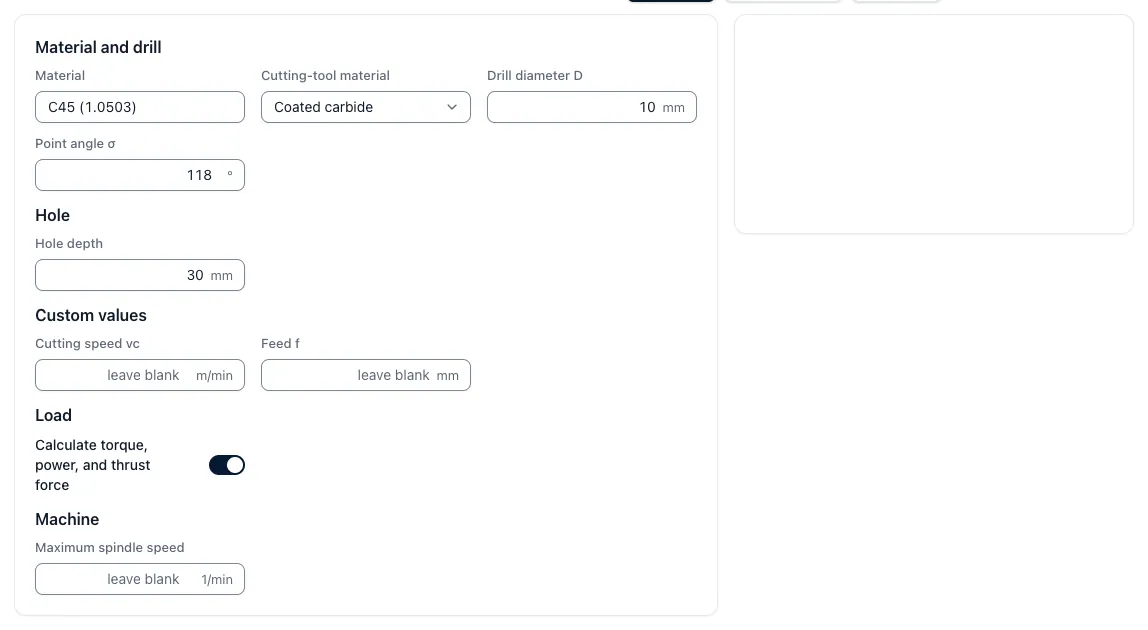
Example of calculation: hole Ø 10 mm in 42CrMo4
Solid carbide drills with 10 mm diameter and 140° tip angle, 30 mm cylindrical drilling depth, starting values from the database. For comparison in brackets the same diameter as HSS drills with 118° tip angle with the same feed:
- Cutting speed 80 m/min, feed 0.16 mm (HSS: 24 m/min, 0.16 mm)
- Speed 2,546 1/min, feed speed 407 mm/min (HSS: 764 1/min, 122 mm/min)
- material removal rate 32.0 cm³/min (HSS: 9.6 cm³/min)
- Torque 9.8 Nm, cutting power 2.6 kW, axial force around 3,900 N
- Drilling time including tip 0.078 min or 4.7 s (HSS: 0.27 min or 16.2 s)
From cutting data to drilling time and costs
In the example, the HSS drill will take about three and a half times as long for each hole. For 24 holes per part, this is 6.5 instead of 1.9 minutes of pure drilling time; at a machine hourly rate of 85 €/h, the difference is around 6.50 € per part before tool costs are compared.
The drilling time of this calculator contains only the feed path via drilling depth and tip. Retractions during demachining with G73 or G83, safety distance, rapid passage between the drilling and residence times are calculated by the tool Hauptzeit Drilling. Starting from about five times the diameter, demachining or internal cooling is necessary, otherwise the chips clamp the drill. The calculation of the number of holes over the bit time shows the page Drilling time.
Questions and answers
How do I calculate the speed of drilling?
With n = vc × 1000 ÷ (π × D). For a 10-mm drill at 80 m/min, this is 80,000 ÷ (π × 10) ≈ 2,546 1/min. If this is above the maximum speed of the machine, the maximum speed applies, and the effective cutting speed decreases.
What speed for an 8 mm drill in steel?
The material database of the app for remuneration steel C45 is called the middle 95 m/min for carbide. This results in 95 × 1000 ÷ (π × 8) ᐅ 3,780 1/min. A 30 percent HSS drill drill runs at around 1,134 1/min. Both are starting values; the drill manufacturer is binding.
Why does a larger drill need less speed?
Because the cutting speed at the cutting corners is to remain the same and a larger drill per revolution covers a longer circumference. In n = vc × 1000 (π × D) the diameter is in the denominator: A double-sized drill only needs half the speed.
What advance do I take while drilling?
The feed per revolution from the catalog of the drill manufacturer. Without catalogue value the app uses the average starting value of its database, for C45 at 10 mm about 0.185 mm. Larger drills tolerate more feed per revolution, so the app calculates the value to the diameter.
Why is the speed of the HSS drill so much lower?
High-speed steel can withstand significantly less heat than coated carbide. The app therefore reduces the cutting speed for HSS to 30 percent of the carbide value. With the same feed, each hole takes a correspondingly longer period.
What distinguishes this page from "calculate drilling time"?
This is about the cutting data and the load of a drill. The side drilling time calculates the time per hole and component including peak length, start-up and positioning time.
Does the calculator also apply to deep hole drilling, rubbing and sinking?
No. The cutting data calculator applies to drilling to the full with the spiral drill. For deep drilling, the app provides the deep hole drill with stroke number, for rubbing and lowering own tools.