Material, cutting values and cost structure
Machinability is not a single characteristic, but rather an evaluation of several properties: achievable cutting speed, tool life, chip formation and chip removal, achievable surface quality as well as power and performance requirements. A material can be processed with high cutting values and still be problematic if the chips are not broken or the surface is not reached in a stable way. Therefore, the evaluation is always bound to processes, tools and machines.
The practical differences are considerable. When milling with coated solid carbide, typical starting values for aluminium are between 300 and 800 m/min, for structural steel S235JR between 150 and 250 m/min, for remuneration steel such as C45 and 42CrMo4 between 100 and 200 m/min, for austenitis-grade steel between 80 and 140 m/min and for titanium Ti-6Al-4V only between 40 and 80 m/min. The power requirement also differs: The specific cutting force for aluminium is about 500 to 900 N/mm², for stainless steel, however, between 1,900 and 2,400 N/mm². For the same component, this can mean a multiple processing time.
The causes are material-specific. Austenitic stainless steel solidifies under the cutting edge and forms tough, long chips; too small precipitates exacerbate the problem. Titanium emits heat poorly, so that the temperature remains at the cutting edge, and reacts chemically with the cutting material. Nickel base alloys remain stable even at high temperature. Hardened steels over about 45 HRC require special cutting materials and very stable processes. Conversely, grey cast iron and brass are short-spaning and good-natured, but sometimes cause increased abrasive wear.
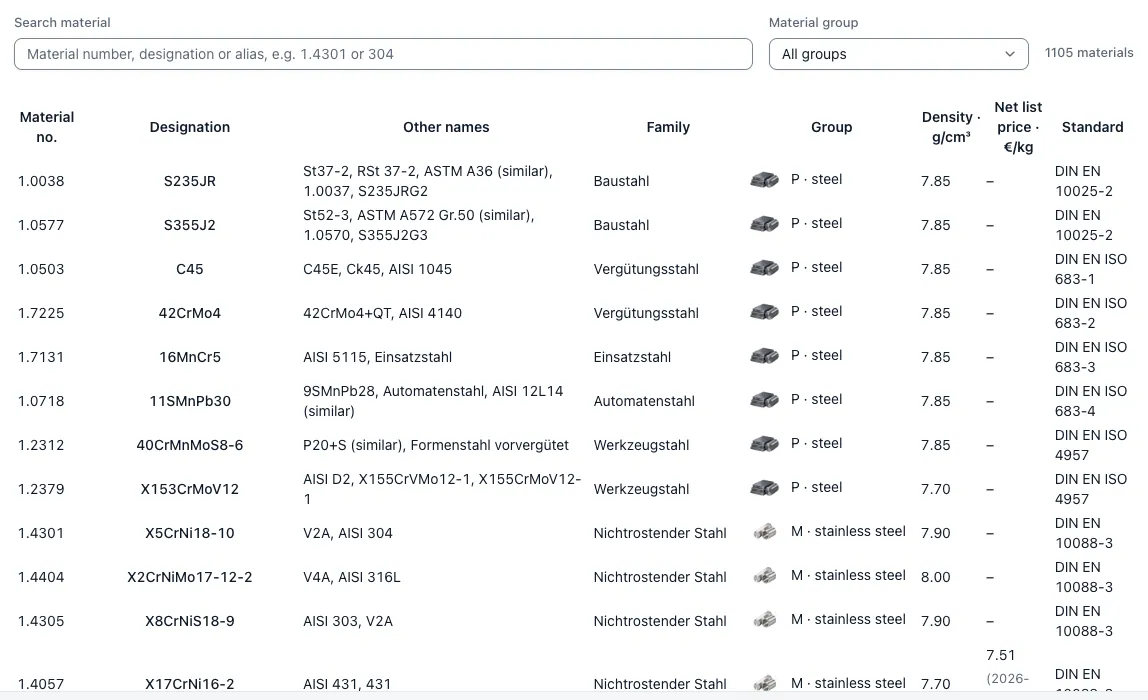
For calculation, the material acts via three separate ways: smaller cutting values extend the main time, shorter service life increases tool costs and change times, and lower process reliability requires additional tests or a documented risk surcharge. These parts should remain visible individually instead of disappearing into a flat-rate material factor – otherwise it can no longer be seen whether a deviation was due to the time, tool or assumption. The most robust comparison with a released reference part from the same material and delivery condition remains; the order of magnitude can be quickly checked with the material removal rate calculator and the rotary number calculator. You can check the material number, short name and density of a material in the material database.
Key points
Materials are explained in such a way that inputs, procedures, effects and limits in the CNC calculation remain comprehensible.
- Three effects: Smaller cut values, shorter service life and higher process risk have a separate effect on the price.
- Check the delivery status: Rolled, tempered, annealed or hardened, the same material number changes significantly.
- Reference suggests factor: A reference part made of the same material is more resilient than any standard supplement.