Pre-drill diameter from finished dimension and friction dimension
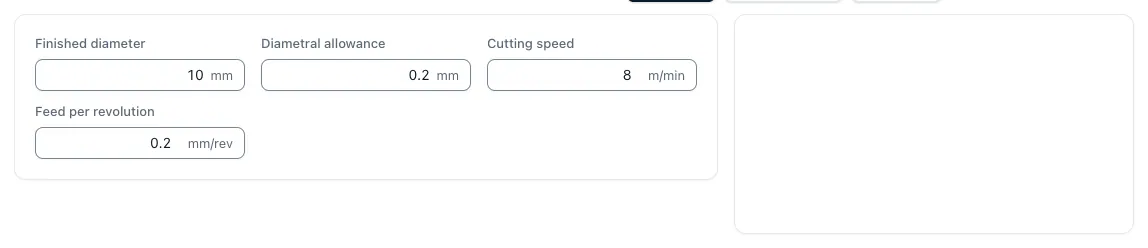
The friction blade removes only a small amount of material and thereby produces the size and surface of the bore. The calculator Reiben expects the finished diameter and the dimension over the diameter, not per side. The pre-drilling is the difference between the two: For Ø 12 mm with 0.2 mm dimension, the 11.8 mm.
The size of the dimensions can be determined by the manufacturer depending on the diameter, material and type of reamer. Too little size can be used to press the cuttings rather than cut them, too much overloads them. The pre-setting of the app of 0.2 mm at 10 mm is a calculation example, no recommendation.
D_before = D_ready − Extent
Drill size for pre-drilling
The pre-drill must match an existing drill. The tool drill sizes search the next smaller and the next larger size in the grid of your drill range. With a grid of 0.1 mm there is 11.8 mm directly. With a grid of 0.5 mm there are 11.5 and 12.0 mm beside it, and the nearest value would be 12.0 mm, i.e. the finished dimension itself.
In this case, only the smaller size remains. With 11.5 mm, the dimensions increase to 0.5 mm, which the reamer manufacturer must release. Tolerance and actual diameter of the drill are added: If the drill bit is larger than its nominal size, the dimensions shrink.
Speed, feed and time when rubbing
The speed is calculated from the manufacturer's finished diameter and cutting speed, the feed speed from the feed per revolution. With the sample values of the app, 8 m/min and 0.2 mm/U, a 12-mm friction bar runs at 212 1/min and 42 mm/min. The values for your friction bars depend heavily on cutting material, material and cooling and are listed in the catalogue.
The slow feed makes friction time-consuming. A 20 mm through hole with 2 mm inlet and overflow each takes around 0.57 minutes at 42 mm/min. If the friction bar is withdrawn in feed, the time doubles. With 16 fitting holes per part, the 9 to 18 minute friction time is without pre-drilling and measuring.
n = 1000 × vc γ (π × D) · vf = n × f · t = L γ vf
Rubbing H7: Limit dimensions and quality
For a bore Ø 12 H7, the fit calculator according to ISO 286 provides the tolerance limits of 12,000 to 12,018 mm, so the tolerance is 18 µm. With a thread g6, a play fit is created with 6 to 35 µm of play. IT7 is considered a common quality for bearing rings; a bore H7 usually requires grinding or fine drilling with gauges, H6 often honing or grinding.
Rubbing improves both the size and the surface, but hardly the position. The rubbing bar largely follows the pre-drilling, so the position must be correct when pre-drilling. For the surface, the side to Ra and Rz when rubbing and fine drilling indicates an expectation range of approximately Ra 0.8 to 1.6 μm.
Passholes in the calculation
An H7 bore costs significantly more than a drilled hole: pre-drilling, an additional tool change, the slow friction process and the test with a dorse or measuring device. These parts belong to each pass hole in the cycle time per part, not as a lump sum on the whole part. The cutting data for drilling, the friction calculator and the tool change time can be expected each pass hole as its own building block.
In the example with 16 fitting holes alone the approximately 9 minutes friction time at a machine hour rate of 85 €/h cost about 12.80 € per part, with retreat in the feed the double. Whether a fit really has to be H7 or a coarser tolerance the function also fulfills, is therefore worth a question before the offer stands.
Questions and answers
How big is the friction level?
This is what the manufacturer specifies for the rubble depending on the diameter, material and type of reamer. The app calculates your value; the default of 0.2 mm at 10 mm is just one example.
Is the measure on the diameter or on each side?
In the friction calculator it is the dimension over the diameter. A dimension of 0.2 mm means 0.1 mm per side and a pre-drilling, which is 0.2 mm smaller than the finished dimension.
Which speed and feed do I take when rubbing?
Cutting speed and feed rate per revolution from the catalog of the reamer manufacturer. The speed follows from n = 1000 × vc ÷ (π × D) with the finished diameter, the feed speed from vf = n × f.
Is rubbing enough for a hole H7?
As a rule, IT7 is considered the usual quality of reamers. Tighter qualities such as H6 often require honing or grinding. Position and straightness errors of the pre-drilling hardly correct the reamer.