Order time from set-up time and per unit
Formula for the order time
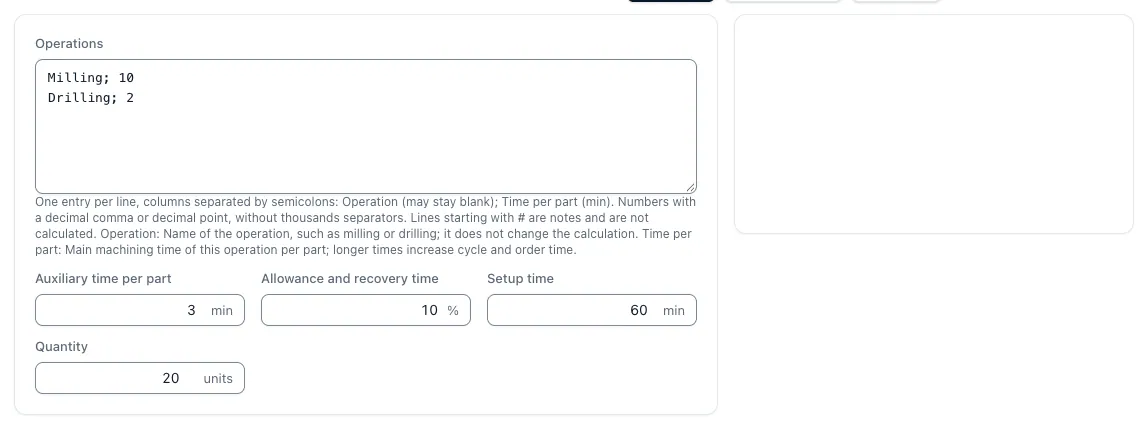
The order time of a manufacturing order is composed of a single and a quantity-dependent part. The set-up time t_r occurs once per job, the time per unit t_e for each of the m parts. The product m × t_e is the execution time.
T = t_r + m × t_e
The time per unit consists of the basic time, i.e. principal and secondary time per part, and a supplement for distribution time. Distributive times are interruptions that cannot be assigned to any single part, such as queries, minor disturbances or paths; they are usually taken as a percentage of the basic time that the company knows from its own inscriptions. In the case of predominantly manual work, a recovery time is added. The formulae differ depending on the source; it is important that calculation and calculation use the same structure.
t_e = (t_main + t_aside) × (1 + distribution time surcharge)
Example of calculation of the basic time at the order time
It is assumed that 60 minutes of set-up time, 40 parts, 6.5 minutes of main time and 2.5 minutes of side time per part and a distribution time surcharge of 10 percent. The base time is 9.0 minutes, the time per unit 9,0 × 1,10 = 9,9 minutes. The execution time for 40 parts is 40 × 9,9 = 396 minutes, the order time 60 + 396 = 456 minutes or 7,6 hours.
Each part is counted as the 456 ÷ 40 = 11.4 minutes, of which 1.5 minutes set-up percentage. 400 parts would have a set-up percentage of 0.15 minutes; this is exactly the effect that makes small lots expensive. Tools Order time and Part time of the app count these steps with their own values.
How much the lot size changes the time per part, shows the same example with 60 minutes set-up time and 9.9 minutes per unit for five quantities:
| Quantity m | Execution time m × t_e | Order time T | Time per part T | Of which set-up share t_r ÷ m |
|---|---|---|---|---|
| 1 | 9.9 min | 69.9 min | 69.9 min | 60 min |
| 10 | 99 min | 159 min | 15.9 min | 6 min |
| 40 | 396 min | 456 min | 11.4 min | 1.5 min |
| 100 | 990 min | 1,050 min | 10.5 min | 0.6 min |
| 400 | 3,960 min | 4.020 min | 10.05 min | 0.15 min |
Time types at a glance
| Time type | Formula symbol | Falling | Examples |
|---|---|---|---|
| Setting-up time | t_r | once per job | Set up clamping devices and tools, load program, check first part, disassemble |
| Main time | t_h | Per part | Tool spant with feed |
| Sidetime | t_n | Per part | Clamping, tool change, rapid movement, measuring |
| Distribution time | Supplement to the basic period | Per part, proportional | Questions, small disturbances, paths |
| Time per unit | t_e | Per part | Basic time from main and side time plus distribution time surcharge |
| Order time | T | per mission | Set-up time plus amount of time per unit |
Main time and main time of use
In the CNC calculation, main time usually stands for the cutting time of a work step: Feeding distance divided by feed speed. As calculated per work step, CNC processing time is calculated, Calculate turning time and Calculate milling time.
The main time of use is the term from the machine's point of view: the time when the equipment works directly for the order. In addition, there are side-use times such as tool changes, loading and unloading and measuring cycles as well as times when the machine stands. This machine-related view counts for the availability of a machine and key figures such as the overall plant effectiveness; for the price of a part the time per unit and the set-up share.
Demarcation of incidental time and set-up time
In addition, each part has to be tensioned and removed, positioning and rapid movement, touching and measuring, removing chips. Set-up time is one for each job: load program, set up clamping agents and tools, set zero point, manufacture and check the first part. A tool change for each part is therefore part of the side-time, the one-time measurement of the tools at set-up time. What setup costs and how it distributes to the lot size, the cost calculator shows.
Key points
Time terms are explained in such a way that inputs, procedures, effects and limits in the CNC calculation remain comprehensible.
- Main time: The time of immediate, planned machining on the workpiece, in CNC calculation the cutting time.
- Miscellaneous time: Necessary recurring operations per part without chip removal, such as clamping, positioning and measuring.
- Surface time: One-time preparation per job; per piece it only counts proportionally above the lot size.