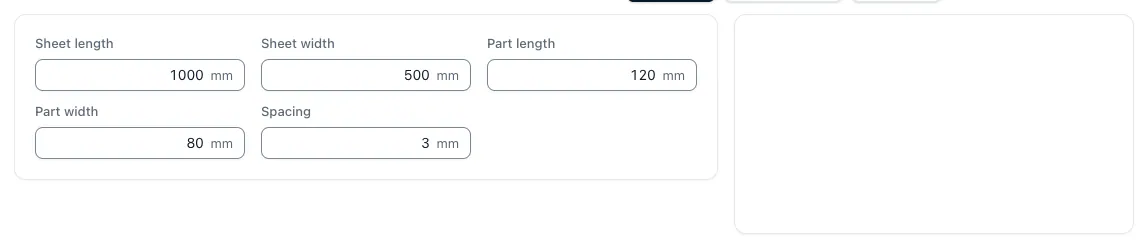
The number of cuttings per plate is determined by the plate size minus edge spacing, divided by part dimension plus bridge. The computer checks both layers, chooses the better and calculates utilization, plate weight and material costs per part.
Formulas
L_nutz = L_Platte − 2 × RandUsable length
Similar to width.
n = abgerundet((L_nutz + Steg) ÷ (l_Teil + Steg))Parts per direction
The bridge falls between the parts, not at the edge.
Ausnutzung = n × Teilefläche ÷ PlattenflächeMaterial utilization
Shows the percentage that actually becomes components.
Kosten je Teil = Plattenpreis ÷ nMaterial costs
The blend is thus completely included.
Cutting decides on the cost of materials
With milling parts made of plate, cutting is the actual material cost basis. A cut changed by a few millimeters can bring a whole series additionally to the plate.
Questions and answers
How many parts do you get from a record?
Useable length and width result from the plate size minus two edge spacing. Dipped by part dimension plus bridge and rounded follows the number per direction; the product is the number of cuts. The computer also checks the position rotated by 90 degrees.
Why is turning the parts worth it?
Because the rest is distributed differently. With 180 × 120 mm parts on a plate 2,000 × 1,000 mm, the rotated position can result in several more parts – without any change to the component.
How large must the bridge and edge distance be?
The bridge depends on the clamping concept and the separation process: when sawing a few millimetres more than the cutting width, when milling enough for the tool diameter plus clamping flaps. The edge spacing must allow the clamping of the plate.
Is the cut part of the calculation?
Yes, about the material costs per cutting instead of per precast weight. This is the only way to show the real material usage. Remaining pieces can be kept as stock or attributed to the order – a uniform rule is important.
Does that replace nesting software?
No. The calculator represents a simple grid of the same rectangle sections. For contour nesting, mixed parts or sheet cutting with laser, a real nesting software is much more efficient.