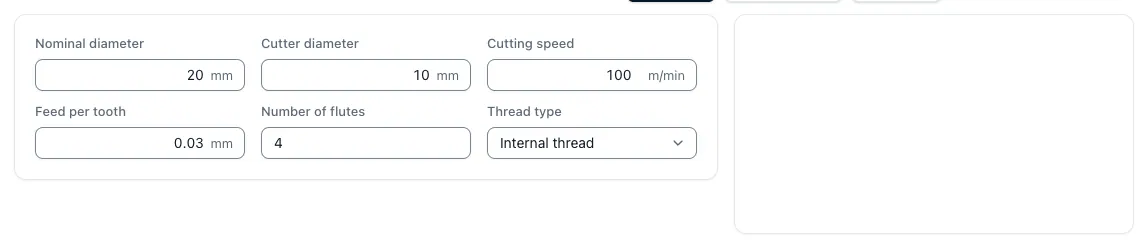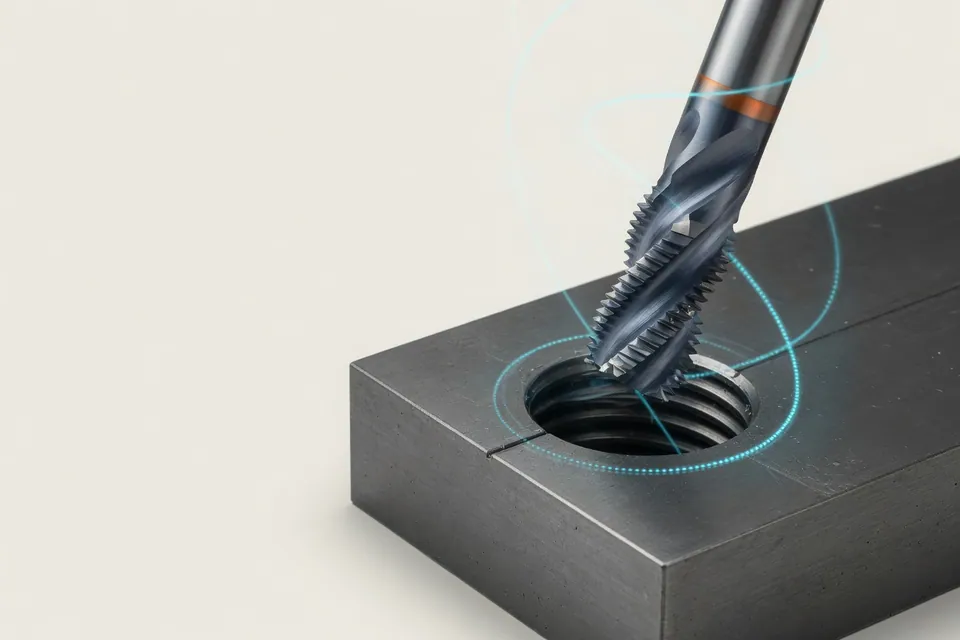
Input and results of the thread milling calculator
The computer needs the nominal diameter of the thread, the diameter of the cutter, cutting speed and tooth feed according to the tool manufacturer, the effective cutting number and the indication whether an internal or an external thread is milled. It supplies the spindle speed, the cutting feed before the circle correction and the corrected web feed at the tool center, which belongs in the program.
The slope is not an input because it does not change the speed or feed. It determines the profile of the milling machine and the Z-hub per rotation of the Helix. The NC program itself does not generate the app: Helix, start and run and radius correction come from the CAM system or the thread milling cycle of the controller.
Speed and feed at the cutting edge
The speed follows as with every cutter from cutting speed and tool diameter. The diameter of the thread cutter is decisive, not that of the thread. The feed at the cutting edge results from tooth feed, cutting number and speed.
With the start values of the app, i.e. a 10 mm diameter milling cutter, vc = 100 m/min, fz = 0.03 mm and four cutting edges, around 3,183 1/min and 382 mm/min result in the cutting edge.
n = 1000 × vc ÷ (π × dc) vf = fz × z × n
Circle correction for internal and external threads
The center of the tool is programmed. In the inner thread, this center is running on a smaller circle than the cutting edge in the material, in the outer thread on a larger one. If the cutting feed is programmed unchanged, the actual feed at the cutting edge is too high inside and too low outside.
For an internal thread M20 with the 10-mm cutter, the factor (20 – 10) is 20 = 0.5, the web feed drops to around 191 mm/min. Without correction, the cutting edge would run with double tooth feed, with appropriate risk for tool and thread quality. Outside, the web feed increases with the factor 1.5 to around 573 mm/min.
Some CAM systems and thread milling cycles already correct the feed itself; then it must not be reduced a second time. The same correction for circular pockets, holes and cones is calculated by the circle feed calculator of the app.
vf,m = vf × (D − dc) ÷ D (inner) vf,m = vf × (D + dc) ÷ D (outer)
Milling time per thread for calculation
The threaded milling machine does not spend any time, but can be estimated directly from the web feed. In the case of the inner thread, the center of the machine travels the path π × (D − dc) per rotation. In the example, the 31.4 mm is at 191 mm/min, i.e. almost 10 seconds per rotation.
A milling cutter whose profile covers the entire thread length needs a rotation plus start and start. A single profile milling cutter cuts gear for gear and needs approximately as many turns as the thread length has gradients: At 20 mm length and 2.5 mm incline, that's eight. In addition, positioning, radial partial deliveries in hard materials and tool changes. If the NC program is already available, the G-code evaluation of the app sums up the evaluable paths to a nominal movement time.
t ≈ i × π × (D − dc) ÷ vf,m (i = number of revolutions)
Threading or tapping machines
When threading, the feed is determined by the slope, vf = n × P, and a thread is created in a back and forth path. For small threads and in the series, this is usually faster. The machine for threading in the app delivers speed, synchronous feed and the ideal cutting time of the way; reverse, return and acceleration are added to the calculation.
Thread milling is worthwhile if process reliability counts more than seconds: for large or expensive components, hard-to-machine materials, large diameters and bag holes with a narrow thread outlet. A milling machine covers several diameters of the same slope, the dimension can be adjusted via radius correction, and breaks the tool, rarely gets stuck in the component. In addition to the time per thread, the risk of losing an almost finished part through a broken thread drill belongs to the calculation.
Questions and answers
Why does the feed have to be corrected during thread milling?
This circle is smaller than the thread diameter, so more feed is generated on the cutting edge than programmed. The factor (D − dc) D compensates for this; the external thread is (D + dc) D.
Does the thread rise affect speed and feed?
No. Speed and web feed depend on milling diameter, cutting speed, tooth feed, cutting number and thread diameter. The slope determines the profile of the milling machine and the Z-hub per rotation.
Does the app create an NC program for thread milling?
No. The app calculates speed, cutting and web feed. Helix, start-up motion and radius correction can be programmed in the CAM system or with the thread milling cycle of your controller.
How large can the cutter be for an internal thread?
It has to be smaller than the thread diameter, otherwise the computer will issue a warning. The closer it reaches the thread diameter, the smaller the web feed becomes in relation to the cutting feed: With dc = 0.8 × D, 20 percent remain.
When is thread milling more economical than thread drilling?
If a tool break becomes expensive, for example with large, expensive or almost finished components, with hard-to-machine materials and large diameters. With small threads in series, thread drilling is usually faster.