Which costs the model minimizes
Small lots cause many set-up operations per year. Large lots cause a higher average stock with even consumption. The classic calculation minimizes the sum of these set-up and storage costs.
D is the annual requirement, S is the cost per set-up process and h is the storage cost per unit per year. h is the calculator made up of unit value and annual storage cost rate. A percentage is divided by 100.
Q = √(2 × D × S ו h); h = unit value × storage cost rate ו 100
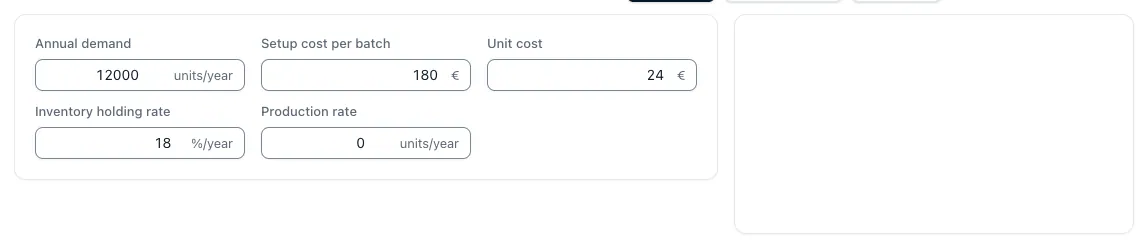
Example with 12,000 parts Annual demand
12,000 parts per year, 180 € per set-up process, 24 € unit value and 18 percent storage costs per year are assumed. This follows 4.32 € storage costs per unit per year. The model quantity is exactly 1,000 parts.
This corresponds to twelve lots per year and 500 parts of medium stock with immediate replenishment. Equipment costs and storage costs amount to € 2,160 each, together with € 4,320 per year. The procurement or production of all 12,000 parts is not included in this sum of additional volume-related costs.
When the inventory grows during production
If consumption during production is at the same time, the stock is growing slower. With production rate p, the calculator takes into account the factor 1 − D/p. Production and consumption must use the same time base, and p must be larger than D.
At an assumed production rate of 24,000 parts per year, the example shows a model quantity of around 1,414.21 parts. For the actual order, meaningful integer quantities and operational limits are compared separately.
Q_Production = √(2 × D × S ו (h × (1 − D/p))
What assumptions limit an application
Uniform requirements, constant costs and no shortages are required. Safety inventory, limited storage area, durability, quantity discounts, delivery dates and coupled setup operations are not included.
If demand or delivery capacity fluctuates strongly, a computational quantity does not answer these planning questions. Even a short-term customer order cannot be simply increased to the economic annual zero size.
Sources and classification
- Instituto Superior Técnico: Economic Order Quantity
Teaching model for constant demand, fixed set-up costs and linear storage costs. The figures on this page are own examples.
- Virginia Tech: Lean Inventory Management
Relationship between lot size, set-up and storage costs and requirements of the model.
Questions and answers
Is the economic lot size the same as the customer's order quantity?
No. The model quantity serves an internal cost assessment under assumed annual demand. Customer quantity, date, approvals and storage policy are additional specifications.
Why is the production rate higher than the demand?
Only then can a stock be built up during production. At the same or lower rate the current consumption cannot be sufficiently filled with this model.