Price of a rotating part as a calculation path instead of a lump sum
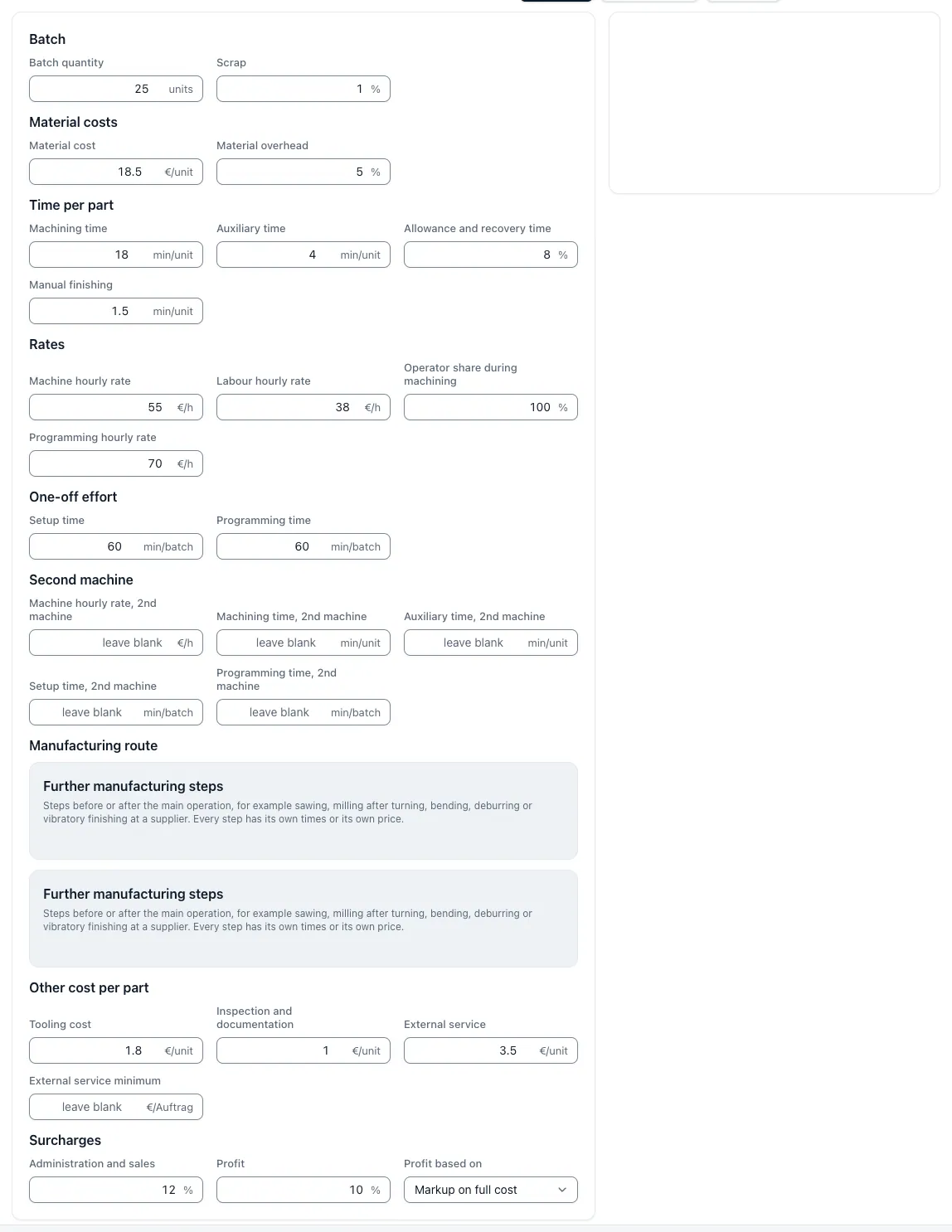
The question "What does CNC turning cost?" can only be answered as a calculation path. The unit price is derived from four blocks: material including detour and clamping addition, processing time evaluated with the hourly rate, one-time order-related expenses for setups, programming and initial sample testing as well as overhead costs, risk and margin. Simplified applies: Self-cost = (material + t_processing × hourly rate + t_rushes × hourly rate ÷ N + external services) × (1 + GK), then follows the price decision.
Size of an example
A rotating part made of steel, bar section Ø 40 × 62 mm to 2.40 €/kg, with 3.2 minutes main time, 1.1 minutes side time, 90 minutes set-up time and an hourly rate of 72 €/h for machine and operator costs at 20 pieces 12.03 € manufacturing costs per piece, at 500 pieces 6.84 €. With 18 % overhead costs and 12 % margin it becomes 16,13 € and 9,18 € per piece. The machining remains the same – only the set-up part is distributed differently. Whoever calls or compares a price without corresponding quantity compares therefore two different things. The complete table of 1 to 500 pieces with calculation path is under Calculation turning parts.
What drives up the price of a rotating part
The price is driven upwards by concrete requirements, not by the component itself: tight fit and shape and position tolerances with reference system, fine surfaces, long slender geometries with set-stock or bezel requirements, deep internal machining, thin wall thicknesses, hard-to-machine materials such as stainless steel or titanium, additional stresses as well as external performance such as hardening, grinding or coating. Test and documentation requirements – measurement protocol, initial sample test report, material certificate – are also independent cost positions.
Making offers comparable
Offers can only be compared when quantity, material, revision, scope of delivery and test size are identical. Those who want to evaluate incoming offers decompose them into material, production time, set-up percentage and surcharges and hold them against their own reference part with real feedback times. With the unit cost calculator and the machine hourly rate calculator this way can be understood with their own numbers; the way with the tools of the app shows rotary parts calculated online.
In Pro, the CNC Calculator app from drawing and STEP model automatically creates a scaled calculation design, any value with origin that you check and release; Pro is unlocked on request. For more information, see Complete automatic calculation from drawing and CAD.
Key points
Price formation is explained in such a way that inputs, procedures, effects and limits in the CNC calculation remain comprehensible.
- Four blocks instead of a number: Material, machine time, one-off costs and surcharges are assessed separately.
- Lot size determines the price: Setting up and programming seem completely different for ten parts than for a thousand.
- Name price driver: Tolerance, surface, material and test circumference are visible in the calculation.