Steel grades with own cutting data in the app
The CNC Calculator app's cutting data finder has ten steels with its own value ranges: the S235JR and S355J2 construction steels, C45 and 42CrMo4, the 16MnCr5 application steels, 11SMnPb30 automatic steels, the 1.2312 and 1.2379 tool steels, and hardened steels in the 45–55 HRC and 58–62 HRC stages. For each type, it shows a minimum, start and maximum value for cutting speed, speed, feed and feed speed, with specific cutting force kc1.1, the rise value mc and a reference to cutting.
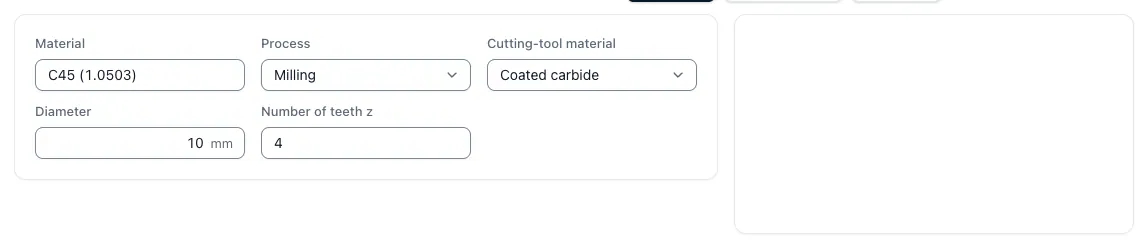
The areas apply to coated carbide, the starting value is the middle of the range. The tooth feed is stored for a 10 mm diameter cutter and is converted to other diameters using (D/10)^0.75. Select HSS as cutting material, the app lowers the cutting speed by a factor of 0.3. A comparison table lists all materials of the same ISO group side by side, so that the distance between S235JR and 1.2379 becomes visible at a glance.
n = vc × 1000 γ (π × D) vf = fz × z × n
Starting values for milling and turning per steel grade
The following areas are starting values from the cut data finder of the app. When milling, the tooth feed fz applies to Ø 10 mm, when turning the feed f per revolution. Data from your tool manufacturer is binding.
When drilling with Ø 10 mm, the app for C45 specifies 70 to 120 m/min at 0.12 to 0.25 mm feed per revolution, for 42CrMo4 60 to 100 m/min at 0.10 to 0.22 mm and for 1.2379 40 to 70 m/min at 0.08 to 0.15 mm.
- S235JR (1.0038): milling vc 150–250 m/min, fz 0.05–0.09 mm; turning vc 180–300 m/min, f 0.15–0.45 mm
- S355J2 (1.0577): milling vc 140–230 m/min, fz 0.05–0.09 mm; turning vc 170–280 m/min, f 0.15–0.45 mm
- C45 (1.0503): milling vc 120–200 m/min, fz 0,04–0.08 mm; turning vc 150–260 m/min, f 0,15–0.40 mm
- 42CrMo4 (1.7225): milling vc 100–160 m/min, fz 0,04–0.07 mm; turning vc 120–220 m/min, f 0,12–0.35 mm
- 16MnCr5 (1.7131): milling vc 130–200 m/min, fz 0,05–0.08 mm; turning vc 150–250 m/min, f 0,15–0.40 mm
- 11SMnPb30 (1.0718): milling vc 150–260 m/min, fz 0.06–0.10 mm; turning vc 200–350 m/min, f 0.10–0.40 mm
- 40CrMnMoS8-6 (1.2312): milling vc 90–150 m/min, fz 0.04–0.07 mm; turning vc 110–180 m/min, f 0.12–0.30 mm
- X153CrMoV12 (1.2379): milling vc 70–120 m/min, fz 0.03–0.06 mm; turning vc 90–150 m/min, f 0.10–0.25 mm
Delivery condition, hardness and tool steel
Within a variety, the delivery state often shifts the values more strongly than the change to the neighboring variety. For C45, the areas are normal annealed; delivered in a remunerated manner, you reduce the cutting speed by about a quarter according to the App Note. 42CrMo4 is tempered tough, here stable tension and good cooling significantly extend the service life. 16MnCr5 can be machined well soft annealed, after the application hardening only hard work. 11SMnPb30 forms short breaking chips and is designed for rotary parts in series.
The app distinguishes two cases for the tool steels. 1.2312 is delivered pre-compensated to about 30 HRC, is sulfurized and therefore easy to machine. 1.2379 is soft-smelled, its high carbide content quickly covers the cutting; the milling starting value is well below that of C45 at 95 m/min. Warm working steels such as 1.2343 and 1.2344 are in the app's material database with density and group, but have no separate entry in the cutting data finder. The material catalog refers to 42CrMo4 for them; this is a rough orientation, not a specific indication for these grades.
If the hardness in the test certificate is in HV, the hardness conversion of the app approaches the HRC value for unalloyed and low-alloy steels. Thus, it can be decided whether the values of the base grades or those of hard machining still apply.
Milling and turning hardened steel
For hardened steel, the app performs two steps in ISO Group H. At 45–55 HRC, it calls 50 to 120 m/min with fz 0.02 to 0.05 mm and at turning 60 to 140 m/min with f 0.05 to 0.15 mm. At 58–62 HRC, the milling range drops to 30 to 80 m/min with fz 0.015 to 0.04 mm; at turning with CBN, 80 to 180 m/min are f 0.05 to 0.12 mm.
The specific cutting force kc1.1 increases from 2,220 N/mm² at C45 to 3,600 and 4,200 N/mm². The app notes require hard machining tools, small deliveries and a rigid machine; for 58–62 HRC they point out that grinding is often more economical. When turning hard, you also check the cutting material because CBN, ceramics and carbide have different application areas.
Cost effect of the steel grade in the calculation
A comparison with identical tool and procedure shows how much the variety changes the main time: milling cutter Ø 10 mm with three cutting edges, cutting depth 10 mm, cutting width 5 mm, each with the starting values of the app. This results in a material removal rate of around 67 cm³/min at S235JR, 46 cm³/min at C45, 34 cm³/min at 42CrMo4 and 20 cm³/min at 1.2379. For 100 cm³ chip volume, this is 1.5, 2.2, 2.9 and 4.9 minutes of peak time.
At 42CrMo4 the milling time almost doubles compared to structural steel, and at 1.2379 it grows to a good threefold. A remunerated C45 with a quarter less cutting speed takes about a third more time than a normal annealed one. The power requirement also differs: With 0.1 mm chip thickness and 80% efficiency, a kilowatt drive power at S235JR achieves around 18 cm³/min, at 42CrMo4 only around 11 cm³/min.
For the calculation this means: to record the material as a grade with delivery status, not as "steel". The main time comes from cutting data milling or turning, the effect of a changed cutting speed on service life and tool costs from the service life calculator of the app.
Q = ap × ae × vf 简 1000
Questions and answers
What is the cutting speed for C45?
For C45, the app's cutting data finder lists 120 to 200 m/min for milling with coated carbide with a starting value of 160 m/min, 150 to 260 m/min for turning and 70 to 120 m/min for drilling. The values are normal annealed; you can reduce the cutting speed by about a quarter on a remunerated basis.
Why doesn't 1.2344 have its own record on the cut data finder?
The finder contains 28 materials with their own cutting data. 1.2344 (X40CrMoV5-1) stands with density, standard and group in the material database of the app; for cutting data, the catalog refers to 42CrMo4. This is a rough orientation. For hot working steel, the manufacturer's specifications and the hardness condition according to the test certificate apply.
Do the values apply to HSS tools?
The database applies to coated carbide. If you select HSS as cutting material in the cut data finder, the app calculates the cutting speed with the factor 0.3; the feed remains unchanged.
How much longer does a tougher steel grade extend the processing time?
With the same milling cutter and procedure, 42CrMo4 with the start values of the app takes almost twice as long as S235JR, 2.9 instead of 1.5 minutes per 100 cm³ chip volume. With soft annealed tool steel 1.2379, it's good three times.